
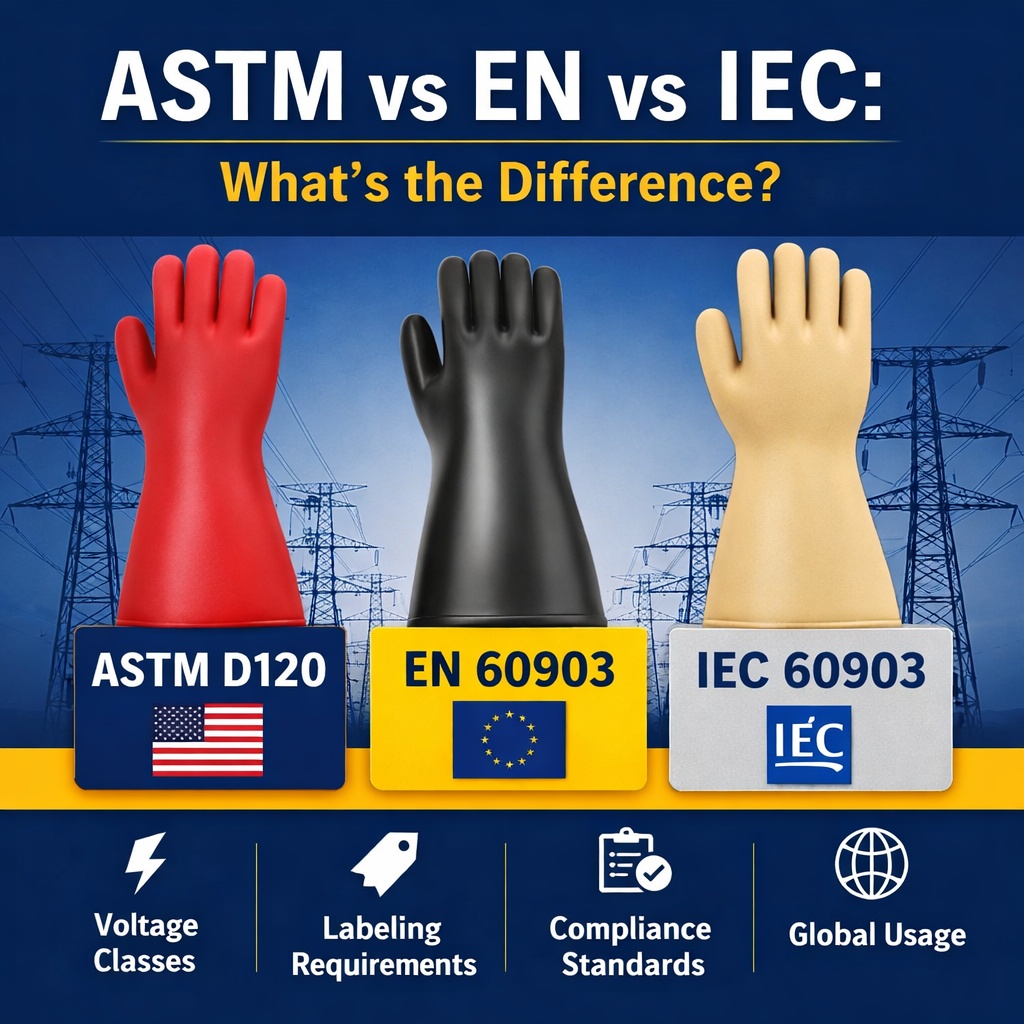
When sourcing insulating gloves for electrical work, one of the most common questions from procurement teams is:
What is the difference between ASTM (American standard), EN (European standard), and IEC standards?
Understanding these standards is critical for project approval, compliance, and electrical worker safety. This guide explains the key differences clearly and practically.
Why Insulating Glove Standards Matter
Insulating gloves are designed to protect workers from electric shock during live electrical operations. Because electrical systems vary by region, different regulatory bodies have developed specific testing and classification standards.
The three most referenced standards globally are:
-
ASTM D120 (American Standard)
-
EN 60903 (European Standard)
-
IEC 60903 (International Standard)
Although they appear similar, they are not identical in structure, labeling, and regulatory usage.
1. What Is IEC 60903?
The International Electrotechnical Commission (IEC) develops international standards for electrical technologies.
IEC 60903 is the international reference standard for insulating gloves used in live working conditions.
Key characteristics:
-
Defines voltage classes (Class 00 to Class 4)
-
Specifies proof test voltage and maximum use voltage
-
Establishes material and dielectric performance requirements
-
Provides testing methodology guidance
IEC standards serve as a technical foundation. Many national standards are based on IEC but adapted locally.
2. What Is ASTM D120 (American Standard)?
The American standard for rubber insulating gloves is:
ASTM D120 – Standard Specification for Rubber Insulating Gloves
Developed by ASTM International, this standard governs insulating gloves primarily used in:
-
United States
-
Canada
-
Some Latin American projects referencing US specifications
ASTM D120 defines:
-
Six voltage classes (00, 0, 1, 2, 3, 4)
-
Proof test voltage levels
-
Physical properties (tensile strength, elongation)
-
Detailed marking requirements
-
Mandatory retesting intervals in practice (often every 6 months in US utility environments)
ASTM is widely required in North American utility tenders and industrial electrical contracts.
3. What Is EN 60903 (European Standard)?
The European standard for insulating gloves is:
EN 60903 – Live Working – Gloves of Insulating Material
EN 60903 is largely aligned with IEC 60903 but formally adopted for the European market.
It applies across EU member states and is typically required for:
-
European electrical utilities
-
Industrial maintenance contracts in the EU
-
CE-marked PPE products
EN 60903 includes:
-
Same voltage class structure (00 to 4)
-
AC proof test voltage requirements
-
Additional labeling and CE compliance requirements
-
Category marking (A, H, Z, R, C depending on resistance properties)
In the EU, compliance with EN standards is often necessary for CE marking and legal market access.
ASTM vs EN vs IEC: Key Differences
Below is a practical comparison relevant for procurement and compliance teams:
| Feature | IEC 60903 | ASTM D120 | EN 60903 |
|---|---|---|---|
| Scope | International reference | United States standard | European Union standard |
| Voltage Classes | 00–4 | 00–4 | 00–4 |
| Technical Base | Original framework | Independent US spec | Based on IEC |
| CE Marking Required | No | No | Yes (for EU market) |
| Label Format | IEC format | ASTM marking rules | EN + CE marking |
| Main Usage Region | Global reference | USA & Canada | Europe |
Voltage Classification Comparison
All three standards use the same class numbering system:
-
Class 00 – Up to 500V AC
-
Class 0 – Up to 1,000V AC
-
Class 1 – Up to 7,500V AC
-
Class 2 – Up to 17,000V AC
-
Class 3 – Up to 26,500V AC
-
Class 4 – Up to 36,000V AC
However, proof test voltage values and labeling presentation may differ slightly between ASTM and EN implementations.
Certification and Compliance Differences
In the United States:
Projects typically specify ASTM D120 compliance.
Testing reports must clearly reference ASTM.
In the European Union:
Products must comply with EN 60903 and may require:
-
CE marking
-
EU Declaration of Conformity
-
Notified Body involvement for Category III PPE
In International Projects:
Some tenders reference IEC 60903, especially in Africa, Asia, and Middle East infrastructure contracts.
How to Choose the Correct Standard for Your Project
When purchasing insulating gloves, consider:
1. Tender Requirements
Always check if the project explicitly states:
-
ASTM D120 required
-
EN 60903 required
-
IEC 60903 acceptable
2. Country of End Use
-
North America → ASTM
-
European Union → EN 60903
-
Mixed / International → Often IEC reference
3. Inspection and Testing Reports
Ensure the supplier can provide:
-
Accredited laboratory dielectric test reports
-
Batch traceability
-
Production date marking
-
Periodic retesting recommendations
Common Procurement Mistake
A frequent issue in international trade is assuming that “IEC compliant” automatically satisfies US or EU project requirements.
In reality:
-
An IEC-tested glove may not meet full ASTM marking requirements.
-
An ASTM glove without CE documentation may not be legally marketable in the EU.
Clarifying this before shipment prevents customs delays and rejection during site inspection.
Final Thoughts
While ASTM, EN, and IEC insulating glove standards share technical similarities, they serve different regulatory environments.
Understanding their differences ensures:
-
Proper compliance
-
Smooth project approval
-
Worker safety
-
Reduced rejection risk during inspection
For electrical PPE procurement teams, standard alignment is not just a technical detail — it is a contractual necessity.