
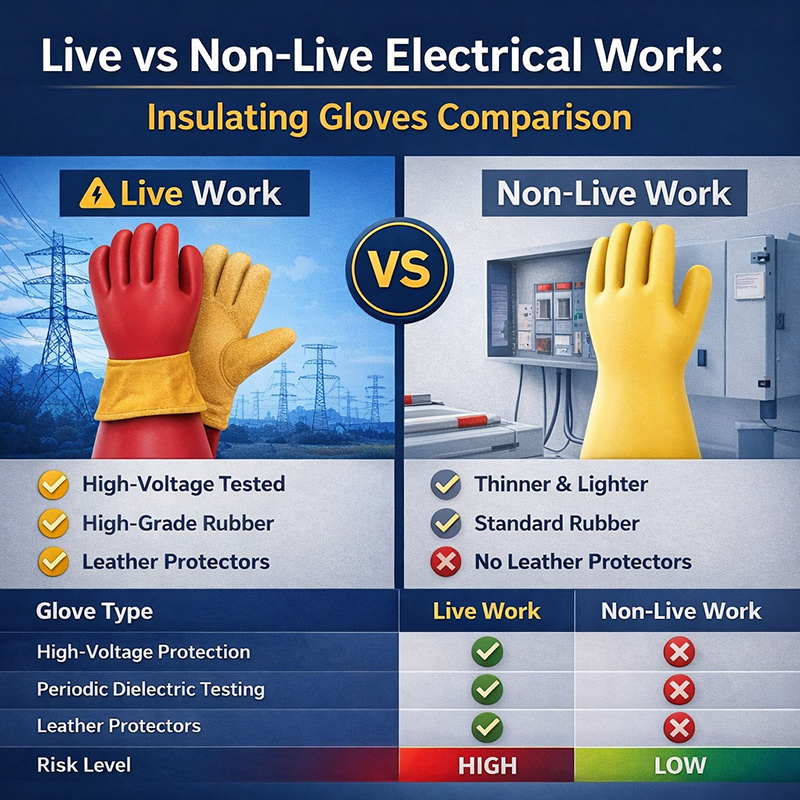
When working with electricity, the type of insulating gloves you choose is critical. Live (energized) electrical work and non-live (de-energized) electrical work require different gloves to ensure worker safety and compliance with industry standards.
This guide explains the key differences between insulating gloves for live and non-live operations.
1️⃣ What Are Live and Non-Live Electrical Work?
Live (energized) work:
-
Working on electrical circuits or equipment that is carrying current.
-
Examples: switching operations, maintenance on live lines, testing voltage.
-
High risk of electric shock; safety standards are strict.
Non-live (de-energized) work:
-
Working on circuits that are completely powered off.
-
Examples: installing or repairing de-energized lines, equipment assembly, insulation testing.
-
Risk mainly comes from accidental energization or static electricity.
2️⃣ Insulating Gloves for Live Work
Purpose: Protect workers from high-voltage electric shock.
Key Features:
-
Made from high-quality natural or synthetic rubber.
-
Tested according to ASTM D120 (US), EN 60903 (EU), or IEC 60903 (International).
-
Classified by voltage classes (Class 00 – Class 4) based on maximum AC voltage protection.
-
Must undergo dielectric testing before first use and retesting every 6–12 months.
-
Often worn with leather protectors for mechanical protection.
Example Use: High-voltage line maintenance, live switchgear operations.
3️⃣ Insulating Gloves for Non-Live Work
Purpose: Prevent accidental contact with residual voltage, static discharge, or minor electric hazards.
Key Features:
-
Can be lighter and thinner than live-work gloves.
-
May or may not be tested for high-voltage proof testing, depending on risk level.
-
Often used as a first layer or in combination with tools that ensure de-energized work.
Example Use: Equipment installation after de-energization, assembly of electrical panels, testing voltage-free components.
4️⃣ Key Differences at a Glance
| Feature | Live Work Gloves | Non-Live Work Gloves |
|---|---|---|
| Purpose | Protect against high-voltage shock | Protect against residual voltage or minor hazards |
| Material | High-grade rubber / ASTM/EN/IEC tested | Standard insulating rubber or general protective gloves |
| Voltage Rating | Classified (00 – 4) | Low or not specified |
| Thickness | Thicker, robust | Thinner, lighter |
| Mechanical Protection | Often combined with leather protectors | Optional |
| Testing Frequency | Before first use + periodic dielectric testing | Usually not required |
| Common Use | Energized line maintenance, live switchgear | Assembly, installation, non-live panel work |
5️⃣ Practical Tips for Selecting Gloves
-
Always verify the voltage class for live work. Using a glove below the required class can be fatal.
-
Check certifications: ASTM D120, EN 60903, IEC 60903.
-
Layering: For live work, wear rubber insulating gloves + leather protectors.
-
Inspect before use: Look for cracks, punctures, or aging in rubber.
-
Storage: Keep gloves in a cool, dry place away from sunlight and chemicals.
6️⃣ Conclusion
The main difference between live and non-live work insulating gloves is protection level against electric shock.
-
Live-work gloves: Thick, high-voltage rated, tested, and often combined with leather protectors.
-
Non-live gloves: Lighter, simpler, mainly to prevent accidental contact or minor hazards.
Choosing the right glove type is essential for worker safety, compliance, and successful electrical project execution.