
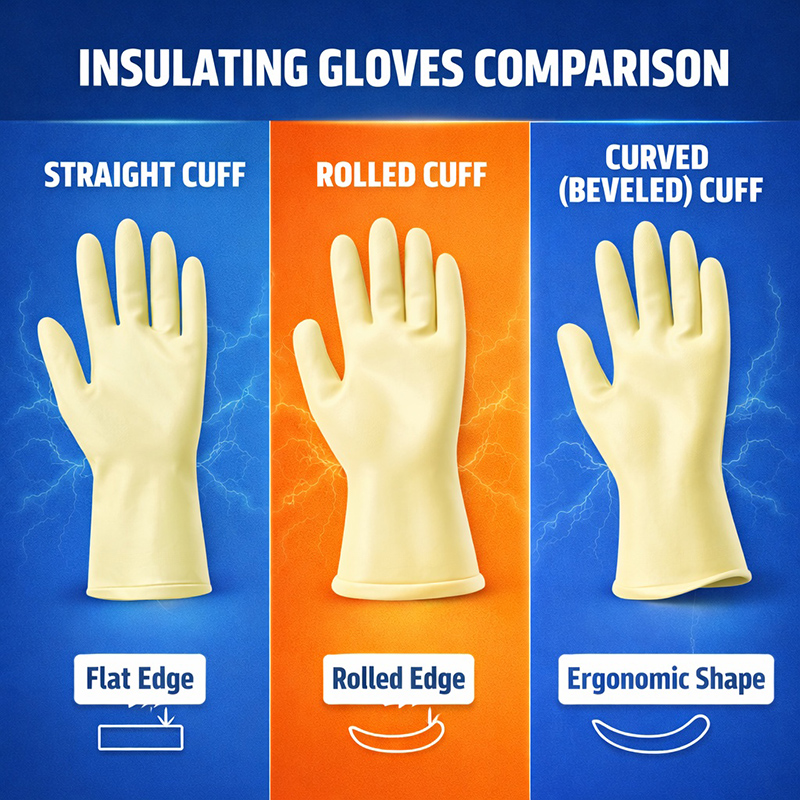
In electrical work, choosing the right insulating gloves not only ensures safety but also affects work efficiency. The most common glove cuff designs are straight cuff, rolled cuff, and curved (beveled) cuff. Each design has its advantages and ideal applications. Understanding their differences can help you select the most convenient and safe gloves for your tasks.
1️⃣ Straight Cuff Insulating Gloves
Features:
-
Flat, straight cuff without any rolled edge
-
Easy to put on and remove quickly
-
Can be paired with wrist sleeves or protective clothing
Advantages:
-
Simple and cost-effective
-
Suitable for everyday low-voltage tasks or short-duration operations
Disadvantages:
-
Less protection at the cuff, liquids or dust may enter
-
Requires attention when combined with workwear sleeves
Tip: Straight cuff gloves are ideal for quick tasks in low-risk environments, but offer less protection in high-voltage or wet conditions.
2️⃣ Rolled Cuff Insulating Gloves
Features:
-
The cuff is rolled outward, usually 1–2 cm wide
Advantages:
-
Prevents liquids from entering the glove
-
Makes putting on and removing the glove easier
-
Reinforced cuff, more wear-resistant
Disadvantages:
-
Slightly thicker cuff may limit operation in tight spaces
Tip: Rolled cuff gloves are suitable for indoor and outdoor electrical maintenance and environments with light chemical exposure. They are the most commonly used industrial choice.
3️⃣ Curved/Beveled Cuff Insulating Gloves
Features:
-
Cuff is curved to follow natural wrist shape
-
Ergonomic design for better wrist movement
Advantages:
-
Comfortable for long-term wear, allows flexible wrist movement
-
Gloves fit snugly, less likely to slip off
-
Compatible with sleeves and other protective equipment
Disadvantages:
-
Usually more expensive than straight or rolled cuff gloves
-
Different cuff curves may not fit all wrist sizes
Tip: Curved gloves are ideal for long-duration work, precision tasks, and situations requiring high wrist flexibility.
4️⃣ Convenience Comparison
| Cuff Type | Ease of Wearing | Flexibility | Protection | Best For |
|---|---|---|---|---|
| Straight | High | Medium | Low | Quick, short low-voltage tasks |
| Rolled | Medium | Medium | Medium | Routine electrical maintenance, light chemical protection |
| Curved | Medium-Low | High | High | Long-duration work, high-precision tasks, high-safety requirements |
Summary: For quick donning, straight cuffs are most convenient. For balance of protection and economy, rolled cuffs are widely used. For wrist comfort and flexibility, curved cuffs are the best choice.
5️⃣ Buying Recommendations
-
Choose the cuff design based on your work environment
-
For high-voltage tasks, prefer rolled or curved cuffs
-
For long-duration use, curved cuffs reduce wrist fatigue
-
Ensure cuffs seal well with protective sleeves or clothing
Conclusion:
The cuff design of insulating gloves directly affects safety and convenience. Straight cuffs allow quick changes, rolled cuffs balance protection and cost, and curved cuffs offer the best comfort and flexibility. Choosing the right design is key to both safety and efficiency in electrical work.