
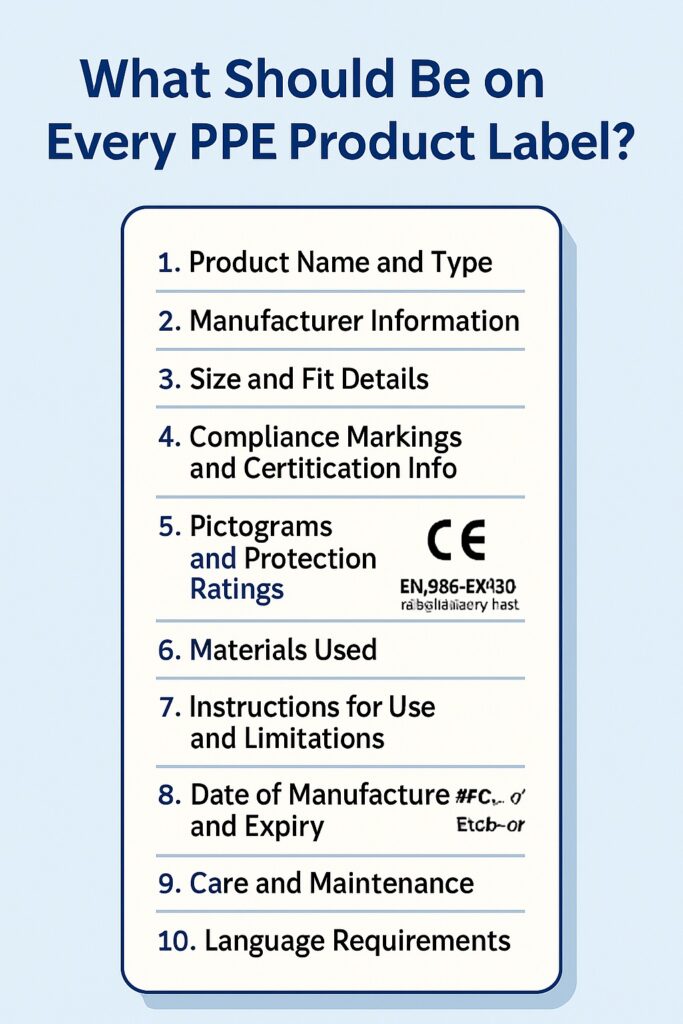
Discover the essential elements that should appear on every PPE product label to ensure safety, compliance, and transparency in both U.S. and EU markets.
Why PPE Labeling Matters
PPE (Personal Protective Equipment) is more than just gear — it’s a frontline defense against workplace hazards. But how can users, inspectors, or procurement teams know if the product truly meets safety standards? The answer lies in the product label.
An accurate, standardized label provides compliance evidence, usage guidance, and traceability—all essential for workplaces under OSHA (USA) or CE/EN (EU) regulations.
Let’s break down the key information that should appear on every PPE product label, no matter the category (gloves, helmets, safety shoes, etc.).
✅ 1. Product Name and Type
The label must clearly state what the product is — e.g., “Cut-Resistant Gloves Level D” or “Anti-Fog Safety Goggles” — so users don’t confuse it with unsuitable PPE.
✅ 2. Manufacturer Information
Includes:
-
Manufacturer name or logo
-
Full address or country of origin
-
Contact info or website (optional but helpful)
This ensures traceability, especially for imported goods or product recalls.
✅ 3. Size and Fit Details
Fit is critical to protection and comfort. PPE labels should indicate:
-
Size (e.g., S/M/L or numeric)
-
Gender-specific design, if any
-
Adjustable features (e.g., straps, Velcro)
For example: Size M – fits palm width 8–9cm
✅ 4. Compliance Markings and Certification Info
This is where regulatory trust begins. Depending on the market, look for:
-
CE Marking for EU compliance
-
EN Standard Numbers (e.g., EN 388 for gloves, EN 166 for goggles)
-
Notified Body Number (if applicable)
-
ANSI/ISEA or OSHA-compliance info for the U.S. market
Example:
CE
EN 388: 4X43D
Notified Body: 0598
✅ 5. Pictograms and Protection Ratings
Icons help workers instantly recognize the protection level or hazard type, even if they don’t read the full label. Examples include:
-
Cut resistance
-
Chemical splash protection
-
Impact resistance
-
Heat resistance
-
Water/oil repellence
Pictograms should match the relevant EN/ANSI standards.
✅ 6. Materials Used
Some users have allergies (e.g., latex) or preferences (e.g., vegan leather). A basic material breakdown helps:
-
Outer material: Nitrile, Polycarbonate, PVC, etc.
-
Lining or coating: Cotton, Aramid, Latex
-
Special features: Breathable mesh, anti-fog coating
✅ 7. Instructions for Use and Limitations
A brief section explaining:
-
How to wear the PPE
-
What it should NOT be used for
-
Environmental or mechanical limitations (e.g., “Not flame resistant”)
Example: For chemical handling only. Not suitable for thermal protection.
✅ 8. Date of Manufacture and Expiry (if applicable)
Especially critical for:
-
Disposable PPE (e.g., masks, coveralls)
-
Products with shelf life (e.g., certain gloves, respirators)
Example:
MFG: 2025-07
EXP: 2028-07
Some countries may also require batch numbers for traceability.
✅ 9. Care and Maintenance Instructions
For reusable PPE, labels should indicate:
-
How to clean or disinfect
-
How to store (e.g., dry place, away from sunlight)
-
When to replace
✅ 10. Language Requirements
For the EU market, labels must be in the official language of the destination country. For North America, English is standard, and French is often required for Canada.
🔍 Bonus: QR Code or Digital Access
Some manufacturers now include a QR code linking to:
-
Digital user manual
-
Full test reports
-
Certificates of conformity
This is especially useful for safety audits and B2B clients.
✅ Final Thoughts
A PPE product label is more than just a sticker — it’s your first layer of compliance and communication with end users. Whether you’re a manufacturer, importer, or safety officer, ensuring proper labeling is non-negotiable in today’s regulated, safety-conscious markets.
Want to ensure your PPE products meet EU and U.S. labeling standards?
Contact us at GONOW SAFETY EQUIPMENT CO., LTD — we provide more than PPE, we provide peace of mind.