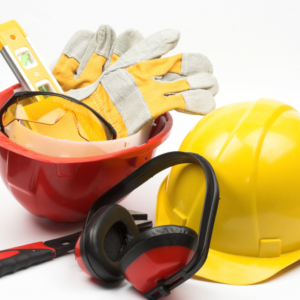
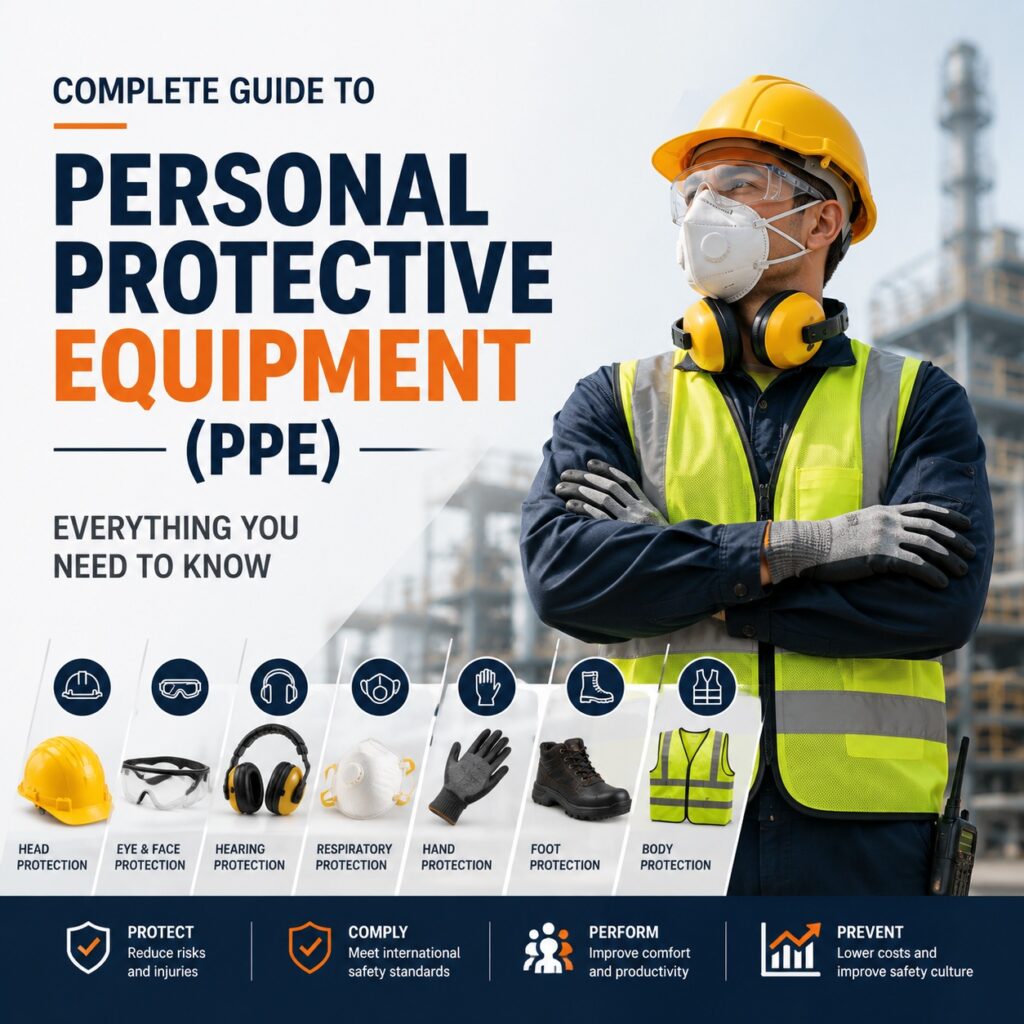
Introduction
Every day, millions of workers around the world face workplace hazards that could lead to serious injuries, occupational illnesses, or even fatalities. Whether on a construction site, inside a manufacturing plant, in a chemical laboratory, at a food processing facility, or within a logistics warehouse, employees are exposed to risks such as falling objects, sharp materials, hazardous chemicals, airborne particles, excessive noise, electrical hazards, and extreme temperatures.
While employers should always eliminate or reduce hazards through engineering controls and safe work practices, risks cannot always be completely removed. This is where Personal Protective Equipment (PPE) plays a critical role.
PPE serves as the last line of defense between workers and workplace hazards. When properly selected, correctly fitted, and consistently used, PPE helps minimize injuries, improve workplace safety, and ensure compliance with international safety regulations.
However, selecting the right PPE involves much more than purchasing helmets, gloves, or safety shoes. Every workplace has unique hazards, requiring different levels of protection, certifications, materials, and maintenance practices.
This comprehensive guide explains everything you need to know about Personal Protective Equipment, including:
- What PPE is and why it is important
- The different types of PPE
- Common workplace hazards
- International PPE standards
- How to choose the right PPE
- PPE for different industries
- PPE inspection and maintenance
- Common PPE mistakes
- Frequently asked questions
Whether you are a safety manager, procurement specialist, contractor, distributor, or employer, this guide will help you make informed decisions and create a safer workplace.
Looking for reliable PPE for your business? Explore GONOW SAFETY’s complete range of certified safety equipment for industrial applications.
What Is Personal Protective Equipment (PPE)?
Personal Protective Equipment (PPE) refers to specialized clothing, equipment, and accessories designed to protect workers from hazards that cannot be eliminated through engineering controls or administrative measures.
PPE reduces exposure to physical, chemical, biological, electrical, thermal, and mechanical hazards by creating a protective barrier between the worker and the source of danger.
Examples of PPE include:
- Safety helmets
- Safety glasses
- Face shields
- Respirators
- Ear plugs
- Ear muffs
- Protective gloves
- Chemical suits
- Flame-resistant clothing
- High-visibility vests
- Safety shoes
- Fall protection harnesses
PPE is used across virtually every industry where occupational hazards exist, making it one of the most essential components of workplace safety programs.
Why Is PPE Important?
Personal Protective Equipment protects workers from injuries that may otherwise result in lost productivity, medical expenses, legal liabilities, and even loss of life.
Proper PPE contributes to safer workplaces in several ways.
1. Protecting Workers from Injuries
Workers may encounter:
- Falling tools
- Flying debris
- Chemical splashes
- Dust and fumes
- Excessive noise
- Sharp edges
- High temperatures
- Electrical hazards
Appropriate PPE significantly reduces the likelihood and severity of injuries.
For example:
A construction worker wearing an EN 397 certified safety helmet has far greater protection against falling objects than someone wearing an ordinary cap.
Similarly, cut-resistant gloves certified to EN 388 provide a much higher level of hand protection than general-purpose work gloves when handling sheet metal or glass.
2. Preventing Occupational Diseases
Not all workplace hazards cause immediate injuries.
Long-term exposure to dust, fumes, chemicals, biological agents, and excessive noise may result in chronic occupational diseases.
Examples include:
- Silicosis
- Hearing loss
- Skin disorders
- Respiratory diseases
- Chemical poisoning
Using appropriate respirators, hearing protection, and protective clothing helps minimize long-term health risks.
3. Improving Safety Compliance
Many countries require employers to provide suitable PPE when workplace hazards cannot be adequately controlled.
Compliance with recognized standards helps organizations meet regulatory requirements while demonstrating their commitment to worker safety.
Common regulatory frameworks include:
- OSHA (United States)
- European PPE Regulation (EU) 2016/425
- ANSI Standards
- ISO Standards
- National occupational safety regulations
4. Increasing Productivity
Workers who feel protected are generally more confident and focused on their tasks.
Modern PPE is designed to improve:
- Comfort
- Breathability
- Mobility
- Ergonomics
Comfortable PPE encourages workers to wear protective equipment consistently, reducing non-compliance.
5. Reducing Business Costs
Workplace accidents can result in:
- Medical expenses
- Equipment damage
- Insurance claims
- Lost production time
- Legal costs
- Regulatory penalties
Investing in high-quality PPE is often far more cost-effective than dealing with the consequences of workplace injuries.
PPE in the Hierarchy of Controls
One common misconception is that PPE should always be the first safety solution.
In reality, occupational safety professionals follow the Hierarchy of Controls, a systematic approach to reducing workplace risks.
The hierarchy ranks hazard control methods from most effective to least effective:
| Control Method | Effectiveness | Example |
|---|---|---|
| Elimination | Highest | Remove the hazard completely |
| Substitution | Very High | Replace hazardous chemicals with safer alternatives |
| Engineering Controls | High | Machine guards, ventilation systems |
| Administrative Controls | Medium | Safety procedures, training, warning signs |
| Personal Protective Equipment (PPE) | Essential Last Line of Defense | Helmets, gloves, respirators, safety shoes |
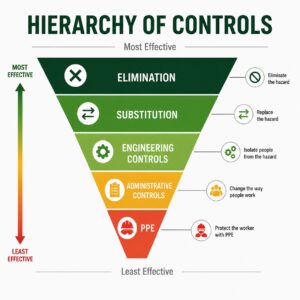
PPE should never replace hazard elimination whenever safer alternatives are available. Instead, it complements other safety measures to provide comprehensive protection.
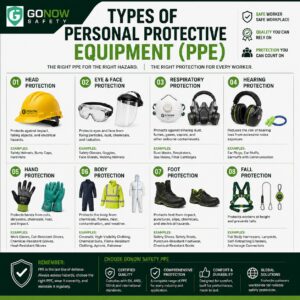
Types of Personal Protective Equipment
Different hazards require different forms of protection. Understanding the major categories of PPE is the first step in selecting appropriate equipment.
Head Protection
Head injuries remain one of the leading causes of serious workplace accidents.
Safety helmets protect workers against:
- Falling objects
- Impact injuries
- Penetration hazards
- Limited electrical hazards
Common applications include:
- Construction
- Mining
- Warehousing
- Utilities
- Heavy manufacturing
Common Head Protection Products
- Industrial Safety Helmets
- Climbing Helmets
- Electrical Helmets
- Bump Caps
Important standard:
EN 397 – Industrial Safety Helmets
Eye and Face Protection
The eyes are extremely vulnerable to workplace hazards.
Flying particles, chemicals, sparks, molten metal, and ultraviolet radiation may all cause permanent vision damage.
Common eye protection products include:
- Safety Glasses
- Goggles
- Face Shields
- Welding Helmets
Typical hazards:
- Grinding
- Cutting
- Welding
- Chemical handling
- Laboratory work
Important standard:
EN 166 – Personal Eye Protection
Respiratory Protection
Respiratory hazards are often invisible.
Workers may inhale:
- Dust
- Smoke
- Fumes
- Toxic gases
- Chemical vapors
- Biological particles
Respiratory PPE includes:
Disposable Respirators
Suitable for dust and non-oily particles.
Examples:
- FFP1
- FFP2
- FFP3
- N95
Half Face Respirators
Provide reusable protection with replaceable filters.
Suitable for:
- Painting
- Chemical handling
- Industrial maintenance
Full Face Respirators
Offer both respiratory and eye protection.
Commonly used in:
- Chemical plants
- Hazardous environments
- Emergency response
Gas Masks
Designed for environments containing hazardous gases or vapors.
Different filter cartridges protect against different contaminants.
Important standards include:
- EN 149
- EN 136
- EN 143
- EN 14387
Hearing Protection
Noise exposure exceeding safe limits may result in permanent hearing loss.
Common hearing PPE includes:
- Ear Plugs
- Ear Muffs
- Electronic Hearing Protection
Typical industries:
- Manufacturing
- Airports
- Construction
- Mining
- Heavy machinery
Hand Protection
Hands are exposed to a wide range of workplace hazards.
Different gloves provide protection against different risks.
Common glove categories:
Cut Resistant Gloves
Suitable for:
- Metal fabrication
- Glass handling
- Automotive manufacturing
Standard:
EN 388
Chemical Resistant Gloves
Protect against:
- Acids
- Solvents
- Oils
- Hazardous liquids
Standard:
EN 374
Heat Resistant Gloves
Designed for:
- Welding
- Foundries
- Glass manufacturing
- High-temperature operations
Impact Resistant Gloves
Ideal for:
- Oil & gas maintenance
- Heavy equipment operation
- Construction
- Mining
General Work Gloves
Used for:
- Material handling
- Warehousing
- Logistics
- Assembly
Body Protection
The human body is often exposed to multiple workplace hazards simultaneously, making body protection an essential component of any PPE program. Depending on the work environment, workers may require protection against chemicals, flames, heat, biological contaminants, weather conditions, or high-visibility requirements.
Unlike helmets or gloves, body protection often covers a large portion of the body and must be compatible with other PPE such as respirators, harnesses, or hearing protection.
Common Types of Body Protection
Protective Coveralls
Coveralls provide full-body protection against dirt, dust, light chemicals, and workplace contamination.
Typical applications include:
- Manufacturing
- Automotive repair
- Warehousing
- Maintenance
- General industry
Disposable coveralls are commonly used in clean environments, while reusable coveralls are preferred for long-term industrial use.
Chemical Protective Suits
Chemical protective clothing is designed to prevent hazardous liquids, gases, vapors, or particles from contacting the skin.
Depending on the protection level, chemical suits may provide resistance against:
- Acids
- Alkalis
- Organic solvents
- Industrial chemicals
- Biological contaminants
Typical industries include:
- Chemical manufacturing
- Laboratories
- Pharmaceutical production
- Hazardous material handling
- Industrial cleaning
Relevant standards include:
- EN 13034
- EN 14605
- EN 943
Flame-Resistant (FR) Clothing
Workers exposed to fire, molten metal, or electrical arc hazards require flame-resistant clothing rather than ordinary workwear.
FR clothing is designed to:
- Resist ignition
- Reduce burn injuries
- Self-extinguish after flame exposure
- Minimize heat transfer
Common users include:
- Welders
- Electricians
- Oil refinery workers
- Utility maintenance teams
- Steel manufacturing workers
Important standards include:
- NFPA 2112
- IEC 61482
- ISO 11612
High-Visibility Clothing
Visibility is critical where vehicles, heavy equipment, or poor lighting increase the risk of accidents.
High-visibility garments use fluorescent fabrics and reflective tape to improve worker visibility during both daytime and nighttime operations.
Common products include:
- High-visibility safety vests
- Reflective jackets
- Reflective rainwear
- High-visibility coveralls
- Reflective trousers
Industries that commonly require high-visibility PPE include:
- Road construction
- Traffic management
- Warehousing
- Airport operations
- Railway maintenance
- Logistics
Relevant standards:
- EN ISO 20471
- ANSI/ISEA 107
Rainwear
Outdoor workers frequently encounter wet and cold conditions.
Industrial rainwear protects against:
- Rain
- Wind
- Mud
- Moisture
Unlike ordinary raincoats, industrial rainwear is designed to maintain durability while allowing sufficient mobility for physical work.
Foot Protection
Feet are constantly exposed to hazards such as falling objects, punctures, slips, chemicals, and electrical risks.
Safety footwear protects workers while improving comfort during long working hours.
Common Types of Safety Footwear
Steel Toe Shoes
Steel toe shoes contain a steel protective cap capable of resisting heavy impact and compression.
Advantages include:
- Excellent impact resistance
- High durability
- Cost-effective
- Suitable for heavy industry
Applications include:
- Construction
- Manufacturing
- Warehousing
- Logistics
Composite Toe Shoes
Composite toe footwear replaces steel with lightweight materials such as fiberglass, carbon fiber, or Kevlar.
Advantages include:
- Lightweight
- Metal-free
- Better thermal insulation
- Airport-friendly
Common applications include:
- Electrical work
- Cold environments
- Security checkpoints
- Electronics manufacturing
Safety Boots
Safety boots provide additional ankle support and are often preferred for outdoor environments.
Features may include:
- Waterproof uppers
- Slip-resistant soles
- Puncture-resistant midsoles
- Oil-resistant outsoles
- Heat-resistant materials
Construction and mining industries commonly use S3 safety boots for maximum protection.
Key Safety Footwear Features
When selecting safety footwear, buyers should evaluate the following protective features:
- Safety toe cap
- Slip resistance
- Puncture resistance
- Water resistance
- Oil resistance
- Electrical insulation
- Heat resistance
- Anti-static properties
- Energy absorption
Relevant standard:
EN ISO 20345
Fall Protection
Working at height remains one of the leading causes of workplace fatalities worldwide.
Whenever workers perform tasks above ground level where a fall hazard exists, fall protection systems become essential.
Common Fall Protection Equipment
Full Body Harnesses
Distribute fall forces safely across the body.
Suitable for:
- Construction
- Telecommunications
- Wind energy
- Tower maintenance
Shock-Absorbing Lanyards
Reduce impact forces during a fall.
Self-Retracting Lifelines
Provide greater mobility while minimizing fall distance.
Anchorage Connectors
Connect workers safely to secure structures.
Vertical Lifelines
Used for ladder climbing and tower maintenance.
Proper fall protection requires not only certified equipment but also adequate worker training and regular inspections.
Relevant standards include:
- EN 361
- EN 355
- ANSI Z359
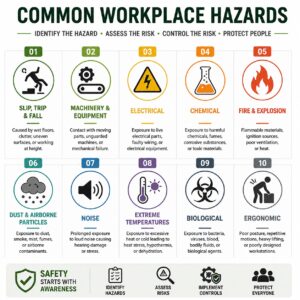
Common Workplace Hazards
Understanding workplace hazards is the foundation of effective PPE selection.
Every workplace should begin with a comprehensive hazard assessment before selecting protective equipment.
The most common workplace hazards are outlined below.
Mechanical Hazards
Mechanical hazards arise from moving machinery, tools, equipment, and sharp materials.
Examples include:
- Rotating machinery
- Sharp edges
- Flying particles
- Crushing hazards
- Falling tools
Recommended PPE:
- Safety helmets
- Safety glasses
- Cut-resistant gloves
- Safety footwear
Common industries:
- Manufacturing
- Metal fabrication
- Construction
- Warehousing
Chemical Hazards
Chemical hazards may occur through contact with liquids, vapors, powders, or gases.
Examples include:
- Acid splashes
- Solvent exposure
- Toxic chemicals
- Industrial cleaners
Recommended PPE:
- Chemical-resistant gloves
- Chemical suits
- Face shields
- Respirators
- Safety goggles
Industries:
- Chemical plants
- Laboratories
- Pharmaceutical production
Respiratory Hazards
Airborne contaminants may enter the lungs without being visible.
Examples include:
- Dust
- Welding fumes
- Smoke
- Silica
- Wood dust
- Biological particles
Recommended PPE:
- FFP2 respirators
- FFP3 respirators
- Half-face respirators
- Full-face respirators
Electrical Hazards
Electricians face hazards including:
- Electric shock
- Arc flash
- Arc blast
Recommended PPE:
- Arc-rated clothing
- Insulating gloves
- Electrical helmets
- Face shields
- Safety footwear
Heat and Flame Hazards
High-temperature operations may expose workers to:
- Sparks
- Molten metal
- Flames
- Radiant heat
Recommended PPE:
- FR clothing
- Welding gloves
- Welding helmets
- Heat-resistant footwear
Noise Hazards
Continuous exposure above safe limits may permanently damage hearing.
Recommended PPE:
- Ear plugs
- Ear muffs
Industries include:
- Mining
- Airports
- Manufacturing
- Construction
Biological Hazards
Healthcare and laboratory personnel may encounter:
- Viruses
- Bacteria
- Bloodborne pathogens
- Contaminated materials
Recommended PPE:
- Disposable gloves
- Respirators
- Protective gowns
- Face shields
Fall Hazards
Working at heights requires specialized fall protection equipment.
Examples include:
- Roof work
- Scaffolding
- Elevated platforms
- Tower maintenance
Recommended PPE:
- Harnesses
- Lanyards
- Lifelines
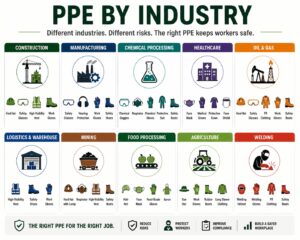
PPE for Different Industries
No single PPE solution is suitable for every workplace. Different industries present different hazards, requiring tailored combinations of protective equipment.
Construction
Construction remains one of the highest-risk industries.
Typical PPE includes:
- Safety helmets
- High-visibility clothing
- Safety footwear
- Cut-resistant gloves
- Safety glasses
- Hearing protection
- Fall protection
Manufacturing
Manufacturing environments often combine mechanical, chemical, and noise hazards.
Recommended PPE:
- Safety glasses
- Work gloves
- Safety shoes
- Ear protection
- Respirators where necessary
Chemical Industry
Chemical processing requires comprehensive protection against hazardous substances.
Typical PPE:
- Chemical suits
- Respirators
- Face shields
- Chemical gloves
- Chemical-resistant boots
Food Processing
Food safety and worker safety must both be considered.
Common PPE:
- Disposable gloves
- Hair nets
- Safety footwear
- Aprons
- Protective sleeves
Warehousing and Logistics
Material handling creates risks from dropped objects, repetitive movement, and forklift traffic.
Recommended PPE:
- Safety shoes
- Work gloves
- High-visibility vests
- Safety helmets (where required)
Mining
Mining operations combine multiple hazards.
Recommended PPE:
- Helmets
- Respirators
- Safety boots
- Hearing protection
- High-visibility clothing
- Protective eyewear
Need help selecting the right PPE? Our team can recommend suitable solutions based on your workplace hazards and industry requirements.
How to Choose the Right Personal Protective Equipment (PPE)
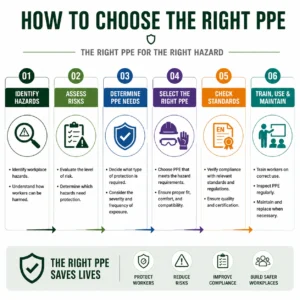
Selecting the right PPE is one of the most important responsibilities for employers, safety managers, and procurement professionals. Purchasing protective equipment simply because it is widely used or inexpensive does not guarantee worker safety. PPE should always be selected based on the actual hazards present in the workplace.
An effective PPE selection process involves hazard assessment, evaluating the required level of protection, verifying compliance with safety standards, ensuring compatibility between different types of PPE, and considering worker comfort and durability.
The following six-step process provides a practical framework for choosing the right PPE.
Step 1: Conduct a Workplace Hazard Assessment
Before selecting any PPE, identify the hazards workers may encounter during each task.
Consider the following questions:
- What hazards are present?
- How serious are the risks?
- How frequently are workers exposed?
- How long does each exposure last?
- Can the hazard be eliminated or reduced before PPE is required?
Typical hazard categories include:
| Hazard | Examples |
|---|---|
| Mechanical | Falling objects, sharp edges, moving machinery |
| Chemical | Acids, solvents, corrosive liquids |
| Respiratory | Dust, fumes, smoke, gases |
| Biological | Viruses, bacteria, bloodborne pathogens |
| Thermal | High temperatures, molten metal, steam |
| Electrical | Electric shock, arc flash |
| Noise | Heavy machinery, compressors |
| Fall | Roof work, scaffolding, elevated platforms |
A documented hazard assessment forms the foundation of every effective PPE program.
Step 2: Select the Appropriate Protection Level
Different hazards require different protection levels.
For example:
Respiratory Protection
| Workplace Condition | Recommended PPE |
|---|---|
| Low dust | FFP1 Dust Mask |
| Moderate dust | FFP2 Respirator |
| Fine particles | FFP3 Respirator |
| Chemical vapors | Half-Face Respirator with Filters |
| Toxic gases | Full-Face Respirator |
Hand Protection
| Hazard | Recommended Gloves |
|---|---|
| Sharp materials | Cut-Resistant Gloves |
| Chemicals | Chemical-Resistant Gloves |
| High temperature | Heat-Resistant Gloves |
| Heavy impact | Impact-Resistant Gloves |
| General handling | Work Gloves |
Foot Protection
| Workplace | Recommended Footwear |
|---|---|
| Warehouse | S1 Safety Shoes |
| Food Processing | S2 Safety Shoes |
| Construction | S3 Safety Boots |
| Mining | Heavy-Duty S3 Boots |
Selecting PPE according to actual workplace risks ensures adequate protection without over-specifying equipment that may reduce comfort or increase unnecessary costs.
Step 3: Verify Safety Standards and Certifications
Certified PPE provides confidence that products have been tested to recognized performance requirements.
Before purchasing PPE, verify that it complies with applicable standards for your region and industry.
Common PPE Standards
| PPE Category | Common Standards |
|---|---|
| Safety Helmets | EN 397, ANSI Z89.1 |
| Eye Protection | EN 166, ANSI Z87.1 |
| Respirators | EN 149, EN 136, NIOSH |
| Gloves | EN 388, EN 374, EN 407 |
| Safety Footwear | EN ISO 20345, ASTM F2413 |
| High Visibility | EN ISO 20471, ANSI/ISEA 107 |
| Flame Resistant Clothing | NFPA 2112, ISO 11612 |
| Arc Flash Clothing | IEC 61482 |
Never purchase PPE solely based on appearance or price. Certification is essential to ensure reliable protection.
GONOW SAFETY supplies PPE that complies with international standards, including EN, ANSI, ASTM, and ISO requirements.
Step 4: Ensure PPE Compatibility
Many tasks require workers to wear several types of PPE simultaneously.
For example:
- Safety Helmet + Ear Muffs + Face Shield
- Safety Glasses + Respirator
- Gloves + Protective Sleeves
- High-Visibility Vest + Fall Protection Harness
Poorly matched equipment can interfere with comfort, movement, or protective performance.
A complete PPE system should function as an integrated solution rather than a collection of separate products.
Step 5: Consider Comfort and Fit
Even the highest-rated PPE cannot protect workers if it is uncomfortable and not worn correctly.
When evaluating PPE, consider:
- Proper sizing
- Adjustable fit
- Lightweight construction
- Breathability
- Ergonomic design
- Moisture management
- Flexibility
Comfort directly influences worker compliance. PPE that is easy to wear for extended periods is more likely to be used consistently.
Step 6: Evaluate Durability and Maintenance
Durable PPE reduces long-term operating costs and minimizes downtime.
When comparing products, consider:
- Material quality
- Expected service life
- Cleaning requirements
- Replacement parts availability
- Inspection frequency
- Resistance to workplace conditions
Reusable PPE should be inspected regularly and replaced when it no longer provides adequate protection.
Understanding PPE Standards
International PPE standards establish minimum performance requirements for protective equipment. These standards help employers compare products objectively and ensure that PPE is suitable for specific workplace hazards.
Although standards vary by region, many share similar testing principles.
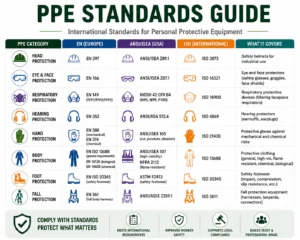
European Standards (EN)
EN standards are widely recognized throughout Europe and many international markets.
Common EN standards include:
| Standard | PPE Category |
|---|---|
| EN 397 | Industrial Safety Helmets |
| EN 166 | Eye Protection |
| EN 149 | Filtering Half Masks |
| EN 136 | Full Face Respirators |
| EN 143 | Particle Filters |
| EN 388 | Mechanical Protection Gloves |
| EN 374 | Chemical Protection Gloves |
| EN 407 | Heat Protection Gloves |
| EN ISO 20345 | Safety Footwear |
| EN ISO 20471 | High Visibility Clothing |
These standards define testing methods for impact resistance, filtration efficiency, puncture resistance, slip resistance, visibility, and other key performance characteristics.
ANSI Standards (United States)
ANSI standards are commonly used across North America.
Examples include:
- ANSI Z89.1 – Safety Helmets
- ANSI Z87.1 – Eye Protection
- ANSI/ISEA 105 – Protective Gloves
- ANSI/ISEA 107 – High-Visibility Apparel
Many multinational companies specify both EN and ANSI compliance to meet the needs of global operations.
OSHA Requirements
The Occupational Safety and Health Administration (OSHA) requires employers to provide appropriate PPE whenever workplace hazards cannot be eliminated.
Employer responsibilities include:
- Conducting hazard assessments
- Selecting suitable PPE
- Providing PPE at no cost where required
- Training employees on correct use
- Maintaining and replacing damaged PPE
OSHA regulations focus on ensuring that PPE is appropriate for the identified hazards rather than prescribing specific brands or models.
ISO Standards
The International Organization for Standardization (ISO) develops globally recognized standards for quality, testing, and management systems.
ISO standards promote consistency and facilitate international trade by providing common technical requirements.
NIOSH Certification
For respiratory protection in the United States, NIOSH certification is particularly important.
Common examples include:
- N95
- N99
- P100
NIOSH-approved respirators are tested for filtration efficiency and performance under defined conditions.
PPE Inspection and Maintenance
Purchasing certified PPE is only the first step. Regular inspection and maintenance are essential to ensure ongoing protection.
Damaged or poorly maintained PPE may fail when workers need it most.
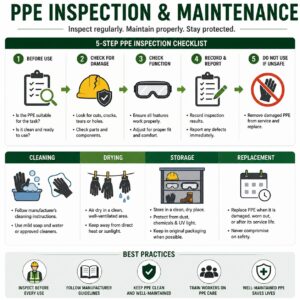
Daily Inspection Checklist
Before use, workers should inspect PPE for signs of damage.
Helmets
Check for:
- Cracks
- Dents
- UV damage
- Worn suspension systems
Safety Glasses
Inspect for:
- Scratches
- Loose frames
- Broken lenses
Gloves
Look for:
- Holes
- Tears
- Chemical degradation
- Excessive wear
Respirators
Verify:
- Proper seal
- Valve condition
- Filter expiration dates
- Strap integrity
Safety Footwear
Check:
- Toe cap condition
- Sole wear
- Puncture damage
- Stitching
- Slip-resistant tread
Harnesses
Inspect:
- Webbing
- Buckles
- D-rings
- Stitching
- Shock absorbers
Any damaged PPE should be removed from service immediately.
Cleaning PPE
Cleaning procedures vary depending on the equipment.
General recommendations include:
- Follow manufacturer instructions.
- Use mild detergents where appropriate.
- Avoid harsh chemicals unless approved.
- Dry reusable PPE thoroughly before storage.
- Disinfect shared PPE between users.
Proper cleaning helps maintain both hygiene and protective performance.
Proper Storage
PPE should be stored in a clean, dry environment away from:
- Direct sunlight
- Extreme temperatures
- Moisture
- Chemicals
- Sharp objects
Improper storage can shorten service life and reduce protective effectiveness.
When Should PPE Be Replaced?
Replace PPE immediately if it shows signs of:
- Cracking
- Deformation
- Excessive wear
- Chemical contamination
- Failed inspections
- Expired service life
Replacing worn PPE promptly helps maintain a safe working environment.
Common PPE Mistakes to Avoid
Even the highest-quality PPE cannot provide adequate protection if it is selected, worn, or maintained incorrectly. Many workplace injuries occur not because PPE is unavailable, but because it is used improperly.
Understanding these common mistakes can help organizations build a more effective safety program.
Mistake 1: Choosing PPE Based Only on Price
Many companies focus primarily on purchase cost when selecting PPE. While controlling costs is important, the least expensive product is not always the safest or most economical option.
Low-quality PPE may:
- Wear out quickly
- Provide inconsistent protection
- Reduce worker comfort
- Increase replacement frequency
- Lead to higher long-term costs
Instead of comparing price alone, evaluate:
- Certification and compliance
- Material quality
- Durability
- Worker comfort
- Expected service life
- Supplier reliability
High-quality PPE often delivers better value over its lifecycle.
Mistake 2: Skipping the Hazard Assessment
One of the biggest mistakes is selecting PPE before identifying workplace hazards.
For example:
- Using a dust mask where chemical vapors are present
- Wearing general-purpose gloves when handling sharp metal
- Choosing S1 safety shoes on construction sites where puncture resistance is required
A proper hazard assessment should always come before PPE selection.
Mistake 3: Using One Type of PPE for Every Job
Different tasks require different levels of protection.
For example:
| Task | Appropriate PPE |
|---|---|
| Grinding | Safety glasses, face shield, gloves |
| Welding | Welding helmet, FR clothing, welding gloves |
| Chemical Mixing | Chemical suit, chemical gloves, respirator |
| Roof Installation | Safety helmet, harness, safety boots |
Attempting to use the same PPE across all work activities increases safety risks and may violate workplace regulations.
Mistake 4: Ignoring Comfort and Fit
Workers are far less likely to wear PPE consistently if it is uncomfortable.
Common issues include:
- Helmets that slip during movement
- Gloves that restrict dexterity
- Respirators that create excessive breathing resistance
- Footwear that causes fatigue
- Oversized protective clothing
Selecting ergonomically designed PPE with multiple sizes and adjustable features improves compliance and productivity.
Mistake 5: Not Inspecting PPE Regularly
PPE gradually deteriorates through daily use.
Examples include:
- Helmet shells becoming brittle due to UV exposure
- Glove coatings wearing away
- Respirator straps losing elasticity
- Safety shoes developing worn soles
- Harness webbing becoming damaged
Routine inspections help identify equipment that should be repaired or replaced before it fails.
Mistake 6: Mixing Incompatible PPE
Multiple pieces of PPE often need to work together.
Potential compatibility issues include:
- Safety glasses interfering with respirator seals
- Ear muffs preventing proper helmet fit
- Thick gloves reducing tool control
- Harnesses covering reflective clothing
When purchasing PPE, always consider the complete protective system rather than individual products.
Future Trends in Personal Protective Equipment
As workplaces evolve, PPE continues to become smarter, lighter, and more sustainable. New technologies are improving both worker protection and comfort.
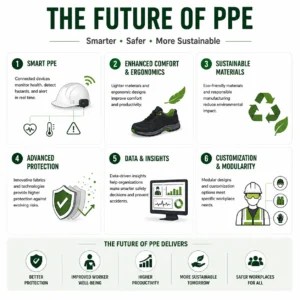
Smart PPE
Smart PPE integrates digital technologies into protective equipment.
Examples include:
- Smart helmets with communication systems
- Wearable sensors monitoring worker fatigue
- Gas detection integrated into helmets
- GPS-enabled safety devices
- Connected fall detection systems
These innovations improve situational awareness and emergency response.
Lightweight Materials
Manufacturers are replacing traditional materials with advanced composites to reduce weight without sacrificing protection.
Examples include:
- Composite toe caps
- Carbon fiber components
- High-performance synthetic fabrics
- Lightweight helmet shells
Reducing weight helps decrease worker fatigue during long shifts.
Sustainable PPE
Environmental responsibility is becoming increasingly important.
Manufacturers are introducing:
- Recyclable packaging
- Recycled materials
- Longer-lasting products
- Reduced manufacturing waste
- Eco-friendly production processes
Sustainable PPE helps organizations meet environmental goals while maintaining workplace safety.
Improved Comfort
Modern PPE focuses on user experience.
Recent developments include:
- Moisture-wicking fabrics
- Better ventilation
- Flexible glove coatings
- Adjustable helmet suspension systems
- Ergonomic footwear
- Improved respirator designs
Comfort encourages consistent PPE use, which ultimately improves safety outcomes.
Customization and Branding
Many companies now prefer customized PPE that reflects their corporate identity.
Common customization options include:
- Company logos
- Custom colors
- Reflective printing
- Private labeling
- OEM & ODM production
Customized PPE enhances brand recognition while maintaining compliance with applicable safety standards.
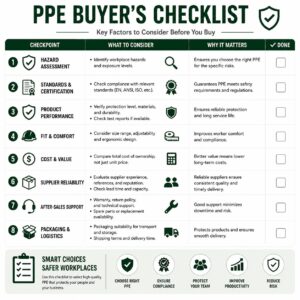
PPE Buyer’s Checklist
Before purchasing PPE, review the following checklist to ensure products meet workplace requirements.
Workplace Assessment
✔ Have workplace hazards been identified?
✔ Has a formal risk assessment been completed?
✔ Are all exposure scenarios considered?
Product Selection
✔ Does the PPE provide adequate protection?
✔ Is it suitable for the specific work environment?
✔ Is it compatible with other PPE?
✔ Is the correct size available?
Certification
✔ Does the product comply with applicable standards?
✔ Are certification markings clearly displayed?
✔ Can the supplier provide test reports if required?
Comfort
✔ Is the PPE lightweight?
✔ Is it breathable?
✔ Is it adjustable?
✔ Can workers wear it comfortably throughout the workday?
Maintenance
✔ Is the product easy to clean?
✔ Can replacement parts be obtained?
✔ Is the expected service life suitable?
Supplier Evaluation
✔ Does the supplier have export experience?
✔ Are OEM/ODM services available?
✔ Is technical support provided?
✔ Are samples available?
Frequently Asked Questions (FAQ)
What is PPE?
PPE (Personal Protective Equipment) refers to protective clothing and equipment designed to reduce exposure to workplace hazards.
Why is PPE important?
PPE protects workers from injuries and occupational illnesses when workplace hazards cannot be completely eliminated.
What are the main categories of PPE?
The primary categories include:
- Head Protection
- Eye and Face Protection
- Respiratory Protection
- Hearing Protection
- Hand Protection
- Body Protection
- Foot Protection
- Fall Protection
Is PPE required by law?
In many countries, employers are legally required to provide appropriate PPE whenever workplace hazards cannot be adequately controlled by other means.
How often should PPE be replaced?
Replacement depends on the product type, usage conditions, manufacturer recommendations, inspection results, and signs of wear or damage. PPE should be replaced immediately if it no longer provides reliable protection.
What is the difference between PPE and safety equipment?
PPE refers to equipment worn by individuals to protect against hazards, while “safety equipment” is a broader term that also includes items such as machine guards, emergency showers, fire extinguishers, and ventilation systems.
What are the most commonly used PPE products?
Common PPE includes:
- Safety helmets
- Safety glasses
- Respirators
- Work gloves
- Safety shoes
- High-visibility clothing
- Hearing protection
- Fall protection equipment
What is the difference between FFP2 and N95?
Both provide high levels of particulate filtration but are certified under different standards. FFP2 follows the European EN 149 standard, while N95 is certified under the U.S. NIOSH system.
What is the difference between S1 and S3 safety shoes?
S1 shoes provide toe protection, anti-static properties, and heel energy absorption. S3 shoes include all S1 features plus water-resistant uppers and puncture-resistant midsoles, making them more suitable for demanding industrial environments.
Can PPE eliminate workplace hazards?
No. PPE is considered the last line of defense. Employers should first attempt to eliminate or reduce hazards through engineering controls and administrative measures before relying on PPE.
Conclusion
Personal Protective Equipment is far more than a regulatory requirement—it is a critical investment in worker health, operational efficiency, and business continuity.
From safety helmets and respirators to gloves, protective clothing, safety footwear, and fall protection systems, each type of PPE plays a unique role in reducing workplace risks. However, effective protection depends on more than simply wearing equipment. Employers must begin with a thorough hazard assessment, select PPE that matches the specific risks, ensure compliance with recognized safety standards, provide proper training, and establish regular inspection and maintenance procedures.
As workplaces continue to evolve, so does PPE. Innovations in smart technology, lightweight materials, ergonomic design, and sustainable manufacturing are making modern protective equipment safer, more comfortable, and better suited to the demands of today’s industries.
Ultimately, the goal of every PPE program is simple: protect people so they can work safely, confidently, and productively every day.
About GONOW SAFETY
At GONOW SAFETY, we provide comprehensive Personal Protective Equipment (PPE) solutions for customers around the world. Our product portfolio includes safety helmets, respirators, protective gloves, chemical protective clothing, flame-resistant apparel, high-visibility garments, safety footwear, hearing protection, and fall protection equipment for industries such as construction, manufacturing, logistics, food processing, utilities, and industrial maintenance.
In addition to supplying certified PPE, we support customers with OEM and ODM services, private labeling, customized branding, and flexible sourcing solutions tailored to international markets.
Whether you are a distributor, importer, contractor, or industrial buyer, GONOW SAFETY is committed to delivering reliable PPE products that combine Safety, Quality, and Comfort.
Protect Every Worker. Every Workplace. Every Day.
Contact GONOW SAFETY today to discuss your PPE sourcing needs, request product recommendations, or inquire about OEM and private label services.