In extreme heat environments, ordinary flame-resistant clothing may not provide sufficient protection.
Firefighters and emergency responders may face:
- Intense radiant heat
- Direct flame exposure
- High-temperature environments
- Short-duration extreme thermal hazards
For these situations, specialized protective clothing is required.
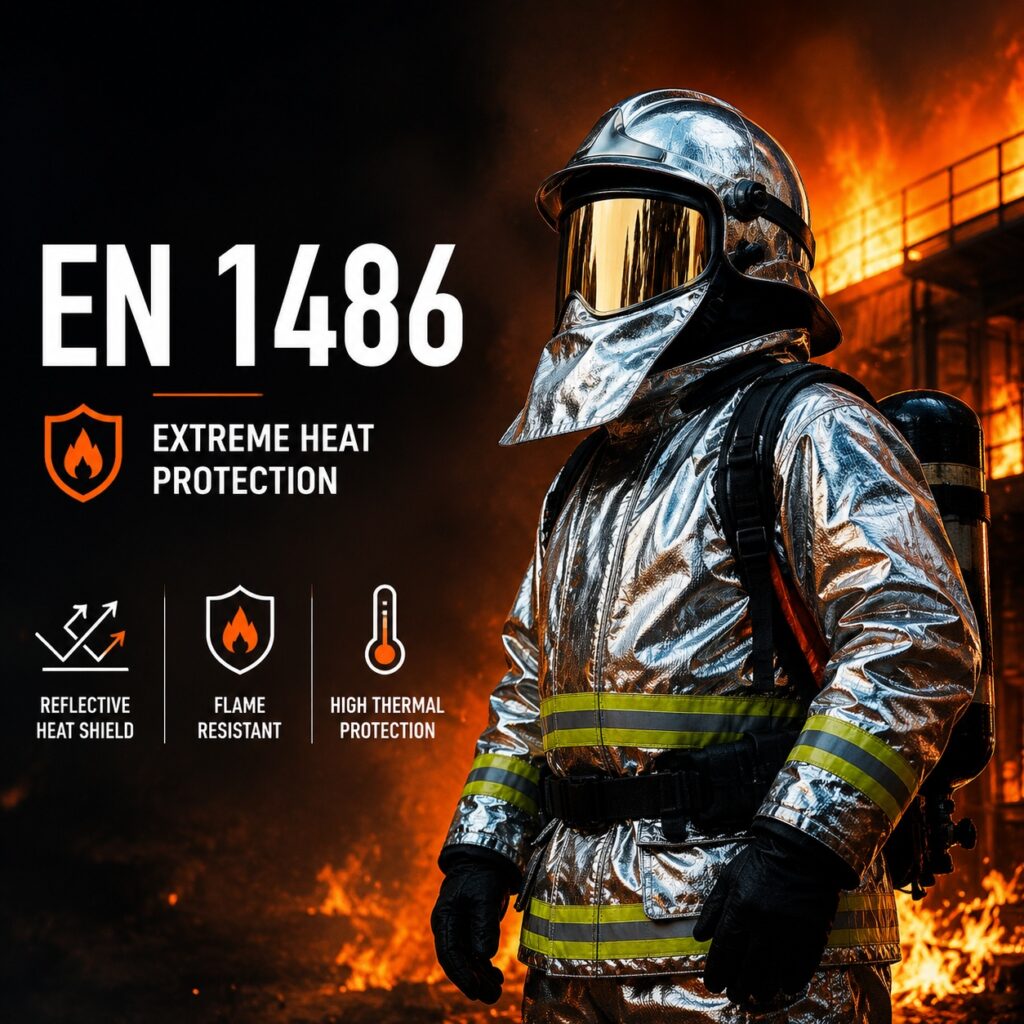
EN 1486 is a European standard that specifies requirements for protective clothing used by firefighters in high thermal exposure environments.
This guide explains what EN 1486 means, how reflective heat protective clothing works, and when this type of PPE is required.
What Is EN 1486?
EN 1486: Protective Clothing for Firefighters — Test Methods and Requirements for Reflective Protective Clothing for Specialized Firefighting
EN 1486 specifies requirements for protective clothing designed to provide enhanced protection against:
- High levels of radiant heat
- Flame exposure
- Extreme thermal environments
The standard focuses on garments that use reflective materials to reduce heat transfer to the wearer.
Why Is EN 1486 Protective Clothing Important?
Fire environments can expose workers to extremely high temperatures.
Heat can transfer through:
1. Radiation
Heat energy travels directly from flames or hot surfaces.
This can cause:
- Skin burns
- Heat stress
- Serious injury
2. Convection
Hot air transfers heat to protective clothing.
3. Direct Flame Contact
Firefighters may encounter:
- Flash flames
- Burning materials
- High-temperature conditions
EN 1486 clothing helps reduce thermal exposure during these extreme situations.
How Does EN 1486 Protective Clothing Work?
EN 1486 garments typically use:
Reflective Outer Materials
Special reflective surfaces help:
- Reflect radiant heat
- Reduce heat absorption
- Improve short-duration protection
Multi-Layer Construction
Protective clothing may include:
Outer Layer
Provides:
- Heat reflection
- Flame resistance
Moisture Barrier
Helps prevent:
- Heat transfer
- Moisture penetration
Thermal Insulation Layer
Provides:
- Additional thermal protection
EN 1486 Testing Requirements
EN 1486 evaluates protective clothing performance under extreme heat conditions.
Key areas include:
1. Radiant Heat Protection
Measures how effectively the garment reduces heat transfer.
2. Flame Resistance
Evaluates:
- Ignition behavior
- After-flame performance
- Material stability
3. Heat Transfer Performance
Determines how much heat reaches the wearer.
4. Garment Construction
Testing considers:
- Seams
- Closures
- Overall design
Because protection depends on the complete garment system.
EN 1486 vs EN ISO 11612
These standards are often confused.
They protect against different levels of thermal hazards.
| EN 1486 | EN ISO 11612 | |
|---|---|---|
| Main Application | Extreme firefighting environments | Industrial heat and flame protection |
| Protection Level | Very high thermal exposure | General workplace hazards |
| Typical Users | Firefighters, emergency responders | Industrial workers |
| Focus | Reflective heat protection | Heat and flame resistance |
EN 1486 vs EN 469
Both are related to firefighter protection.
EN 1486
Focuses on:
- Specialized reflective clothing
- Extreme radiant heat protection
EN 469
Focuses on:
- General firefighter protective clothing
- Structural firefighting operations
Applications of EN 1486 Protective Clothing
Firefighting Operations
Used for:
- Approaching intense heat sources
- Emergency response
- Fire rescue operations
Industrial Emergency Response
Potential applications:
- High-temperature industrial facilities
- Chemical emergency situations
- Rescue operations
Specialized Heat Protection
Used where workers may experience:
- Extreme radiant heat
- Short-duration high-temperature exposure
Components of EN 1486 Protective Equipment
A complete system may include:
Reflective Protective Suit
Provides:
- Heat reflection
- Flame protection
Protective Hood
Protects:
- Head
- Neck
- Face areas
Heat Resistant Gloves
Protects hands against:
- Heat
- Flame
- Thermal exposure
Protective Boots
Provides:
- Heat resistance
- Mechanical protection
How to Choose EN 1486 Protective Clothing?
1. Assess the Heat Hazard
Consider:
- Temperature level
- Exposure duration
- Heat source type
2. Select the Correct Protection Level
Higher thermal hazards require specialized protection systems.
3. Consider Worker Mobility
Protective clothing should balance:
- Protection
- Weight
- Comfort
- Movement
Common Mistakes When Selecting Heat Protective Clothing
Mistake 1: Using Standard FR Clothing for Extreme Heat
EN ISO 11612 clothing may not replace specialized EN 1486 protection in extreme thermal environments.
Mistake 2: Ignoring Exposure Duration
Extreme heat protection is often designed for short-duration exposure.
Mistake 3: Selecting Individual Products Instead of a System
Heat protection requires compatibility between:
- Suit
- Hood
- Gloves
- Boots
How GONOW SAFETY Supports Heat and Flame Protection Solutions
At GONOW SAFETY, we provide protective clothing solutions for demanding industrial environments.
Our solutions include:
- Flame-resistant clothing
- Heat protective garments
- Welding protective clothing
- Arc flash protective clothing
- Customized PPE solutions
We help customers select suitable PPE based on:
- Workplace hazards
- Industry requirements
- International standards
From everyday industrial protection to specialized thermal hazards, GONOW SAFETY supports safer workplaces with reliable PPE solutions.
Conclusion
EN 1486 represents a specialized level of thermal protection designed for extreme heat environments.
In simple terms:
- EN 1486 provides enhanced protection against intense radiant heat
- It is mainly used for specialized firefighting and emergency response
- It is different from standard industrial flame-resistant clothing
Understanding the correct protective clothing standard helps companies select PPE that matches the actual workplace hazard.