
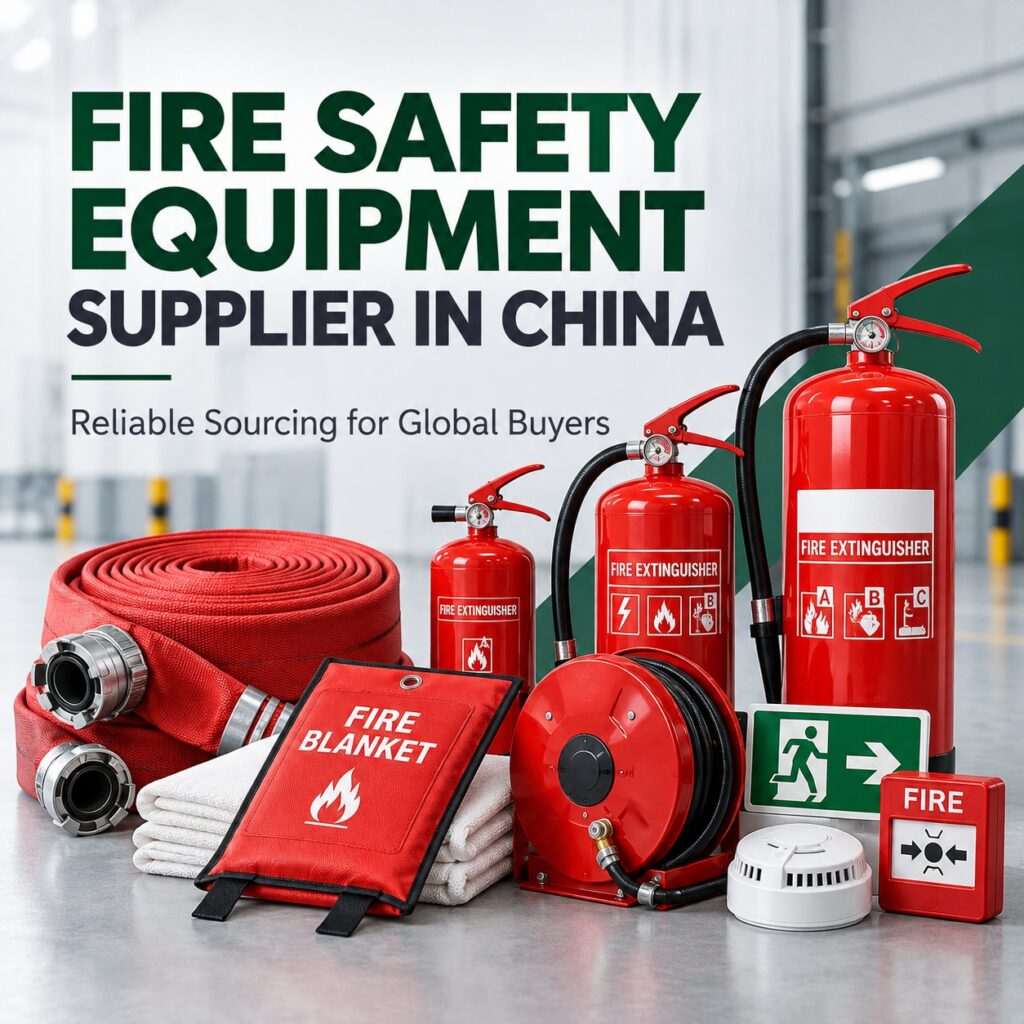
Finding a reliable fire safety equipment supplier in China is an important step for importers, distributors, contractors, and businesses purchasing fire protection products for commercial or industrial applications.
China offers a broad supply chain covering fire extinguishers, fire hoses, fire blankets, emergency safety equipment, and related products. For international buyers, sourcing from China can provide access to a wide range of products and flexible purchasing options. However, successful procurement requires careful supplier evaluation, product specification checks, compliance verification, and effective shipment coordination.
For buyers managing multiple product categories, working with a one-stop safety equipment sourcing partner may also simplify communication and purchasing arrangements.
In this guide, GONOW SAFETY explains how to select a fire safety equipment supplier in China, which products to consider, how to verify product documentation, and what to prepare before placing an international order.
1. What Does a Fire Safety Equipment Supplier Provide?
Fire safety equipment includes products designed to help prevent fires, control small fires, support emergency response, and protect people during fire-related incidents.
The exact product range depends on the supplier and its manufacturing partners. Common categories include portable fire extinguishers, fire hoses, fire blankets, emergency equipment, and selected personal protective equipment for firefighting applications.
When evaluating a supplier, buyers should first distinguish between general fire safety products and specialized firefighting equipment. These products may have different technical specifications, intended uses, and regulatory requirements.
A supplier’s ability to source several categories can be useful for distributors and project buyers who want to consolidate purchasing. Nevertheless, each product must be evaluated individually according to its application and applicable requirements.
2. Common Fire Safety Equipment Categories
Before requesting quotations, identify the product categories required for your market and application.
2.1 Fire Extinguishers
Fire extinguishers are among the most commonly purchased fire safety products. Available types include:
- ABC dry powder fire extinguishers.
- Carbon dioxide (CO₂) fire extinguishers.
- Foam fire extinguishers.
- Water-based fire extinguishers.
- Other specialized extinguishers designed for particular fire risks.
Different extinguishing agents are suitable for different fire classes and applications. For example, a CO₂ extinguisher may be selected for certain electrical equipment risks, while dry powder extinguishers are commonly used for a range of flammable-liquid and flammable-gas risks, subject to the product rating and applicable guidance.
Buyers should not select an extinguisher based on price or capacity alone. Confirm the fire rating, intended application, operating instructions, applicable standard, and local requirements before ordering.
For bulk procurement, also specify the required extinguisher capacities, cylinder materials, valve configurations, mounting accessories, labels, and packaging.
2.2 Fire Hoses and Hose Accessories
Fire hoses are used to convey water or other approved firefighting media in compatible systems.
Depending on the application, buyers may need fire hoses, hose reels, couplings, nozzles, adapters, or related accessories.
Important specifications include:
- Hose diameter and length.
- Working pressure and applicable test pressure.
- Hose material and construction.
- Coupling type and connection dimensions.
- Compatibility with the intended system.
- Applicable product standards and testing requirements.
Connection compatibility deserves particular attention in export orders. A hose and coupling that appear similar may not be compatible with the buyer’s existing equipment.
Provide drawings, reference samples, or detailed connection specifications whenever possible.
2.3 Fire Blankets
Fire blankets are designed for specific fire-control or emergency applications according to their intended use and product instructions.
Before sourcing fire blankets, buyers should confirm the material, dimensions, packaging, intended application, and relevant test or conformity requirements.
Do not assume that all fire blankets are suitable for every type of fire or emergency. Product selection should follow the manufacturer’s instructions and the applicable safety guidance.
2.4 Emergency and Fire Response Equipment
Depending on the supplier’s product network, additional items may include emergency escape equipment, fire-related signage, selected emergency lighting products, and other workplace safety products.
These items may be relevant to warehouses, factories, commercial buildings, construction projects, and institutional facilities.
For project procurement, prepare a complete product list and identify the technical requirements for each item. This helps the supplier determine which products can be sourced together and which require specialized vendors.
2.5 Firefighting Personal Protective Equipment
Firefighting personnel may require specialized protective clothing, helmets, gloves, boots, eye protection, and respiratory protection.
These products should not be confused with ordinary workwear or general-purpose PPE. Firefighting applications may involve demanding thermal, mechanical, and other hazards, requiring specific product performance and conformity evidence.
Buyers should identify the intended firefighting activity and applicable standards before requesting quotations. Any protective equipment must be suitable for the relevant risk and use conditions.
3. How to Choose the Right Fire Safety Equipment Supplier in China
Selecting a supplier requires more than comparing unit prices. Buyers should evaluate product suitability, supply-chain capabilities, documentation, communication, and quality control.
3.1 Confirm the Supplier’s Business Model
Start by understanding whether the company is a manufacturer, trading company, distributor, or sourcing partner.
A manufacturer may directly control production for its own products. A trading company or sourcing partner may coordinate products from several factories and suppliers.
For buyers sourcing multiple fire safety categories, a multi-category supplier may simplify purchasing and communication. However, buyers should understand which manufacturer supplies each item and who is responsible for product quality, documentation, and after-sales support.
GONOW SAFETY operates as a China-based safety equipment supplier and trading company, coordinating product sourcing through its supply network rather than claiming to manufacture every product directly.
3.2 Evaluate Product Range and Sourcing Capabilities
Check whether the supplier can meet your required product specifications and quantities.
A suitable sourcing partner should be able to clarify product options, identify specification differences, coordinate quotations, and explain which requirements need confirmation with the actual manufacturer.
If your order includes extinguishers, hoses, emergency products, and PPE, request a product-by-product breakdown instead of assuming that one supplier has the same level of expertise in every category.
3.3 Verify Product Quality and Technical Specifications
Request complete specifications before comparing quotations.
Depending on the product, these may include dimensions, materials, capacities, operating pressure, performance ratings, components, packaging, and intended applications.
For fire extinguishers, confirm the extinguishing agent, capacity, fire rating, cylinder details, operating instructions, and required accessories.
For hoses, verify dimensions, pressure ratings, connection types, and compatibility.
For firefighting PPE, check the protective performance requirements and the documentation relevant to the intended application.
Clear specifications reduce misunderstandings and make supplier quotations easier to compare.
3.4 Check Testing, Certification, and Compliance Documentation
Fire safety product requirements vary by product category and destination market.
Depending on the product, relevant evidence may include test reports, product certificates, declarations of conformity, inspection records, technical documentation, and user instructions.
Buyers should verify:
- Whether the cited standard applies to the exact product.
- Whether the document identifies the correct manufacturer and model.
- Whether the issuing organization can be verified.
- Whether the document remains valid where validity periods apply.
- Whether the intended market accepts the relevant conformity route.
- Whether customized products remain covered by the applicable documentation.
Do not assume that a document for one extinguisher model, hose type, or PPE product automatically covers other models.
Likewise, a supplier’s general statement that a product is certified is not a substitute for checking the underlying evidence.
3.5 Assess Communication and Order Coordination
International procurement involves product confirmation, sample review, production follow-up, packaging, documentation, and shipping.
A suitable supplier should communicate specifications clearly, identify unresolved questions early, and provide realistic delivery expectations.
For multi-category orders, confirm who coordinates each product, how readiness is tracked, and how discrepancies are resolved before shipment.
4. Important Standards and Compliance Considerations
Fire safety equipment does not follow one universal certification requirement. The applicable requirements depend on the product, intended use, destination market, and relevant regulations.
Examples of standards that buyers may encounter include:
- EN 3 series: Standards relating to portable fire extinguishers in relevant European product contexts.
- EN 1869: A standard associated with fire blankets.
- EN 694: A standard associated with semi-rigid hoses for fixed fire-fighting systems, within its scope.
- EN 14540: A standard associated with non-percolating layflat hoses for fixed fire-fighting systems, within its scope.
- EN 469: A standard associated with protective clothing for firefighters.
These examples are not a complete compliance checklist, and their applicability must be confirmed for the exact product and intended market.
Buyers sourcing products for Europe, North America, or other markets should identify the relevant national or regional requirements before confirming the order. Some products may be subject to mandatory conformity assessment, specific testing, installation requirements, or approval by local authorities.
For project-based purchases, also check whether the building owner, contractor, insurer, or project specification imposes additional requirements.
Important: Do not request a certificate simply because it is commonly associated with a product category. First establish which standard or regulatory requirement actually applies to the product and its destination.
5. What Information Should You Prepare Before Requesting a Quotation?
Providing complete purchasing information helps a supplier prepare a more accurate quotation and identify potential compliance or compatibility issues.
Product List and Quantities
List each required product, model, capacity, size, quantity, and any necessary accessories.
For extinguishers, specify the type and capacity. For hoses, include diameter, length, pressure requirements, and coupling details.
Destination Market
Identify the destination country and, where relevant, the final application.
This information helps determine which product standards, labeling requirements, and documentation should be reviewed.
Technical Specifications
Provide drawings, reference photographs, datasheets, project specifications, or existing product models.
If you are replacing equipment in an existing installation, include connection dimensions and compatibility requirements.
Branding and Packaging
For distributors and private-label buyers, confirm logo requirements, language requirements, labels, carton markings, and packaging specifications.
Any customization should be reviewed against applicable product and conformity requirements before production.
Delivery and Commercial Terms
Specify the destination port or delivery location, expected order quantity, requested delivery schedule, and preferred Incoterms.
For larger orders, ask the supplier to clarify the packing method, estimated carton dimensions, gross weight, shipment volume, and whether the products can be consolidated.
6. How to Manage a Fire Safety Equipment Order from China
A structured procurement process helps reduce avoidable delays and discrepancies.
Step 1: Define the Requirements
Prepare the product list, technical specifications, quantities, destination market, and any applicable project requirements.
Step 2: Obtain and Compare Quotations
Request quotations based on consistent specifications. Compare product details, included accessories, documentation, packaging, lead time, and commercial terms—not only unit price.
Step 3: Review Samples and Documentation
Where appropriate, request samples or product photographs and review technical documents before placing the order.
For safety-critical products, establish whether additional testing, inspection, or verification is required.
Step 4: Confirm the Order in Writing
Document the final specifications, approved models, quantities, packaging, quality requirements, payment terms, and delivery schedule.
Resolve any differences between the quotation, purchase order, and technical documents before production or order processing.
Step 5: Arrange Quality Inspection
Define the inspection scope and acceptance criteria according to the product and order risk.
Depending on the product, checks may include quantity, visual condition, labels, dimensions, accessories, packaging, and relevant test documentation. Any functional or pressure testing should be performed using appropriate procedures and qualified personnel.
Step 6: Prepare Shipping Documents
Depending on the shipment and destination, documents may include a commercial invoice, packing list, bill of lading, certificate of origin, and product-specific documents.
The exact requirements depend on the destination country’s import rules, the products being shipped, and the agreed trade terms.
Step 7: Coordinate Shipment and Delivery
Confirm cargo readiness, packing details, shipping arrangements, and required documentation before dispatch.
For orders containing multiple product categories, coordinate the readiness of each item to avoid unnecessary delays and additional logistics costs.
7. What Affects the Cost of Fire Safety Equipment?
The total procurement cost depends on the product specifications, quantity, documentation requirements, packaging, and shipping arrangements.
Product Type and Specifications
Different extinguishing agents, cylinder capacities, hose constructions, components, and product ratings can lead to significant price differences.
Products should be compared using equivalent technical specifications.
Order Quantity
Larger quantities may improve purchasing efficiency or reduce certain per-unit costs, but minimum order quantities and pricing structures vary by supplier and product.
Certification and Testing
Required testing, inspection, certification-related work, or third-party verification may affect the total cost. Confirm which services are included in the quotation.
Branding and Packaging
Custom labels, multilingual instructions, branded packaging, and special carton requirements may involve additional charges.
Shipping and Handling
Product dimensions, gross weight, packing volume, destination, and shipping method affect freight costs.
For products with special transport or handling requirements, confirm the applicable arrangements with the supplier and freight forwarder before shipment.
Total Landed Cost
For international buyers, the relevant comparison is often the total landed cost rather than the factory or supplier price alone.
Depending on the agreed Incoterms, the total may include freight, insurance, customs clearance, duties, taxes, and destination handling charges.
8. Common Mistakes to Avoid When Sourcing Fire Safety Equipment
Choosing Products Based Only on Price
A lower price does not necessarily represent better value if specifications, accessories, documentation, or testing differ.
Ignoring Destination-Market Requirements
A product suitable for one market may not meet the requirements of another. Confirm the applicable rules before ordering.
Overlooking Compatibility
Hoses, couplings, adapters, and other system components must match the intended installation and connection requirements.
Accepting Unverified Certificates
Check that documents relate to the exact product and manufacturer. Do not rely on certificate images or general claims alone.
Changing Specifications Without Review
Changes to components, materials, product design, or labeling may affect compliance or performance. Confirm the implications before approving changes.
Leaving Packaging and Shipping Details Until the Last Minute
Packaging affects product protection, shipment volume, and handling. Confirm these details before the order is finalized.
Failing to Define Inspection Requirements
Agree on acceptance criteria and inspection responsibilities in advance, especially for larger orders and project procurement.
9. Why Work with GONOW SAFETY for Fire Safety Equipment Sourcing?
GONOW SAFETY is a China-based safety equipment supplier and trading company serving international buyers seeking industrial safety products and PPE.
For buyers managing multiple product categories, GONOW SAFETY can coordinate sourcing and purchasing communication through its supply network, subject to product availability and project requirements.
Support may include:
- Coordinating quotations for selected fire safety products.
- Clarifying product specifications and purchasing requirements.
- Communicating with relevant manufacturing partners.
- Coordinating product information and available documentation.
- Following up on packaging, order readiness, and inspection arrangements.
- Supporting shipment coordination and export documentation.
For multi-category orders, a coordinated sourcing approach can help reduce the administrative burden of communicating with several suppliers independently.
The availability of particular products, certifications, customization options, and technical services must be confirmed for each project. Buyers should verify the actual manufacturer, relevant documentation, and agreed responsibilities before placing an order.
10. Frequently Asked Questions
How do I find a reliable fire safety equipment supplier in China?
Evaluate the supplier’s business model, product range, technical communication, manufacturing partners, quality-control procedures, and documentation. Request product-specific information and verify the evidence relevant to your destination market.
Which fire safety products can I source from China?
Depending on supplier capabilities, buyers may source fire extinguishers, fire hoses, fire blankets, emergency safety equipment, and selected firefighting PPE. Availability and compliance requirements should be confirmed for each product.
What certifications are required for fire safety equipment?
Requirements depend on the product, destination market, intended application, and applicable regulations. Identify the relevant requirements before requesting quotations, and verify documents for the exact product model.
Can I order different fire safety products from one supplier?
A multi-category supplier may coordinate several products through its supply network. Confirm product availability, technical documentation, quality responsibilities, and shipment consolidation arrangements.
Can fire safety products be customized with my company logo?
Some products support customized labels, packaging, or branding. The available options depend on the product and manufacturer. Confirm that customization does not conflict with labeling, traceability, or conformity requirements.
What information is needed for a fire extinguisher quotation?
Provide the extinguisher type, capacity, required fire rating, destination market, quantity, packaging requirements, and any applicable technical specifications or documentation requirements.
How long does shipping from China take?
Transit time depends on the destination, shipping method, carrier schedule, cargo readiness, and customs procedures. Request a shipment-specific estimate rather than relying on a general transit time.
Conclusion
Choosing a suitable fire safety equipment supplier in China requires careful consideration of product specifications, technical documentation, destination-market requirements, quality control, and logistics.
By preparing clear purchasing requirements and evaluating suppliers systematically, international buyers can reduce sourcing risks and improve coordination across product categories.
GONOW SAFETY supports global buyers with safety equipment sourcing and supply-chain coordination, subject to the requirements and availability of each project.
Looking for a fire safety equipment sourcing partner in China? Contact GONOW SAFETY with your product list, specifications, quantities, and destination market to discuss suitable sourcing options and request a quotation.