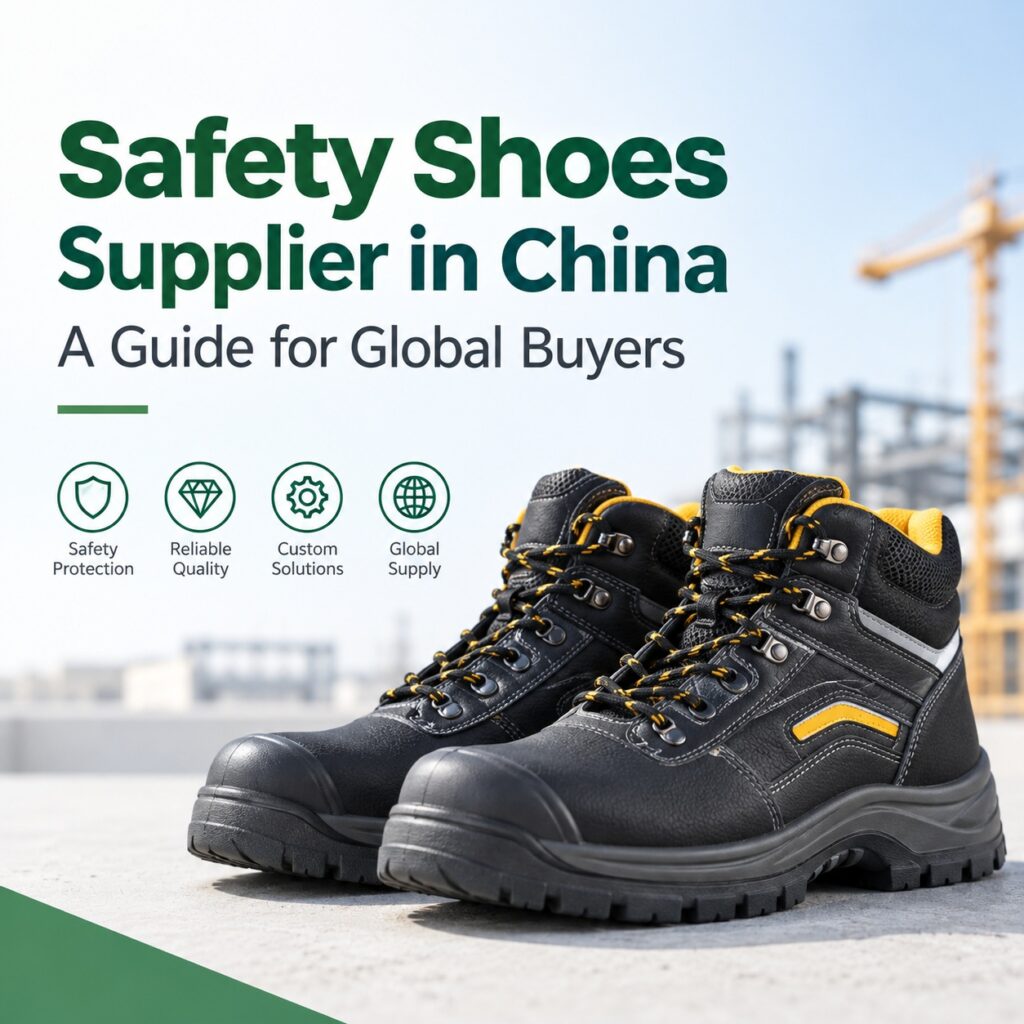
Finding a reliable safety shoes supplier in China involves more than comparing prices. For importers, distributors, wholesalers, and industrial buyers, the right sourcing partner should be able to match product specifications, verify relevant documentation, coordinate quality checks, and support international order fulfillment.
Safety footwear is widely used in construction, manufacturing, warehousing, logistics, metalworking, and other industrial environments. However, different workplaces require different combinations of toe protection, outsole performance, comfort, and resistance to specific hazards.
For international buyers, the challenge is not simply finding a supplier that offers safety shoes. It is identifying a supplier that can provide suitable products, maintain consistency between approved samples and bulk orders, and coordinate purchasing and export requirements effectively.
This guide explains how to source safety shoes from China, compare materials and standards, evaluate suppliers, reduce purchasing risks, and prepare a more effective request for quotation (RFQ).
1. Why Source Safety Shoes from China?
China has an established footwear manufacturing and export supply chain, offering a wide range of industrial safety footwear for different applications and purchasing requirements.
Depending on the supplier’s product range and manufacturing partners, buyers may be able to source several types of protective footwear, including:
- Steel toe safety shoes
- Composite toe safety shoes
- Industrial safety boots
- Lightweight safety footwear
- Anti-static and ESD footwear
- Slip-resistant work shoes
- Waterproof safety footwear
- Footwear with specialized outsole properties
For importers and distributors, sourcing from China provides access to different designs, materials, manufacturing arrangements, and customization options.
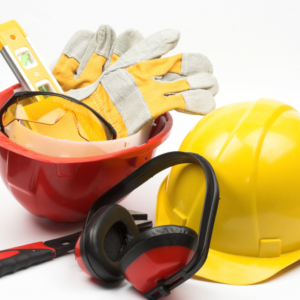
Another consideration is the ability to coordinate multiple PPE categories through one sourcing partner. Buyers who purchase safety footwear alongside protective clothing, safety gloves, safety helmets, and other workplace protection products may benefit from consolidated communication and order follow-up.
However, the advantages depend on the supplier’s actual capabilities. Product availability, customization options, quality control arrangements, and export experience should be evaluated individually rather than assumed.
2. Choose the Right Type of Safety Shoes
Before requesting a quotation, identify the hazards workers may encounter and the protection required by the intended market and workplace.
Steel Toe vs. Composite Toe Safety Shoes
Steel toe safety shoes use a metal protective toe cap. Composite toe safety shoes use non-metallic materials designed to meet applicable protective requirements.
Composite toe footwear may be preferred where non-metallic components or reduced weight are considerations. However, actual weight and comfort depend on the complete footwear construction, not only the toe cap.
When comparing these options, confirm:
- Toe-cap material and applicable protective performance
- Overall footwear weight and construction
- Available sizes and fit characteristics
- Applicable safety standard and supporting documentation
- Any specific workplace restrictions or requirements
Neither option is automatically better for every application. The choice should reflect the intended hazards, product performance, comfort, and budget.
Safety Shoes vs. Safety Boots
Safety shoes generally have a lower-cut design, while safety boots provide a higher upper that may offer additional coverage around the ankle and lower leg.
Low-cut footwear may suit many indoor industrial and warehouse applications. Boots may be preferred for certain construction, outdoor, or maintenance tasks.
The appropriate design depends on the workplace hazards, required protection, comfort, and applicable workplace rules.
Anti-Static and ESD Footwear
Anti-static footwear helps control the accumulation of electrostatic charge. Electrostatic discharge (ESD) footwear is intended for use within an appropriate ESD control system.
These products may be relevant to electronics manufacturing, component handling, and other controlled environments.
Importantly, anti-static and ESD properties do not mean that footwear provides electrical insulation. Buyers should identify the actual electrical hazards and required footwear performance before selecting a product.
Slip-Resistant and Specialized Safety Footwear
Slip-resistant footwear may be required in warehouses, factories, food processing facilities, and other workplaces where floor conditions create slipping risks.
Certain applications may also require particular outsole properties, such as resistance to heat, oil, or specified chemicals.
These characteristics should be confirmed against the intended conditions of use and relevant test evidence. General descriptions such as “anti-slip” or “oil-resistant” should not replace verification of the actual product requirements.
3. Understand Safety Footwear Standards Before Buying
Applicable safety footwear standards vary by destination market and product application. Identifying the required standard early helps buyers avoid selecting an unsuitable model or requesting the wrong documentation.
Three standards international buyers may encounter are:
EN ISO 20345 — Safety Footwear
This European standard specifies requirements for safety footwear incorporating protective toe caps designed to provide protection against defined impact and compression risks.
Buyers should confirm the applicable edition, classification, and additional properties required for their application.
ASTM F2413 — Protective Footwear
This US standard specifies performance requirements for protective footwear. Buyers should identify the applicable edition and the specific protection requirements relevant to the intended workplace and market.
EN ISO 20347 — Occupational Footwear
This European standard addresses occupational footwear that does not necessarily incorporate the protective toe caps required under EN ISO 20345.
Occupational footwear under this standard should not automatically be treated as equivalent to safety footwear with protective toe caps.
What Documents Should You Request?
When evaluating a supplier, ask for the relevant product technical specifications and supporting conformity or test documentation.
Check that:
- The documents identify the correct product or model.
- The stated standard and edition are appropriate.
- The claimed protective properties are supported by relevant evidence.
- The documents are valid and applicable to the product being offered.
- Required conformity marking and market-specific documentation are addressed where applicable.
A generic certificate image is not sufficient evidence that every model offered by a supplier meets the same requirements.
Where a specific certification or regulatory requirement applies, confirm the requirements and verify the documentation before approving the product or placing a bulk order.
4. Compare Safety Shoes Materials and Construction
Material and construction choices affect footwear weight, comfort, durability, cost, and suitability for different working conditions.
Understanding these differences helps buyers compare quotations on a like-for-like basis.
Upper Materials
Common upper materials include leather, synthetic materials, textiles, and combinations of different materials.
Leather may be considered for durability and certain industrial applications. Synthetic materials and textile constructions offer different combinations of weight, flexibility, breathability, and cost.
The appropriate option depends on the design and intended environment. If water resistance or another special property is required, specify the performance requirement and ask how it is verified.
Outsole Materials
PU, dual-density PU, rubber, and other outsole constructions are used in different types of safety footwear.
Their characteristics vary according to formulation, construction, and testing. No single outsole material is automatically the best choice for every workplace.
Consider the following factors:
- Slip-resistance performance
- Abrasion and wear requirements
- Flexibility and comfort
- Resistance to relevant workplace substances
- Heat-related performance where required
- Expected working conditions and replacement cycles
For example, a buyer sourcing footwear for a warehouse may prioritize slip resistance, comfort, and durability. A buyer supplying workers in a high-temperature industrial environment may need to assess additional outsole requirements.
Toe Caps and Additional Protective Features
The toe cap is an important component, but it is only one part of the footwear’s overall protective performance.
Depending on the application and product classification, buyers may also need to consider penetration resistance, water resistance, antistatic performance, or specialized outsole properties.
Not every model includes every feature. List the required properties explicitly instead of relying on broad product descriptions.
5. How to Evaluate a Safety Shoes Supplier in China
A supplier’s business model, technical knowledge, quality management, and communication can affect the entire purchasing experience.
Some companies manufacture footwear directly. Others work with partner factories and coordinate sourcing, specifications, quality follow-up, and export arrangements.
Neither model automatically guarantees better results. Buyers should understand how the supplier operates and how responsibilities are assigned.
Confirm the Business Model and Product Range
Ask whether the supplier manufactures the footwear directly or sources it through manufacturing partners.
If partner factories are involved, clarify who confirms specifications, coordinates production, checks product quality, and handles issues that arise before shipment.
Also confirm whether the supplier can support the requested footwear models and quantities rather than assuming that every catalogue item is readily available.
Review Technical Documentation
Request model-specific specifications and relevant supporting documents before making a purchasing decision.
Where protection standards are essential, verify the relationship between the offered product, its classification, and the supporting documentation.
If the product is intended for a regulated market, establish the documentation requirements before production begins.
Evaluate Quality Control Procedures
Ask how the supplier checks product conformity and consistency.
Depending on the order, quality checks may cover:
- Materials and workmanship
- Stitching, bonding, and outsole attachment
- Size assortment and product labeling
- Color and appearance
- Packaging and carton markings
- Consistency with the approved sample
- Required documentation
For larger orders, agree on inspection criteria, acceptable tolerances, and the inspection process before production.
Assess Communication and Order Follow-Up
A capable supplier should be able to identify missing specifications, explain available options, communicate production progress, and coordinate packaging and shipping requirements.
Clear written confirmation is particularly important when orders involve multiple styles, size assortments, custom branding, or several PPE categories.
6. How to Prevent Quality Problems in Bulk Orders
One common sourcing risk is a difference between the sample approved by the buyer and the products delivered in the bulk order.
A documented approval process can help reduce this risk.
Step 1: Prepare a Detailed Specification
Record the product model, materials, protective properties, size range, colors, branding, packaging, and applicable requirements.
Avoid relying exclusively on photographs or informal messages.
Step 2: Evaluate and Approve the Sample
Check the footwear’s fit, comfort, workmanship, appearance, and consistency with the requested specifications.
Specialized safety performance must be supported by appropriate testing and documentation. A visual inspection alone cannot verify every protective property.
Step 3: Confirm the Final Product Configuration
Before production, confirm the approved sample and written specifications. Record all agreed changes clearly.
This is particularly important for private-label orders, where changes to materials, colors, labels, or packaging may be introduced during the process.
Step 4: Agree on Pre-Shipment Inspection
Define what will be checked before shipment, who will perform the checks, and how any discrepancies will be handled.
Depending on the order, this may include appearance, workmanship, sizes, quantities, packaging, markings, and document consistency.
Any specialized testing should be arranged according to the product requirements and agreed testing procedures.
Step 5: Retain the Approved Records
Keep the final specifications, sample approval, artwork, inspection criteria, and relevant product documents together with the order records.
These records provide both parties with a clear reference if questions arise during production or after delivery.
7. How to Compare Safety Shoes Quotations
When sourcing from several suppliers, the lowest unit price is not necessarily the most economical choice.
Quotations may cover different materials, protective features, packaging arrangements, order quantities, and delivery terms.
For a meaningful comparison, request the same specifications from each supplier.
Example: Why Two Quotations May Differ
The following is an illustrative example, not a comparison of actual supplier quotations.
| Comparison item | Supplier A | Supplier B |
|---|---|---|
| Toe cap | Steel | Composite |
| Outsole | PU | Rubber |
| Product standard | To be confirmed | To be confirmed |
| Packaging | Standard shoe box | Customized shoe box |
| Quotation basis | EXW | FOB |
In this example, the quotations are not directly comparable yet. The toe cap, outsole, packaging, and delivery terms differ.
Before deciding which offer provides better value, the buyer should:
- Confirm the required protection standard and product specifications.
- Request clarification on materials and performance requirements.
- Standardize the packaging and branding requirements where possible.
- Compare quotations under equivalent Incoterms and delivery assumptions.
- Evaluate product documentation, sample quality, and order conditions alongside price.
The objective is to compare equivalent products and purchasing arrangements rather than selecting a supplier based on one number.
What Should a Complete Quotation Include?
| Cost or requirement | What to confirm |
|---|---|
| Product price | Currency, unit of sale, and quantity basis |
| Materials | Upper, outsole, and toe cap |
| Protection | Applicable standard and required properties |
| MOQ | Minimum order quantity per model or customization |
| Samples | Cost, availability, and delivery arrangements |
| Branding | Logo application and development costs |
| Packaging | Shoe boxes, labels, cartons, and markings |
| Lead time | Sample development and bulk production schedule |
| Inspection | Scope, timing, and responsibility |
| Shipping | Incoterm, destination, and cost allocation |
| Documentation | Required test reports and export documents |
Consider the Total Landed Cost
For importers and distributors, the product price is only one part of the purchasing cost.
Depending on the agreed Incoterm and shipment arrangement, additional costs may include international freight, insurance, customs duties, import taxes, customs clearance, and local delivery.
Buyers should compare the total expected cost under equivalent delivery assumptions.
Packaging also deserves attention. Shoe boxes, carton dimensions, and pairs per carton can affect shipment volume and handling requirements.
When comparing suppliers, request carton dimensions, gross weight, and packing quantities alongside the unit price.
8. OEM and Private Label Safety Shoes
Importers and distributors may want to sell safety footwear under their own brands. Depending on the selected model and manufacturing arrangement, customization may include:
- Logo printing, embossing, or other available branding methods
- Upper materials and color options
- Selected outsole colors or design options
- Customized shoe boxes and labels
- Carton markings and packing requirements
- Certain model or specification adjustments
The availability of these options depends on the product and manufacturing process.
Before confirming an OEM or private-label order, discuss the minimum order quantity, customization costs, sample development, artwork approval, and production lead time.
Confirm the final product configuration and packaging design in writing before mass production.
Changes affecting protective performance should be assessed appropriately. A cosmetic modification should not be assumed to leave all existing product evidence or conformity documentation unaffected.
9. Prepare for International Shipping
A successful sourcing project also requires clear arrangements for production, packing, payment, and shipping.
Before placing an order, confirm the following.
Production schedule: Establish when the production lead time begins, such as after deposit receipt, final specification approval, or sample approval.
Packing details: Confirm pairs per carton, carton dimensions, gross weight, and estimated shipment volume.
Export documents: Identify the documents required for the transaction, such as the commercial invoice, packing list, and bill of lading, together with any destination-specific documents.
Delivery terms: Agree on the applicable Incoterm and which party is responsible for export clearance, freight, insurance, and other costs under those terms.
Payment terms: Confirm the payment schedule and the conditions associated with production and shipment.
Pre-shipment confirmation: Agree on how product quantities, packing details, and relevant documents will be checked before dispatch.
For buyers sourcing several PPE categories, coordinating delivery schedules and packing information across products can also help simplify shipment planning.
10. Common Mistakes When Buying Safety Shoes
Selecting Products Before Defining Workplace Hazards
A product that suits a warehouse may not meet the requirements of a metalworking facility or another environment with different hazards.
Start with the intended application and required protective properties.
Comparing Different Products by Unit Price Alone
Differences in materials, construction, protection, packaging, and delivery terms can explain price differences. Confirm that quotations cover comparable products before selecting a supplier.
Accepting Documentation Without Checking Product Identification
Documents should be relevant to the actual product and its intended market. Check the model, applicable standard, scope, and validity rather than relying on generic claims.
Skipping Sample Approval
Photographs do not fully demonstrate fit, comfort, workmanship, or product construction. Approving a sample and documenting the final specifications helps establish a clear production reference.
Leaving Size Assortments and Packaging Unconfirmed
A quotation may appear attractive but become difficult to execute if size quantities, shoe-box requirements, or carton markings are not settled in advance.
Confirm these details before production.
Making Unrecorded Changes
Changes to materials, colors, construction, or protective components may affect product conformity, consistency, or documentation.
Record agreed changes and evaluate their implications before implementing them.
11. Why Consider GONOW SAFETY for PPE Sourcing?
GONOW SAFETY is a China-based PPE supplier supporting international buyers with product sourcing, order coordination, and export arrangements.
Our business model works with selected partner factories rather than presenting GONOW SAFETY as the direct manufacturer of every product.
For buyers sourcing safety footwear, the process begins with understanding the required application, specifications, target market, estimated quantity, and customization needs.
Based on the project requirements and product availability, GONOW SAFETY can coordinate with suitable sourcing partners, clarify product details, follow up on order requirements, and support shipment preparation.
For importers and distributors purchasing several PPE categories, we can also discuss coordinating safety footwear with other workplace protection products through one sourcing channel.
Product specifications, documentation, customization options, quality checks, and delivery arrangements are confirmed according to the selected products and individual order requirements.
The objective is to help buyers make informed sourcing decisions and establish clear expectations before placing an order.
12. What Information Should You Include in a Safety Shoes RFQ?
A detailed request for quotation helps suppliers understand the project and provide more accurate offers.
Use the following checklist when contacting a potential supplier:
- Destination market: Country or region where the products will be imported or used.
- Application: Construction, manufacturing, warehousing, metalworking, or another workplace.
- Required standard: Applicable footwear standard, edition, and classification, where known.
- Product design: Safety shoes or boots, toe cap type, upper material, and outsole requirements.
- Special properties: Slip resistance, antistatic performance, water resistance, or other specific requirements.
- Quantity: Estimated pairs per model and expected order frequency.
- Size assortment: Required sizes and quantities for each size.
- Branding: Logo, color, shoe box, labels, and carton markings.
- Documentation: Required product reports or conformity documents.
- Shipping: Preferred Incoterm, destination port, or delivery address, where known.
- Budget: Target price, if available.
If you already have a product specification sheet, reference sample, or product photograph, include it with the RFQ.
You do not need to have every detail finalized before making an inquiry. However, identifying the essential requirements early helps suppliers determine which options are suitable for further evaluation.
GONOW SAFETY welcomes inquiries from international importers, distributors, wholesalers, and industrial buyers looking for PPE sourcing options in China.
Contact GONOW SAFETY to discuss your safety footwear requirements and request a quotation.
Frequently Asked Questions
1. How can I find a reliable safety shoes supplier in China?
Define the required product specifications and applicable standards first. Then assess the supplier’s sourcing arrangements, technical documentation, sample quality, quality control procedures, communication, and export support.
2. Is it better to buy directly from a safety shoes factory?
Not necessarily. Direct manufacturers and sourcing suppliers have different operating models. Buyers should compare product suitability, quality management, communication, customization options, and total purchasing costs rather than relying on the business model alone.
3. What standards should I consider when importing safety shoes?
The applicable requirements depend on the destination market and intended use. EN ISO 20345, ASTM F2413, and EN ISO 20347 are examples of standards buyers may encounter. Confirm the relevant edition, product classification, and documentation requirements before ordering.
4. Can I order safety shoes with my own brand?
Many models offer private-label options, including logos, labels, colors, and packaging. Minimum quantities, customization costs, lead times, and available modifications depend on the selected product and manufacturing arrangement.
5. Should I request samples before placing a bulk order?
Yes. Samples help buyers evaluate fit, comfort, workmanship, and consistency with the requested specifications. Specialized safety performance should also be supported by appropriate test evidence and documentation.
6. What affects the price of safety shoes?
The price depends on factors such as materials, construction, protective features, product standard, order quantity, customization, and packaging. Shipping arrangements and order-specific requirements may also affect the total purchasing cost.
7. Can I source safety shoes and other PPE products from one supplier?
Depending on product availability and the supplier’s sourcing capabilities, several PPE categories may be coordinated through one supplier. Buyers should still confirm the specifications, documentation, lead times, and quality requirements for each product separately.
Conclusion
Finding a suitable safety shoes supplier in China requires a clear understanding of workplace hazards, product specifications, applicable standards, quality control, and international purchasing requirements.
For global buyers, the most effective approach is to prepare a detailed RFQ, verify the relevant product documentation, approve a representative sample, and agree on inspection and shipping arrangements before bulk production.
Comparing suppliers on these factors, rather than unit price alone, can help reduce sourcing risks and establish more consistent purchasing processes.
Looking for a safety shoes supplier in China? Contact GONOW SAFETY to discuss your PPE sourcing requirements and request a quotation.