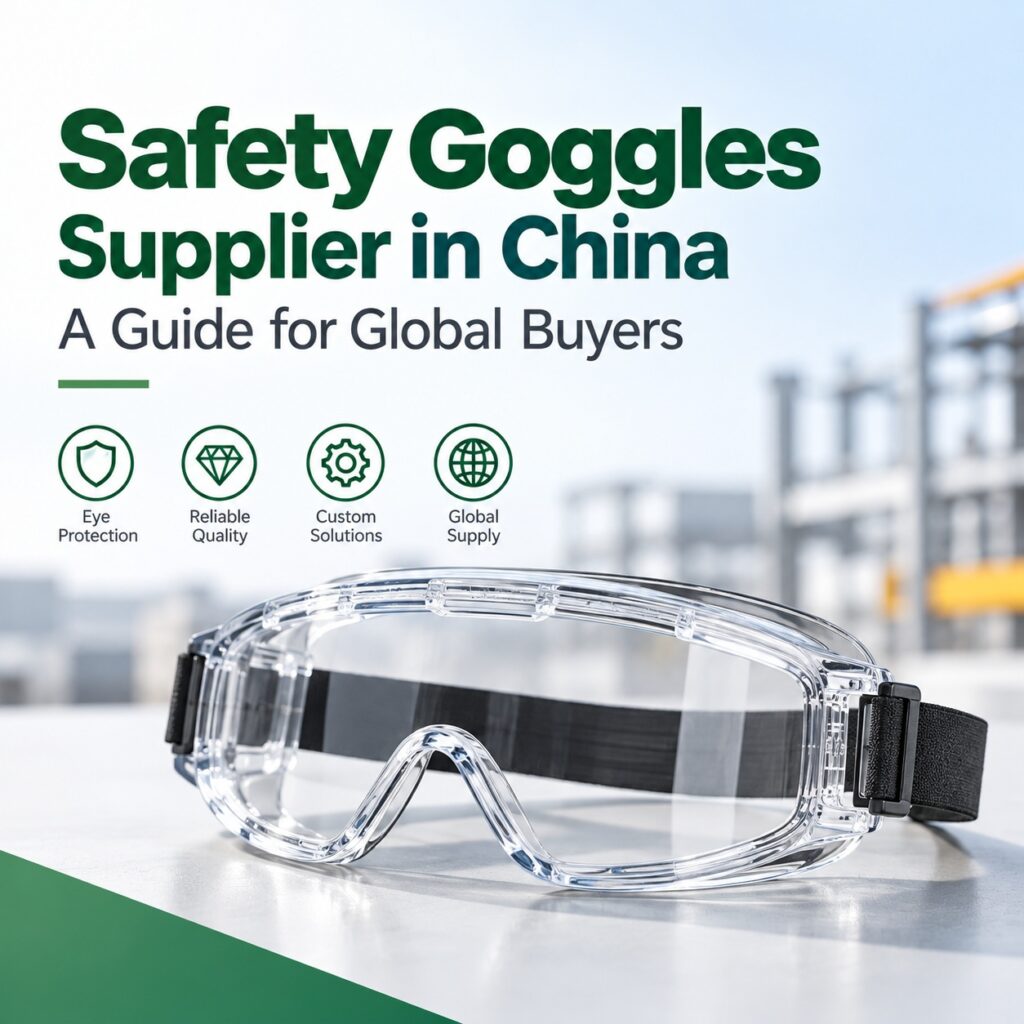
Choosing the right safety goggles is an important part of workplace eye protection. In industries such as manufacturing, construction, chemical processing, laboratories, and maintenance, workers may face hazards from flying particles, liquid splashes, dust, and other workplace exposures. The appropriate eye protection depends on the specific hazards, working conditions, and applicable safety requirements.
For importers, distributors, wholesalers, and industrial buyers, sourcing safety goggles from China can provide access to a broad range of product designs, materials, and customization options. However, price alone should not determine the purchasing decision. Product performance, documentation, comfort, quality consistency, and supplier reliability also deserve careful consideration.
This guide explains the main types of industrial safety goggles, important product features, relevant safety standards, and practical steps for selecting a safety goggles supplier in China.
1. Types of Industrial Safety Goggles
Safety goggles are designed to protect the eyes from specific workplace hazards. Understanding the available types helps buyers identify products that match their customers’ applications.
1.1 Direct-Vent and Indirect-Vent Safety Goggles
Ventilation design affects airflow and protection against workplace hazards.
- Direct-vent goggles: Allow airflow through openings designed to reduce heat buildup and fogging. They are generally intended for applications where the relevant hazards permit this type of ventilation.
- Indirect-vent goggles: Use indirect ventilation paths to help reduce the entry of liquid splashes while allowing some airflow.
- Non-vented goggles: Have no ventilation openings and may be appropriate for certain dust or liquid-splash applications, depending on the product’s verified protection capabilities.
Buyers should not assume that all vented goggles provide the same protection. The design must match the hazard assessment and the manufacturer’s specified application.
1.2 Chemical Splash Safety Goggles
Chemical splash goggles are designed to help protect the eyes from splashes of liquids, including certain chemicals. They typically feature a close-fitting design and may use indirect ventilation or a non-vented construction.
When sourcing chemical splash goggles, buyers should check the product’s intended chemical applications, material compatibility, sealing design, and relevant test documentation. No single goggle should be assumed to protect against every chemical.
1.3 Dust and Fine-Particle Safety Goggles
Dust protection goggles are used in applications such as woodworking, grinding, cement handling, and selected manufacturing processes.
Depending on the workplace, buyers may need products designed for coarse dust, fine particles, or other specific airborne hazards. Ordinary dust goggles should not automatically be considered suitable for hazardous fine dust or chemical vapors.
1.4 Anti-Fog Safety Goggles
Fogging can reduce visibility and interrupt work, particularly in hot, humid, or physically demanding environments.
Anti-fog features may include specially treated lenses, ventilation design, or a combination of both. When comparing products, ask whether anti-fog performance has been tested and documented rather than relying only on marketing descriptions.
1.5 Over-the-Glasses Safety Goggles
Over-the-glasses (OTG) goggles are designed to fit over many prescription spectacles. They can be useful in workplaces where employees need corrective eyewear and additional eye protection.
Buyers should evaluate internal clearance, compatibility with different spectacle frames, peripheral coverage, and comfort during extended wear.
2. Safety Goggles vs. Safety Glasses
Safety goggles and safety glasses serve related purposes, but their designs and typical applications differ.
| Feature | Safety Goggles | Safety Glasses |
|---|---|---|
| Design | Close-fitting around the eyes | Eyewear-style frame |
| Side coverage | Typically provides broader coverage around the eyes | Depends on frame and side-shield design |
| Liquid splash protection | Suitable when specifically designed and tested for splash hazards | Generally not the preferred choice for substantial splash exposure |
| Dust protection | Certain designs provide improved coverage against dust | Coverage depends on the design |
| Ventilation | Direct-vent, indirect-vent, or non-vented options | Usually more open |
| Prescription eyewear | OTG models are available | Prescription safety eyewear is available |
The best choice depends on the hazard assessment. Neither product type should be selected solely by appearance or price, and a face shield may also be required for certain hazards.
3. Key Features to Compare When Buying Safety Goggles
Before requesting quotations, define the technical requirements that matter most for the intended application.
Lens Material
Common lens materials include:
- Polycarbonate: Frequently used for impact-resistant protective eyewear because of its combination of low weight and impact performance.
- Other approved lens materials: May be used for specific optical, chemical, or application requirements, depending on the product design.
Material alone does not establish compliance. Buyers should verify the complete product’s performance, including the lens, frame, and construction.
Lens Color and Optical Properties
Clear lenses are commonly selected for indoor work and environments requiring good visibility. Tinted or specialized lenses may be appropriate for particular lighting conditions or applications.
For outdoor use, check whether the lens provides the required UV protection. For welding, infrared radiation, or other intense light sources, use purpose-designed protection with the correct filter rating. General-purpose safety goggles should not be substituted for specialized welding or laser protection.
Anti-Fog and Anti-Scratch Performance
Anti-fog and anti-scratch treatments can improve usability and help maintain visibility. However, these features are not interchangeable: a scratch-resistant lens is not necessarily anti-fog, and an anti-fog coating does not establish impact protection.
Ask the supplier to identify which features are included in the quoted model and whether supporting test information is available.
Frame Design and Comfort
A suitable frame should provide the intended coverage without creating excessive pressure or interfering with other PPE.
For bulk orders, evaluate:
- Fit and sealing around the eye area
- Adjustable straps and secure positioning
- Compatibility with helmets, respirators, and prescription glasses
- Weight and comfort during prolonged use
- Ease of cleaning and maintenance
Comfort matters because poorly fitting eyewear may be removed or worn incorrectly during work.
4. Safety Goggles Standards: What Buyers Need to Know
Safety standards are an important part of product selection, but the correct requirements depend on the destination market and intended use.
European Market
EN 166 is a widely referenced European standard for personal eye protection. Buyers may also encounter the newer EN ISO 16321 series, which addresses eye and face protection.
When purchasing for Europe, confirm the applicable current standard, conformity-assessment requirements, product markings, and documentation for the exact product. Do not assume that an older EN 166 reference automatically establishes compliance with every current market requirement.
United States Market
ANSI/ISEA Z87.1 is an important American standard covering occupational and educational eye and face protection. The 2025 edition is the latest edition identified by ANSI’s standards store as of October 2026.
The standard addresses requirements and testing for protection against hazards such as impact, liquid splashes, and certain forms of non-ionizing radiation. Buyers should confirm the required product markings and performance level for their application.
OSHA’s eye and face protection requirements also require employers to provide appropriate protection for identified workplace hazards. See OSHA 29 CFR 1910.133 and the ANSI/ISEA Z87.1-2025 standard listing.
What Should Importers Verify?
Before placing an order, ask the supplier for the documentation applicable to the specific model, such as:
- Relevant test reports and product specifications
- Applicable conformity documents
- Product markings and traceability information
- Instructions for use, cleaning, and maintenance
- Evidence supporting any claimed impact, splash, UV, or anti-fog performance
A supplier’s general statement that a product meets a standard is not a substitute for checking the documentation and scope of coverage for the actual model being purchased.
5. How to Choose a Reliable Safety Goggles Supplier in China
A reliable supplier should be able to understand your requirements, communicate product specifications clearly, and coordinate the documentation and delivery process.
Confirm Product and Application Experience
Ask whether the supplier can provide the specific types of goggles you need, including chemical splash, dust protection, anti-fog, or OTG designs.
If you are sourcing several PPE categories, a supplier with a broader product range may simplify purchasing coordination and consolidate orders.
Review Product Documentation
Request the relevant technical documents before confirming an order. Check that model numbers, product descriptions, markings, and supporting documents are consistent.
If certification or testing is a purchasing requirement, verify that the documents apply to the exact model and intended market.
Evaluate Quality Control
Discuss how the supplier checks incoming materials, finished products, packaging, and order consistency. For repeat orders, establish approved samples and written specifications so that subsequent deliveries can be compared with the original requirements.
Compare Total Purchasing Costs
The lowest unit price does not always produce the best overall value. Consider product quality, packaging, customization, inspection, delivery arrangements, and the cost of handling quality problems.
Request quotations based on the same specifications and order quantities to make comparisons meaningful.
Check Communication and Order Coordination
For international orders, clear communication about samples, production schedules, packaging, shipping marks, and export documents can help reduce misunderstandings.
Buyers should confirm responsibilities and lead times before placing a bulk order.
6. OEM, ODM, and Customization Options
For importers and distributors developing their own product ranges, customization may help distinguish their offerings.
Depending on the model and supplier capabilities, available options may include:
- Logo printing or other approved branding
- Customized packaging and labels
- Selected frame or strap colors
- Product combinations for different customer segments
- Adjustments to specifications where technically feasible
Before starting a customized order, confirm the available options, minimum order quantity (MOQ), sample cost, production lead time, artwork approval process, and any additional testing or conformity requirements.
Changes to product materials or construction may affect performance and compliance. Customized products should therefore be reviewed against the requirements applicable to the final design.
7. Bulk Purchasing Checklist for Safety Goggles
To obtain an accurate quotation, buyers should prepare a clear request for quotation (RFQ).
Include the following information wherever possible:
- Product type: Chemical splash goggles, dust goggles, anti-fog goggles, OTG goggles, or another specified design.
- Intended application: For example, grinding, laboratory work, manufacturing, or liquid handling.
- Target market: Country or region where the products will be sold or used.
- Required standard: Applicable standard, performance level, and documentation requirements.
- Lens specifications: Material, color, optical requirements, and requested coatings.
- Frame and strap: Design, fit requirements, and compatibility with other PPE.
- Customization: Logo, label, color, or packaging requirements.
- Quantity: Estimated order quantity and expected repeat-order volume.
- Packaging: Individual packaging, inner cartons, master cartons, and labeling instructions.
- Commercial terms: Target delivery date, destination, and requested Incoterms.
Providing these details helps the supplier recommend suitable models and prepare a more comparable quotation.
8. Why Source Safety Goggles from GONOW SAFETY?
GONOW SAFETY supports international buyers seeking personal protective equipment for industrial and workplace applications.
As a PPE trading and supply company, GONOW SAFETY can help customers coordinate product selection, sourcing, customization requests, and export arrangements according to their project requirements.
For buyers sourcing safety goggles alongside other PPE categories, working with a coordinated supplier may simplify communication and purchasing management.
When discussing a safety goggles order with GONOW SAFETY, buyers can share their intended application, target market, required standards, estimated quantity, and customization needs. These details provide a starting point for evaluating suitable products and quotation options.
Specific product availability, customization options, documentation, and lead times should be confirmed for each order.
9. Frequently Asked Questions
What types of safety goggles are available for industrial use?
Common options include chemical splash goggles, dust goggles, anti-fog goggles, vented and non-vented designs, and over-the-glasses models. The appropriate choice depends on the workplace hazards and required performance.
What is the difference between safety goggles and safety glasses?
Safety goggles generally fit more closely around the eyes and can offer broader coverage against certain dust and splash hazards. Safety glasses have an eyewear-style design and may be appropriate for other impact hazards when correctly selected. Always check the protection provided by the specific model.
Which safety goggles standard should I request?
This depends on the destination market and application. Buyers may encounter EN 166 and EN ISO 16321 references in European sourcing, while ANSI/ISEA Z87.1 is important in the United States. Confirm the current applicable requirements before ordering.
Can safety goggles be customized with a company logo?
Some models support logo printing, custom packaging, or selected color options. Availability, MOQ, cost, and lead time depend on the model and supplier. Confirm that customization will not compromise the product’s performance or required compliance.
What information is needed for a bulk quotation?
At minimum, provide the intended application, product type, target market, required standard, estimated quantity, lens and frame preferences, packaging requirements, and delivery destination.
How can I evaluate a safety goggles supplier in China?
Review the supplier’s product range, technical documentation, quality-control process, communication, customization capabilities, and ability to coordinate international orders. Request samples where appropriate and verify that the documents apply to the exact product.
Conclusion
Selecting the right safety goggles involves more than comparing prices. Buyers should consider the workplace hazard, product design, lens performance, comfort, applicable standards, documentation, and supplier reliability.
For importers and distributors, a clear RFQ and a structured supplier evaluation process can make bulk sourcing more efficient and help reduce purchasing risks.
Looking for a safety goggles supplier in China? Contact GONOW SAFETY with your product requirements, target market, estimated quantity, and customization needs to discuss suitable sourcing options for your business.