Spray painting is widely used in construction, automotive repair, shipbuilding, metal fabrication, and industrial coating applications. While it provides an efficient and smooth finishing process, it also exposes workers to serious airborne hazards that are often invisible.
Paint mist, organic vapors, and chemical fumes can quickly enter the respiratory system if proper protection is not used. Choosing the right respiratory protection is therefore essential to ensure worker safety, compliance, and long-term health protection.
Why Respiratory Protection Is Critical in Spray Painting
During spray painting operations, the following hazards are commonly present:
- Paint overspray and fine mist particles
- Organic solvent vapors (VOC exposure)
- Isocyanates (in PU coatings)
- Poor ventilation in enclosed spaces
- Long exposure duration during continuous spraying
These substances can cause:
- Dizziness and headaches
- Respiratory irritation
- Long-term lung damage
- Occupational asthma
- Reduced concentration and fatigue
Because many paint chemicals are not immediately noticeable by smell, workers often underestimate the risk.
Main Types of Respiratory Protection for Spray Painting
1. Disposable Respirators (Light Duty Work)
Disposable masks such as N95 or P2 respirators are suitable only for very light spray painting tasks with low chemical exposure.
Best for:
- Short-duration work
- Low-toxicity paints
- Outdoor or well-ventilated environments
Limitations:
- No protection against organic vapors
- Not suitable for industrial coating or PU paints
2. Half-Face Respirators with Cartridges
Half-face respirators are one of the most commonly used solutions in industrial spray painting.
They are typically equipped with:
- Organic vapor cartridges (OV)
- Particulate filters (P95 / P100)
Best for:
- General industrial painting
- Automotive refinishing
- Metal coating work
Advantages:
- Reusable and cost-effective
- Better sealing than disposable masks
- Replaceable filters for different environments
Limitations:
- Does not protect eyes
- Requires correct cartridge selection
3. Full-Face Respirators
Full-face respirators provide both respiratory and eye protection in one system.
Best for:
- High-concentration paint fumes
- Confined or poorly ventilated spaces
- Industrial coating applications
Advantages:
- Full facial sealing
- Eye protection included
- Higher protection factor than half masks
Limitations:
- Higher cost
- More maintenance required
4. Powered Air-Purifying Respirators (PAPR)
PAPR systems use a battery-powered blower to deliver filtered air into the mask or hood.
Best for:
- Long-duration spray painting
- High-exposure environments
- Industrial-scale coating projects
Advantages:
- High comfort (positive airflow reduces breathing resistance)
- Excellent protection level
- Reduced heat buildup inside mask
Limitations:
- Higher investment cost
- Requires battery maintenance
5. Supplied-Air Respirators (SAR)
Supplied-air systems provide clean air from an external source, making them the highest level of respiratory protection.
Best for:
- Confined space spray painting
- Shipyards and tank coating
- Highly toxic coating environments
Advantages:
- Maximum protection level
- Independent of ambient air quality
Limitations:
- Requires air supply system
- Limited mobility
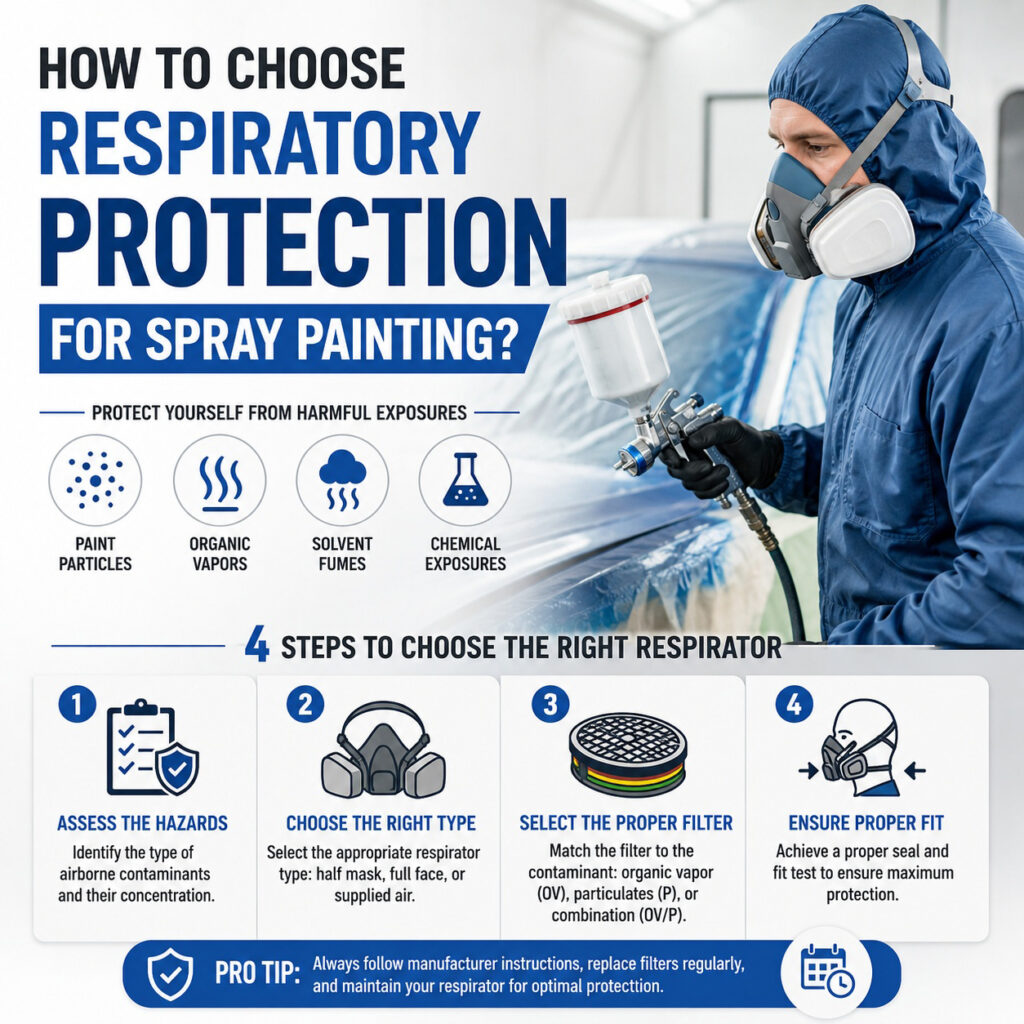
How to Choose the Right Respirator
When selecting respiratory protection for spray painting, consider the following key factors:
1. Type of Paint Used
- Water-based paints → lower protection level
- Solvent-based paints → organic vapor cartridges required
- PU coatings → high-level respiratory protection required
2. Work Environment
- Open outdoor areas → half mask may be sufficient
- Indoor workshop → full-face or cartridge respirator
- Confined space → PAPR or supplied air system
3. Exposure Duration
- Short tasks → disposable or half mask
- Continuous spraying → PAPR or full-face respirator
4. Ventilation Conditions
Poor ventilation significantly increases vapor concentration, requiring higher protection levels.
5. Comfort and Fit
A respirator must:
- Fit tightly to the face
- Be comfortable for long use
- Not interfere with visibility or communication
Poor fit = reduced protection, even with high-end equipment.
Common Mistakes Workers Make
Many spray painting workers still make critical PPE mistakes:
- Using dust masks instead of vapor respirators
- Not replacing cartridges regularly
- Wearing poorly fitted respirators
- Ignoring eye protection when using half masks
- Using the same filter for different chemical types
These mistakes significantly reduce protection effectiveness.
GONOW SAFETY Recommendation
For industrial spray painting projects, most contractors typically combine:
- Half-face respirator + organic vapor cartridges (standard work)
- Full-face respirator (higher exposure environments)
- PAPR systems (long-term or large-scale projects)
A proper respiratory protection system should always be matched with:
- Coveralls
- Chemical-resistant gloves
- Eye protection (if not full-face)
Final Thoughts
Choosing the right respiratory protection for spray painting is not only about compliance, but about ensuring long-term health and safe working conditions. Different paint types, environments, and exposure levels require different protection solutions.
By selecting the correct respirator system, companies can significantly reduce occupational risks while improving worker comfort and productivity.