
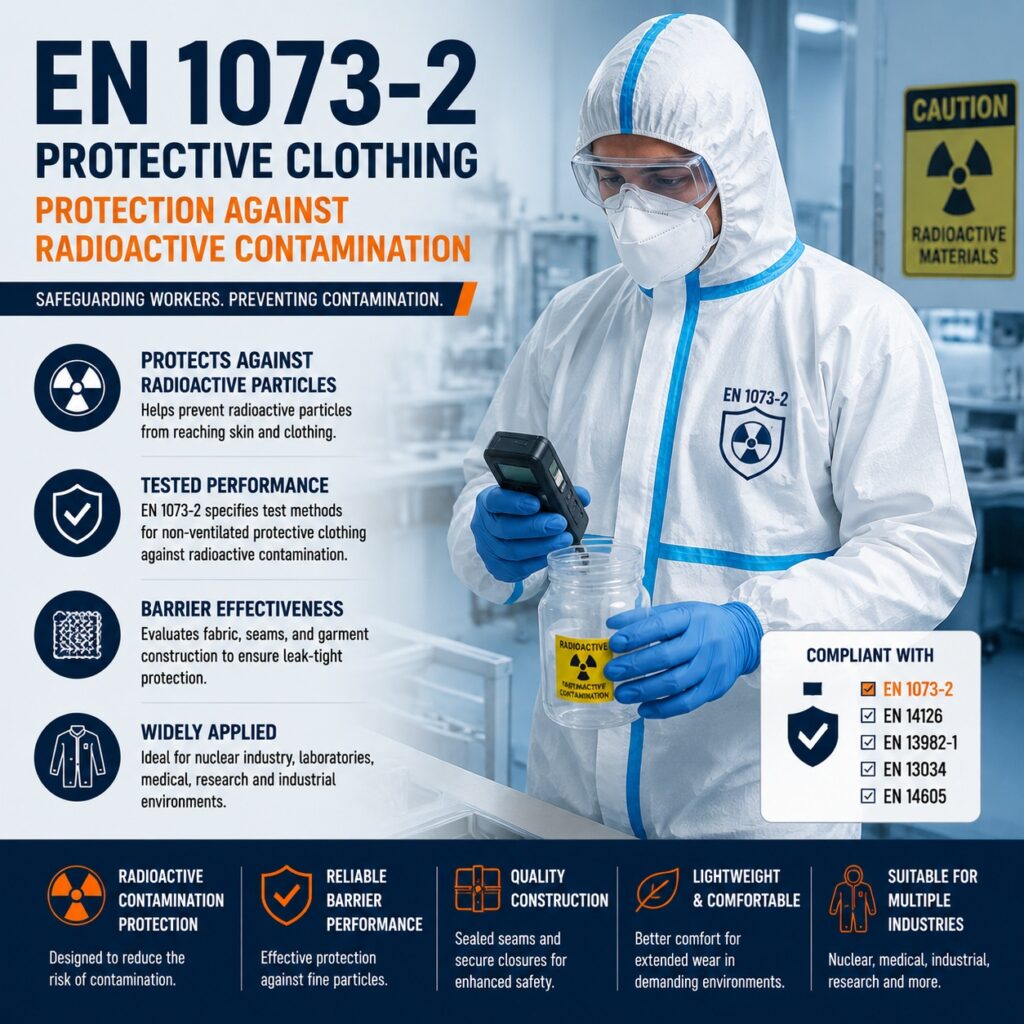
Workers in nuclear, medical, industrial, and research environments may face risks from radioactive contamination.
To reduce exposure risks, protective clothing must provide an effective barrier against radioactive particles and contaminated environments.
EN 1073-2 is an important European standard that specifies requirements for non-ventilated protective clothing against radioactive contamination.
Unlike radiation shielding equipment that protects against radiation energy, EN 1073-2 focuses on preventing radioactive particles from reaching the skin and personal clothing.
This guide explains what EN 1073-2 means, how protective clothing is tested, and how companies can select suitable contamination protection PPE.
What Is EN 1073-2?
EN 1073-2: Protective Clothing Against Radioactive Contamination
EN 1073-2 specifies requirements and test methods for protective clothing designed to protect workers against radioactive contamination.
The standard focuses on:
- Protection against radioactive particles
- Prevention of contamination transfer
- Barrier performance of protective clothing
It applies mainly to:
- Disposable protective coveralls
- Chemical protective garments
- Particle protection suits
What Does EN 1073-2 Protect Against?
EN 1073-2 protects against:
Radioactive Contamination
This refers to radioactive materials being deposited on:
- Skin
- Clothing
- Equipment
- Working surfaces
The purpose of protective clothing is to prevent radioactive particles from entering the body through:
- Skin contact
- Inhalation
- Accidental transfer
EN 1073-2 vs Radiation Protection
A common misunderstanding is that EN 1073-2 clothing blocks radiation.
This is not the main purpose.
EN 1073-2 protective clothing:
✅ Prevents radioactive particles from contaminating workers
It does not:
❌ Provide shielding against radiation such as gamma rays or X-rays
Radiation shielding requires other solutions such as specialized protective materials and equipment.
How Is EN 1073-2 Protective Clothing Tested?
EN 1073-2 evaluates the protective performance of garments against radioactive particle contamination.
Important factors include:
1. Protection Factor
The standard evaluates how effectively clothing prevents radioactive particles from passing through the garment.
Higher performance indicates better contamination control.
2. Material Barrier Performance
The fabric and garment construction are assessed for:
- Particle resistance
- Leakage prevention
- Protective integrity
3. Complete Garment Performance
Testing considers:
- Seams
- Closures
- Overall design
Because protection depends not only on fabric but also on garment construction.
Types of EN 1073-2 Protective Clothing
Common EN 1073-2 compliant products include:
Disposable Protective Coveralls
Used for:
- Nuclear maintenance
- Laboratory environments
- Contaminated areas
Particle Protective Suits
Designed for environments involving:
- Radioactive dust
- Contaminated particles
- Hazardous powders
EN 1073-2 Applications
Nuclear Industry
Workers may use EN 1073-2 clothing during:
- Nuclear facility maintenance
- Decontamination operations
- Inspection work
Medical and Research Facilities
Applications include:
- Radioisotope laboratories
- Research environments
- Controlled areas
Industrial Applications
Used where radioactive contamination risks may exist, including:
- Specialized manufacturing
- Testing facilities
- Research centers
EN 1073-2 vs Other Protective Clothing Standards
| Standard | Protection Focus |
|---|---|
| EN 1073-2 | Radioactive particle contamination |
| EN 14126 | Biological hazards |
| EN 13982 | Dry particle chemicals |
| EN 13034 | Limited liquid chemicals |
| EN 14605 | Liquid chemical protection |
EN 1073-2 vs EN 13982
These two standards are sometimes confused.
EN 1073-2
Designed for:
- Radioactive contamination particles
Main concern:
Prevent radioactive particles from reaching workers.
EN 13982
Designed for:
- Hazardous dry particles
Main concern:
Protect against chemical dust and industrial particles.
Both may involve particle protection, but the hazards are different.
How to Choose EN 1073-2 Protective Clothing?
When selecting contamination protective clothing, consider:
1. Identify the Hazard
Evaluate:
- Type of radioactive material
- Contamination level
- Workplace environment
2. Choose the Correct Garment Design
Consider:
- Coverall type
- Hood design
- Seam protection
- Closure system
3. Consider Comfort and Wearability
Workers may wear protective clothing for long periods.
Important factors:
- Breathability
- Mobility
- Weight
- Fit
Common Mistakes When Selecting EN 1073-2 PPE
Mistake 1: Confusing Contamination Protection With Radiation Shielding
EN 1073-2 prevents radioactive contamination but does not replace radiation shielding equipment.
Mistake 2: Ignoring Seam Design
Protection depends on:
- Fabric
- Seams
- Closures
- Overall garment design
Mistake 3: Selecting PPE Without Risk Assessment
The correct protective clothing depends on:
- Hazard type
- Exposure conditions
- Workplace requirements
How GONOW SAFETY Supports Protective Clothing Solutions
At GONOW SAFETY, we provide protective clothing solutions designed for demanding industrial environments.
Our product range includes:
- Chemical protective clothing
- Disposable coveralls
- Particle protection suits
- Biological protective clothing
- Customized PPE solutions
We help customers select suitable protective equipment based on:
- Workplace hazards
- Industry requirements
- International standards
From chemical protection to contamination control, GONOW SAFETY supports safer workplaces with reliable PPE solutions.
Conclusion
EN 1073-2 is an important standard for protective clothing used in environments where radioactive contamination risks exist.
In simple terms:
- EN 1073-2 protects workers against radioactive particle contamination
- It helps prevent contamination transfer
- It does not provide radiation shielding
Understanding the correct protective clothing standard helps companies select suitable PPE for specialized working environments.