
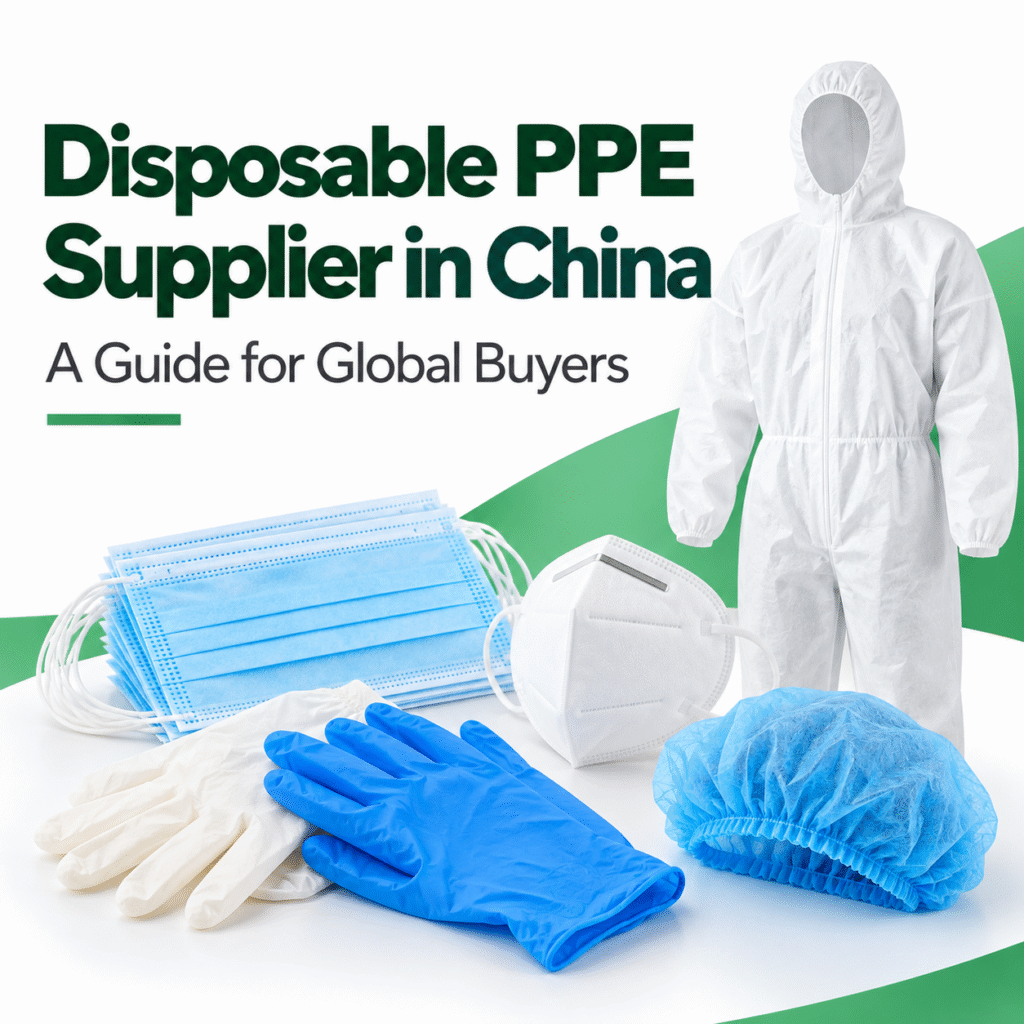
Sourcing disposable personal protective equipment (PPE) from China can help importers, distributors, industrial suppliers, and procurement teams build a flexible product portfolio for different workplace needs. However, choosing the right supplier involves more than comparing unit prices. Buyers must also evaluate product specifications, applicable standards, material quality, packaging, order quantities, and export coordination.
As a PPE sourcing partner, GONOW SAFETY helps international buyers explore disposable protection products for industrial, hygiene, cleaning, food-processing, and other workplace applications, with product specifications and documentation confirmed according to individual requirements.
This guide explains what to consider when selecting a disposable PPE supplier in China, how to compare quotations, and how to prepare a clear request for quotation (RFQ) for bulk purchasing.
1. What Products Can a Disposable PPE Supplier Provide?
Disposable PPE includes protective products designed for single use or limited use under specified conditions. The appropriate product depends on the workplace hazard, intended application, required protection level, and applicable regulations.
When sourcing from China, buyers may consider the following product categories.
Disposable Protective Coveralls
Disposable coveralls help protect workers’ clothing and skin from dust, dirt, splashes, and other workplace contaminants, depending on the garment’s design and tested performance.
Common options include:
- Lightweight nonwoven coveralls for general-purpose tasks
- Hooded coveralls with elasticated cuffs and ankles
- Coveralls with front zippers and protective flaps
- Protective garments designed for specific chemical or particle hazards
Buyers should specify the material, fabric weight, seam construction, closure design, sizing, and required protection classification. A basic nonwoven coverall should not be assumed to provide chemical or biological protection without suitable evidence.
Disposable Gloves
Disposable gloves are widely used in cleaning, food handling, laboratories, healthcare-related tasks, and selected industrial processes.
Common materials include:
- Nitrile: Often selected for its combination of dexterity, durability, and resistance to many oils and chemicals, depending on formulation and thickness.
- Latex: Offers flexibility and a close fit but may present an allergy risk for some users.
- Vinyl: Often considered for lower-risk, short-duration tasks where its performance is suitable.
- Polyethylene (PE): Commonly used for light-duty handling and hygiene applications.
The right choice depends on the substance being handled, exposure duration, puncture or tear risks, fit, and applicable product requirements. Chemical resistance must be verified for the specific glove and chemical involved.
Disposable Masks and Respirators
This category includes different products that should not be treated as interchangeable.
- Disposable hygiene or procedure masks: Used for designated hygiene and splash-related applications according to their intended purpose.
- Filtering facepiece respirators: Designed to provide respiratory protection against specified airborne particles when the product, fit, and conditions of use are appropriate.
- Other disposable face coverings: May serve general hygiene purposes without providing certified respiratory protection.
For filtering facepiece respirators, buyers should confirm the required classification, applicable market approval, manufacturer or model identification, packaging details, and supporting documents.
For example, N95 is a US respirator classification associated with NIOSH approval, while FFP2 and FFP3 are filtering facepiece classes under the relevant European framework. These designations should not be treated as interchangeable without verifying the applicable requirements.
Other Disposable Protective Products
Depending on the supplier’s product range, bulk buyers may also source:
- Disposable shoe and boot covers
- Bouffant caps and other hair covers
- Disposable aprons and protective gowns
- Sleeve covers
- Other single-use protective accessories
Combining suitable products into one procurement plan may help buyers coordinate packaging, documentation, and shipment arrangements across several product categories.
2. How to Match Disposable PPE to the Application
Before requesting a quotation, identify the actual workplace hazards and intended use. A product that works well for dust control may be unsuitable for chemical splash protection or other higher-risk applications.
| Application | Products to consider | Key purchasing checks |
|---|---|---|
| General manufacturing and maintenance | Coveralls, gloves, masks, shoe covers | Dust exposure, abrasion, fit, and task duration |
| Cleaning operations | Disposable gloves, aprons, coveralls | Cleaning chemicals, contact time, splash exposure |
| Food processing | Suitable disposable gloves, aprons, hair covers | Food-contact requirements, hygiene, material suitability |
| Laboratories | Gloves, gowns, coveralls, respirators where required | Chemical compatibility, contamination control, task-specific risk |
| Healthcare-related applications | Suitable masks, gloves, gowns, protective accessories | Intended use, applicable medical or PPE requirements |
| Pharmaceutical and clean environments | Selected gloves, coveralls, masks, shoe and hair covers | Particle control, cleanliness, packaging, and process requirements |
These are sourcing starting points, not blanket protection recommendations. The final product selection must match the risk assessment, the user’s procedures, and the destination market’s requirements.
3. Which Standards and Documents Should Buyers Check?
Compliance is a critical part of disposable PPE procurement. Requirements differ by product type, intended use, and destination market. A supplier should be able to clarify which standards apply to the exact model being quoted and provide relevant supporting documentation where required.
Examples of standards and regulatory frameworks buyers may encounter include:
- EN 149: Filtering half masks for protection against particles.
- EN 374 series: Protective gloves against chemicals and micro-organisms, depending on the applicable part.
- EN 14126: Protective clothing against infective agents.
- EN 13034: Protective clothing offering limited protective performance against liquid chemicals, associated with Type 6 clothing.
- EN ISO 13982-1: Protective clothing against airborne solid particles, associated with Type 5 clothing.
- EN 14605: Protective clothing against liquid chemicals, including applicable Type 3 and Type 4 designs.
- US NIOSH approval requirements: Relevant to approved respirators, including N95 filtering facepiece respirators.
- Applicable medical-device requirements: May apply to certain masks, gloves, gowns, and other products according to their intended purpose and destination market.
Not every disposable PPE product requires the same certification. For example, a general-purpose disposable coverall is not automatically a Type 5 or Type 6 protective garment, and a hygiene mask is not automatically a certified respirator.
Before placing an order, confirm:
- The exact product model and intended use.
- The standard or regulatory requirement applicable to that product.
- Whether the supporting document applies to the quoted model and configuration.
- Whether the destination market requires additional registration, marking, or documentation.
- Whether the packaging and product labels meet the agreed requirements.
Certificates, test reports, declarations, and approvals serve different purposes. Buyers should verify the document type, issuing organization, validity where applicable, and product-model consistency rather than relying on a generic statement that a product is “certified.”
4. How to Evaluate a Disposable PPE Supplier in China
A competitive quotation is useful, but a reliable supplier evaluation should cover product suitability, quality consistency, communication, and delivery coordination.
Product Range and Sourcing Capability
If you purchase several disposable PPE categories, look for a supplier that can coordinate the required products and clarify which items are available from its established sourcing network.
Ask whether the supplier can support your required materials, sizes, specifications, packaging configurations, and applicable standards. Confirm any limitations before comparing offers.
Quality Control and Product Consistency
Disposable PPE is often purchased in large quantities, making consistency between samples and bulk shipments particularly important.
Discuss the following points with the supplier:
- Approved product specifications and reference samples
- Material, dimensions, weight, and workmanship requirements
- Size tolerances and acceptable defect criteria
- Inspection arrangements and inspection records
- Packaging integrity and carton identification
- Procedures for handling nonconforming products
For products requiring specific protection performance, visual inspection alone is not sufficient. Relevant test reports and product documentation should be reviewed as part of the quality-assurance process.
Documentation and Traceability
For regulated or specification-sensitive products, confirm what documents can be provided before production or shipment. Depending on the product and order, these may include technical specifications, applicable test reports, declarations, product labels, packing lists, and commercial invoices.
Where traceability is required, agree on how model numbers, production batches, carton labels, and supporting records will be identified.
Communication and Order Coordination
A supplier should be able to clarify technical questions, record approved specifications, communicate changes, and coordinate multiple products within one order.
For buyers sourcing from several categories, clear responsibility for quotations, samples, production follow-up, inspection, packing, and shipping can help reduce avoidable misunderstandings.
5. How to Compare Bulk Disposable PPE Quotations
The lowest unit price does not necessarily represent the lowest purchasing cost. Two quotations may cover products with different materials, thicknesses, protection classifications, packaging quantities, or documentation.
For a meaningful comparison, request quotations based on the same specification.
| Comparison item | What to confirm |
|---|---|
| Product specification | Material, design, size, weight, and model |
| Protection requirements | Applicable standard, classification, and supporting evidence |
| Unit price | Price per piece, pair, box, or carton |
| Packaging | Units per inner box, bag, and export carton |
| Minimum order quantity | MOQ by product, size, color, or packaging configuration |
| Customization | Logo, labels, printed bags, cartons, and artwork costs |
| Samples | Sample price, shipping cost, and approval process |
| Lead time | Sample preparation, production, inspection, and packing |
| Inspection | Agreed quality criteria and inspection arrangements |
| Shipping terms | Incoterm, named place or port, and cost responsibilities |
| Documentation | Available product and export documents |
Understand the Total Landed Cost
For importers and distributors, the final cost may include more than the quoted product price.
Depending on the agreed trade terms, calculate:
Total landed cost = Product cost + Packaging and customization + Origin charges + Freight and insurance where applicable + Import duties and taxes + Destination charges
The components included in the supplier’s quotation depend on the agreed Incoterm and named place. Avoid adding the same charge twice, and confirm which costs are excluded from each offer.
A slightly higher unit price may still be commercially reasonable if the product specification, packaging, documentation, and delivery arrangement better match your requirements.
6. OEM, Private Label, and Custom Packaging
For distributors, importers, and established PPE brands, customization can help create a consistent product offering.
Subject to product availability and supplier capability, customization may include:
- Logo printing on selected packaging
- Private-label product labels
- Customized inner boxes and export cartons
- Product information and barcode labels
- Selected colors, sizes, and packaging quantities
- Combined product assortments for distribution
Before approving customized packaging, provide the final artwork, brand guidelines, label content, barcode information where applicable, and carton-marking requirements.
Also confirm the minimum order quantity, setup costs, sample or artwork approval process, and production lead time. Customized products may require longer preparation than standard items.
Any claims printed on the packaging, including protection levels, standards, and certification marks, should be accurate and supported by the applicable product documentation.
7. How to Order Disposable PPE in Bulk from China
A clear purchasing process helps buyers reduce specification errors and improve delivery planning.
Step 1: Define Your Product Requirements
Prepare a list of products, target quantities, sizes, materials, intended applications, and destination markets. Identify any mandatory standards or documentation requirements.
Step 2: Request a Comparable Quotation
Ask the supplier to quote the specified models and packaging configurations. Confirm the price basis, MOQ, sample costs, production lead time, and trade terms.
Step 3: Review Samples and Documents
Where samples are necessary, evaluate the material, fit, workmanship, packaging, and relevant product performance information. Check the documents against the exact product model and intended market.
Step 4: Approve the Final Specifications
Record the agreed model, materials, sizes, tolerances, labels, packaging, carton quantities, inspection criteria, and required documents in the purchase order or specification sheet.
Step 5: Confirm Production and Quality Checks
Agree on the production schedule, inspection method, acceptable quality criteria, and procedure for resolving discrepancies. For customized products, approve the final artwork and packaging before mass production.
Step 6: Coordinate Packing and Shipment
Confirm carton dimensions, quantities, gross and net weights, shipping marks, and shipping arrangements. Ensure the commercial invoice, packing list, and any required product or regulatory documents are consistent with the actual shipment.
For repeat orders, retain the approved specifications and reference samples where appropriate. This makes it easier to compare subsequent deliveries and identify changes.
8. Why Source Disposable PPE from GONOW SAFETY?
GONOW SAFETY supports overseas buyers sourcing personal protective equipment from China. For disposable PPE projects, the purchasing process starts with understanding the required application, product specification, target market, and order quantity.
Our sourcing approach focuses on:
- Product selection: Clarifying the required disposable PPE categories and specifications.
- Quotation coordination: Organizing product pricing, packaging details, and order quantities for comparison.
- Customization support: Discussing suitable private-label and packaging options according to project requirements.
- Documentation coordination: Confirming the availability of relevant product documents before order confirmation.
- Order and shipment coordination: Aligning approved specifications, packing information, and export arrangements.
Product availability, customization options, documentation, minimum order quantities, and lead times depend on the specific item and order. We recommend confirming these details before placing a purchase order.
If you are sourcing disposable gloves, protective coveralls, masks, or other single-use protective products, send us your product list and purchasing requirements. Our team can review the request and help coordinate a suitable quotation.
9. Frequently Asked Questions
What disposable PPE products can I source from China?
Common categories include disposable gloves, filtering facepiece respirators, hygiene masks, protective coveralls, gowns, aprons, shoe covers, and hair covers. Availability and applicable standards depend on the specific product and supplier.
What is the MOQ for disposable PPE?
There is no universal MOQ for all disposable PPE products. It varies according to the product, material, size assortment, packaging configuration, customization requirements, and sourcing arrangement. Ask for the MOQ for each item rather than assuming one quantity applies to the entire order.
Can I order different disposable PPE products from one supplier?
Yes, a supplier or sourcing partner may be able to coordinate several product categories in one order. Confirm product availability, individual MOQs, packaging requirements, lead times, and documentation for each item before consolidating the order.
Can disposable PPE be customized with my company logo?
Selected products and packaging may support logo printing, private labels, or customized cartons. The available options, minimum order quantities, artwork requirements, and lead times should be confirmed before production.
What documents should I request from a disposable PPE supplier?
Depending on the product and destination market, relevant documents may include technical specifications, applicable test reports, declarations or approvals, product labels, and shipping documents. The exact requirements should be confirmed for each product rather than applying one document checklist to every category.
How can I verify the quality of disposable PPE before bulk purchasing?
Start by approving the exact product specification and, where appropriate, a reference sample. Review relevant technical documents, agree on inspection criteria, and confirm how bulk goods will be checked. For products requiring certified performance, verify the applicable evidence rather than relying solely on appearance or sample handling.
How long does bulk disposable PPE sourcing take?
Lead time depends on product availability, order quantity, customization, sample approval, production scheduling, inspection, and shipping arrangements. Request a schedule that separates sample preparation, production, inspection, and dispatch so you can plan inventory more accurately.
10. Request a Disposable PPE Quotation
Choosing the right disposable PPE supplier in China requires a balance of product suitability, quality consistency, documentation, price transparency, and delivery coordination.
For global importers, distributors, and industrial buyers, a well-defined specification is the starting point for a reliable quotation and a smoother purchasing process.
Looking for a disposable PPE supplier in China?
Contact GONOW SAFETY with your product list, estimated quantities, target market, required standards, and packaging preferences. We can review your requirements and coordinate suitable sourcing options for your project.
GONOW SAFETY — Safety, Quality, Comfort.