
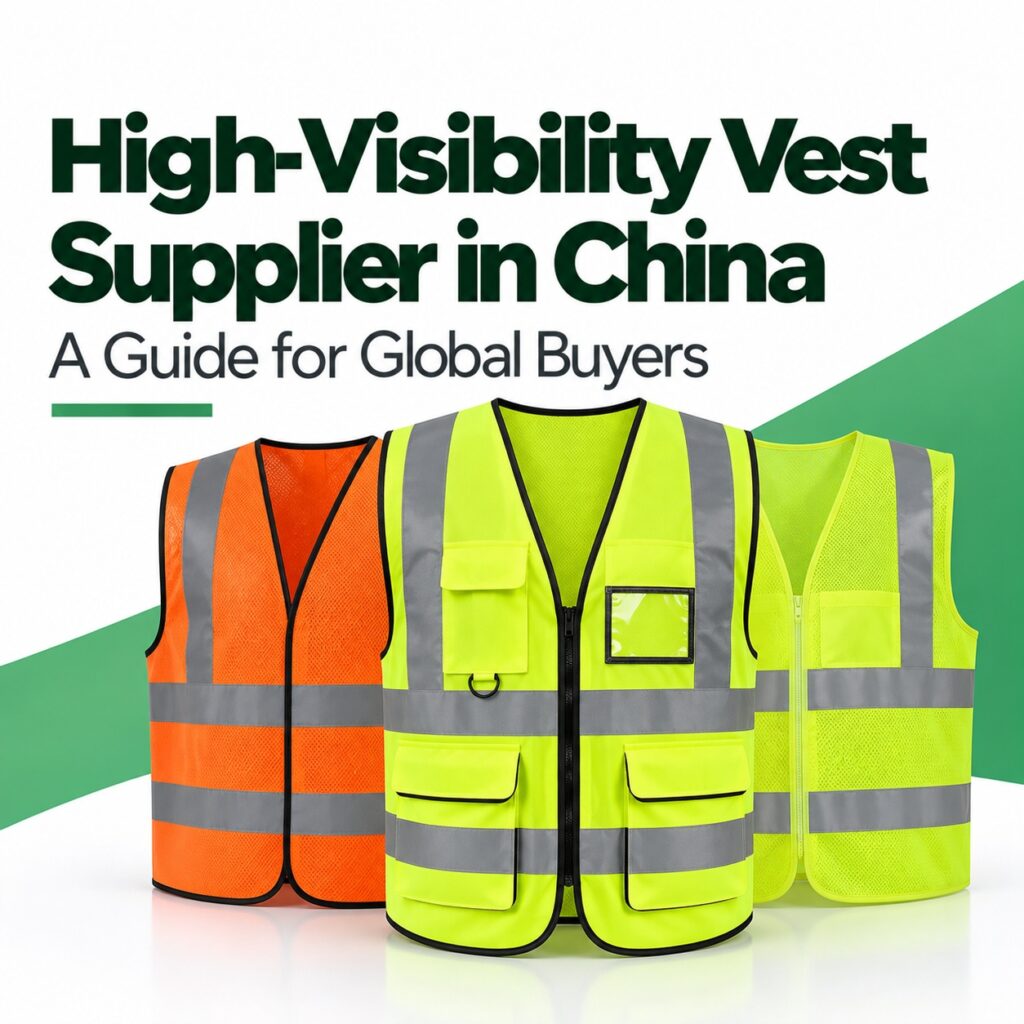
High-visibility safety vests are essential workwear for employees working around moving vehicles, construction equipment, warehouses, roadways, and other environments where visibility is important. For distributors, importers, contractors, and industrial safety suppliers, choosing the right high-visibility vest supplier in China involves more than comparing unit prices. Buyers also need to evaluate garment materials, reflective tape, applicable safety standards, customization options, quality control, and delivery reliability.
China offers a wide range of high-visibility safety vest sourcing options, from basic reflective vests for general workwear to more specialized garments designed for particular working environments. Understanding the differences between these products can help buyers prepare clearer specifications and make better purchasing decisions.
This guide explains how to select high-visibility vests, compare suppliers, and manage bulk orders for international markets.
1. What Is a High-Visibility Safety Vest?
A high-visibility safety vest is a garment designed to make the wearer more noticeable against the surrounding environment. It typically combines a fluorescent background fabric with retroreflective tape or other visibility-enhancing materials.
Fluorescent fabric helps improve visibility in daylight and some low-light conditions, while retroreflective materials return light toward its source, helping the wearer stand out when illuminated by vehicle headlights or other lights.
High-visibility vests are commonly used in:
- Road construction and traffic management
- Building and infrastructure projects
- Warehousing and logistics
- Transportation and delivery operations
- Railway and airport ground operations
- Utilities and maintenance
- Industrial facilities and equipment-handling areas
The appropriate vest depends on the hazards, working conditions, and requirements of the end user’s workplace. A basic reflective vest may be suitable for general visibility needs, while certain roadwork or other higher-risk applications may require garments that meet specific performance standards.
2. Common Types of High-Visibility Vests
Before requesting a quotation, buyers should identify the vest style and intended application.
Basic Reflective Safety Vests
Basic reflective vests are commonly used for warehouses, visitor identification, general maintenance, and other environments where improved visibility is needed.
Typical features include lightweight fabric, reflective strips, front fastening, and a simple sleeveless design. These vests are often suitable for projects that prioritize economical pricing and straightforward customization.
High-Visibility Construction Vests
Construction safety vests may include multiple reflective strips, reinforced pockets, identification panels, and additional storage for pens, tools, or small equipment.
When selecting a construction vest, buyers should consider the worker’s tasks, the required visibility level, the durability of the fabric, and whether the garment must comply with a particular standard.
Traffic Safety Vests
Traffic safety vests are designed for workers who operate near roads, vehicles, or temporary traffic-control areas.
Depending on the intended use and applicable requirements, buyers may need to specify the garment’s design, background material, reflective material, coverage, and required performance class. Do not assume that every brightly colored vest with reflective tape is suitable for regulated roadwork.
Multi-Pocket Safety Vests
Multi-pocket vests are useful for technicians, inspectors, warehouse personnel, and workers who need to carry small tools or documents.
Pocket layout, closure type, stitching, and fabric strength should be confirmed before bulk production. More pockets can improve functionality but may also affect weight, cost, and lead time.
Custom High-Visibility Vests
Custom vests allow buyers to specify company logos, colors, pocket configurations, reflective tape layouts, and identification areas.
For distributors and private-label brands, customization can help create a consistent product range. However, changes to garment design or material placement may affect conformity with a specified standard, so compliance should be checked for the final garment configuration.
3. How to Choose the Right Vest Material
The fabric affects comfort, durability, appearance, and cost. Buyers should select material based on the working environment and expected service life rather than price alone.
| Material option | Common characteristics | Purchasing considerations |
|---|---|---|
| Polyester mesh | Lightweight and breathable | Useful in warm conditions and for general visibility applications |
| Solid polyester fabric | More coverage and a structured appearance | Consider fabric weight, tear resistance, and comfort |
| Mesh and solid-fabric combination | Balances ventilation with selected solid panels | Confirm panel placement and stitching quality |
| Specialized workwear fabric | May provide additional properties when specifically designed and tested | Request relevant technical documentation rather than assuming protection from the fabric name |
For hot climates, breathable mesh may be a practical option. For garments requiring more pockets or a more structured design, solid polyester or a combination construction may be preferable.
Buyers should request fabric composition, fabric weight, color specifications, and available test information when these details are important to the order.
4. Reflective Tape: What Should Buyers Check?
Reflective tape is a key component of many high-visibility vests. However, reflective appearance alone does not prove that a vest meets a particular safety standard.
When comparing suppliers, check the following:
- Tape type: Confirm the specified reflective material and its intended application.
- Tape width: State the required width in the technical specification.
- Tape layout: Confirm the horizontal and vertical strip arrangement.
- Retroreflective performance: Request applicable test reports when required.
- Attachment quality: Check stitching, bonding, and consistency across the garment.
- Durability: Confirm any required performance after washing or other conditioning.
- Documentation: Verify that test evidence relates to the actual material and finished garment being supplied.
The required tape configuration and material area can vary according to the applicable standard and garment class. Buyers should not select tape solely by appearance or assume that a wider strip automatically makes a vest compliant.
5. Understanding High-Visibility Vest Standards
Safety standards are an important part of procurement, particularly when garments will be used in regulated workplaces or supplied to customers with formal compliance requirements.
EN ISO 20471
EN ISO 20471 specifies requirements and test methods for high-visibility clothing intended to make the wearer visually conspicuous in different light conditions. Its requirements address factors such as background color, retroreflection, minimum material areas, and material placement.
The standard includes different garment performance classes. The appropriate class should be determined from the intended application and relevant risk assessment rather than chosen simply because a higher class sounds better.
Official reference: ISO 20471 – High visibility clothing.
ANSI/ISEA 107
ANSI/ISEA 107 is an American standard for high-visibility safety apparel. It addresses garment design, testing, performance, and labeling. The standard uses garment types and performance classes that reflect the intended work setting and the visibility characteristics of the finished garment.
For example, the intended environment and work activity are relevant when determining whether a garment is appropriate for off-road work, roadway use, or public-safety applications.
Official reference: ANSI/ISEA 107-2020.
How Buyers Should Verify Compliance
When a customer requires a compliant high-visibility vest, confirm:
- The exact standard and edition required by the destination market or end user.
- The applicable garment type and performance class.
- Whether test reports or certificates are required for the finished garment.
- Whether the reports cover the actual fabric, reflective tape, design, and construction being ordered.
- Whether labeling and product documentation meet the customer’s requirements.
A supplier’s general statement that its product is “CE compliant” or “ANSI compliant” should not replace verification of relevant documents. Requirements may differ by market, application, and product configuration.
6. How to Evaluate a High-Visibility Vest Supplier in China
A reliable supplier should be able to clarify product specifications, coordinate production, manage quality checks, and provide accurate documentation for the order.
Product Range and Specification Support
Check whether the supplier can offer the vest styles, materials, colors, sizes, pocket layouts, and reflective tape configurations required for your market.
A supplier that can clearly explain available options can help buyers avoid specification gaps before production begins.
Quality Control
Ask how the supplier checks incoming materials, garment dimensions, stitching, reflective tape placement, fasteners, and finished-product appearance.
For repeat orders, confirm whether approved samples, reference specifications, or inspection criteria can be used to maintain consistency between batches.
Documentation and Traceability
Depending on the order, buyers may need product specifications, material information, test reports, packaging details, inspection records, or other supporting documents.
Ask which documents are available for the exact model being quoted. Do not assume that a report for one vest design automatically covers another design or material combination.
Customization and Communication
For customized orders, confirm the logo artwork, printing or transfer method, logo position, garment color, size range, packaging, and approval process in writing.
Clear communication before production can reduce avoidable revisions and delays.
Order Coordination and Delivery
For international orders, discuss minimum order quantities, sample availability, production lead time, packaging, shipment arrangements, and trade terms.
If you work with a sourcing or trading company rather than a direct manufacturer, clarify how it coordinates production, quality checks, documents, and communication with the relevant production partners.
7. What to Include in a High-Visibility Vest Quotation Request
A detailed RFQ helps suppliers quote comparable products and reduces the risk of unexpected changes after order confirmation.
Use the following checklist when requesting a quotation:
| Specification | Details to confirm |
|---|---|
| Vest style | Basic, construction, traffic, multi-pocket, or custom |
| Intended application | Warehouse, roadwork, construction, logistics, or other use |
| Standard and class | Exact required standard, edition, type, and class, where applicable |
| Fabric | Composition, fabric type, weight, and color |
| Reflective tape | Material specification, width, layout, and required test evidence |
| Size range | Required sizes and size chart |
| Closure | Zipper, hook-and-loop fastening, or other specified closure |
| Pockets | Quantity, dimensions, and positions |
| Logo | Artwork, location, dimensions, and application method |
| Packaging | Individual bags, carton quantity, carton markings, and other requirements |
| Order quantity | Quantity by style, color, and size |
| Samples | Availability, cost, and sample lead time |
| Delivery | Production lead time, shipment destination, and requested trade terms |
| Documents | Required test reports, declarations, labels, and inspection records |
Providing these details allows suppliers to quote based on the same requirements, making price comparisons more meaningful.
8. OEM, Private Label, and Customization Options
Many importers and distributors need high-visibility vests that match their own brand or customer specifications.
Depending on the supplier’s capabilities and the selected product, customization may include:
- Company logo printing or transfer
- Custom garment colors
- Reflective tape arrangement
- Pocket design and placement
- Size labels and care labels
- Individual packaging and carton markings
- Private-label branding
Before approving a customized order, request a sample or a clear pre-production confirmation where appropriate. Check the logo artwork, color, dimensions, sewing, and garment construction.
For products intended to meet a specific safety standard, verify that the final customized design remains within the required compliance scope. A change to tape placement, material area, or garment construction may affect conformity.
9. Common Mistakes When Buying High-Visibility Vests
Choosing by Price Alone
Two vests that look similar in a photograph may differ in fabric weight, reflective material, stitching, sizing, and documentation. Compare the full specification rather than only the unit price.
Assuming Every Reflective Vest Meets a Standard
Bright fabric and reflective strips do not automatically establish conformity with EN ISO 20471 or ANSI/ISEA 107. Verify the specific product and supporting documents when compliance is required.
Providing Incomplete Specifications
If buyers do not specify pocket layout, size range, logo position, packaging, or required class, suppliers may make different assumptions. This makes quotations difficult to compare and increases the risk of rework.
Overlooking Sample Approval
A sample helps confirm appearance, fit, materials, and construction before a large order. For repeat orders, retain an approved reference sample or agreed specification when practical.
Failing to Confirm Packaging and Labeling
Packaging, size labels, carton markings, and shipping marks can affect warehouse handling and customer requirements. Confirm them before production rather than waiting until goods are ready to ship.
10. How to Place a Bulk Order for High-Visibility Vests
A clear purchasing process helps reduce delays and specification disputes.
- Define the application. Identify the work environment, visibility hazards, and destination-market requirements.
- Prepare the specification. Confirm style, fabric, reflective tape, colors, sizes, logo, and packaging.
- Request comparable quotations. Send the same specification to each supplier.
- Review samples and documents. Check product construction and verify any required compliance evidence.
- Approve the final details. Confirm the quotation, artwork, size breakdown, packaging, delivery terms, and inspection criteria.
- Monitor production and quality. Agree on the checks required before shipment.
- Confirm shipping documents. Ensure quantities, carton details, labels, and shipping information match the order.
For large or customized orders, written approval of the final specification is particularly important.
11. Sourcing High-Visibility Vests with GONOW SAFETY
GONOW SAFETY supports international buyers sourcing personal protective equipment and workplace safety products from China.
For high-visibility vest projects, buyers can use a clear product specification to discuss available styles, fabric options, reflective tape configurations, customization requirements, packaging, and order quantities.
Before confirming an order, buyers should verify the availability of the requested model, the applicable documentation, sample requirements, production lead time, and final quotation.
Whether you are sourcing standard reflective vests for general workplace use or developing a customized product for distribution, a well-defined specification helps make supplier evaluation more efficient and supports clearer communication throughout the purchasing process.
Looking for a high-visibility vest supplier in China? Contact GONOW SAFETY with your required quantity, target market, product specifications, and customization needs to discuss suitable sourcing options.
Frequently Asked Questions
What is the difference between a reflective vest and a high-visibility safety vest?
The terms are often used interchangeably in general purchasing. However, a vest marketed as reflective does not necessarily meet a particular high-visibility safety standard. Buyers should verify the required performance level and documentation for the intended application.
Which high-visibility vest standard should I choose?
The appropriate standard depends on the destination market, work environment, customer requirements, and risk assessment. EN ISO 20471 is commonly specified in international and European procurement, while ANSI/ISEA 107 is used in the United States. Confirm the exact applicable requirements before ordering.
What fabric is best for high-visibility vests?
Polyester mesh is often selected when breathability and low weight are priorities. Solid polyester and combination constructions may be preferred for different coverage, pocket, or durability requirements. The best choice depends on the intended application and the complete garment specification.
Can high-visibility vests be customized with a company logo?
Many vest styles can be customized with logos, labels, colors, and pocket layouts. Confirm the available options with the supplier and check whether the final design affects any required conformity assessment.
What information should I provide when requesting a quotation?
Provide the quantity, vest style, intended application, required standard and class if applicable, fabric, reflective tape requirements, size range, logo details, packaging, destination, and required documents. The more complete the specification, the easier it is to compare quotations accurately.
How can I check the quality of a high-visibility vest supplier?
Review product specifications, sample quality, material information, quality-control procedures, relevant test documents, customization capability, and delivery arrangements. For products requiring compliance, ensure that the supporting evidence applies to the exact garment being supplied.
Final Note: High-visibility vest sourcing should begin with the intended work environment and required performance, not simply the garment’s color or price. Clear specifications, relevant documentation, and sample approval help buyers compare suppliers and manage bulk orders with greater confidence.