
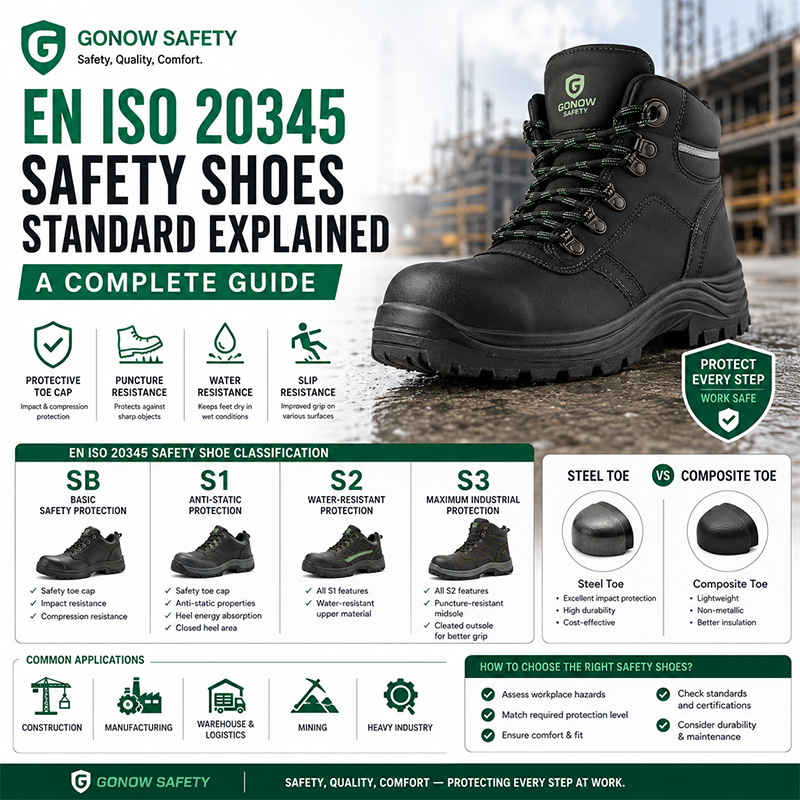
Safety footwear is one of the most important types of PPE in industrial workplaces. Construction workers, factory operators, warehouse employees, and many other professionals rely on safety shoes to protect their feet from impact, crushing, sharp objects, and environmental hazards.
However, not all safety shoes provide the same level of protection.
Understanding EN ISO 20345 helps companies select the correct footwear based on workplace risks and protection requirements.
This safety shoes standards guide explains:
- What EN ISO 20345 means
- Different safety shoe protection levels
- The differences between SB, S1, S2, and S3
- How to choose the right safety boots and steel toe shoes
What Is EN ISO 20345?
EN ISO 20345 is an international standard that defines the basic requirements and testing methods for safety footwear used in workplaces.
Safety shoes certified according to EN ISO 20345 must include:
- Protective toe caps
- Impact resistance
- Compression resistance
- Basic durability requirements
The protective toe cap is designed to protect against falling objects and crushing forces.
Common toe protection materials include:
- Steel toe caps
- Composite toe caps
- Aluminum toe caps
Safety footwear complying with EN ISO 20345 is widely used in:
- Construction
- Manufacturing
- Warehousing
- Logistics
- Mining
- Heavy industry
Why Are Safety Shoes Standards Important?
Choosing footwear only based on appearance or price may result in insufficient protection.
Safety shoes standards help buyers understand:
- What hazards the footwear can protect against
- The level of protection provided
- Whether the shoes are suitable for specific workplaces
For example:
A warehouse worker may only need basic impact protection, while a construction worker may require waterproofing and puncture resistance.
Selecting the correct safety rating ensures workers receive suitable protection.
EN ISO 20345 Safety Shoe Classification
Safety shoes are divided into different categories according to their protective features.
The most common classifications include:
| Classification | Protection Features |
|---|---|
| SB | Basic safety protection |
| S1 | Anti-static + energy absorption |
| S2 | Water-resistant upper + S1 features |
| S3 | Puncture resistance + water-resistant + S2 features |
SB Safety Shoes: Basic Protection
SB represents the basic safety requirement under EN ISO 20345.
Protection includes:
✓ Protective toe cap
✓ Impact resistance
✓ Compression resistance
Suitable for:
- Light industrial environments
- Warehouses
- General workplaces
SB safety shoes provide essential protection but do not include additional features such as anti-static properties or water resistance.
S1 Safety Shoes: Anti-Static Protection
S1 safety shoes include all SB requirements plus additional protection features.
Main features:
✓ Protective toe cap
✓ Anti-static properties
✓ Energy absorption in the heel area
✓ Closed heel area
S1 footwear helps reduce static electricity buildup and improves comfort during long working hours.
Suitable applications:
- Manufacturing factories
- Assembly lines
- Indoor workshops
- Warehouses
Common users:
- Production workers
- Machine operators
- Maintenance personnel
S2 Safety Shoes: Water Resistance Protection
S2 safety shoes include all S1 features with additional water-resistant properties.
Protection includes:
✓ Toe protection
✓ Anti-static properties
✓ Heel energy absorption
✓ Water-resistant upper material
S2 footwear is suitable for workplaces where workers may experience moisture or wet conditions.
Applications:
- Food processing
- Outdoor work
- Logistics
- Manufacturing facilities
S3 Safety Shoes: Maximum Industrial Protection
S3 safety shoes provide one of the highest protection levels commonly used in industrial workplaces.
S3 includes:
✓ All S2 protection features
✓ Puncture-resistant midsole
✓ Cleated outsole for better grip
Protection against:
- Falling objects
- Sharp materials
- Wet environments
- Uneven surfaces
Suitable industries:
- Construction
- Heavy manufacturing
- Mining
- Engineering projects
For many construction and industrial applications, S3 safety boots are the preferred choice.
Comparison of EN ISO 20345 Safety Ratings
| Feature | SB | S1 | S2 | S3 |
|---|---|---|---|---|
| Safety toe cap | ✓ | ✓ | ✓ | ✓ |
| Impact protection | ✓ | ✓ | ✓ | ✓ |
| Compression protection | ✓ | ✓ | ✓ | ✓ |
| Anti-static | ✕ | ✓ | ✓ | ✓ |
| Heel energy absorption | ✕ | ✓ | ✓ | ✓ |
| Water-resistant upper | ✕ | ✕ | ✓ | ✓ |
| Puncture resistance | ✕ | ✕ | ✕ | ✓ |
Steel Toe Shoes vs Composite Toe Safety Shoes
When choosing safety footwear, buyers often compare steel toe shoes and composite toe shoes.
Steel Toe Shoes
Advantages:
- Excellent impact protection
- High durability
- Cost-effective
Common applications:
- Construction
- Manufacturing
- Heavy industry
Composite Toe Shoes
Advantages:
- Lightweight
- Non-metallic
- Better thermal insulation
Suitable for:
- Electrical environments
- Security applications
- Cold environments
The right choice depends on workplace hazards and user requirements.
How to Choose the Right Safety Boots?
When selecting safety boots, consider the following factors:
1. Workplace Environment
Ask:
- Is the workplace wet or dry?
- Are there sharp objects?
- Are workers exposed to chemicals?
- Is there a risk of heavy impact?
Examples:
Construction:
→ S3 safety boots
Indoor manufacturing:
→ S1 or S2 safety shoes
Outdoor logistics:
→ S2 or S3 footwear
2. Required Protection Level
Match footwear features with hazards:
| Hazard | Recommended Feature |
|---|---|
| Falling objects | Safety toe cap |
| Sharp materials | Puncture-resistant sole |
| Wet environment | Water-resistant upper |
| Slippery surfaces | Anti-slip outsole |
| Electrical risks | Appropriate electrical protection |
3. Comfort and Fit
Workers may wear safety footwear for 8–12 hours daily.
Important factors:
- Correct sizing
- Breathable materials
- Lightweight construction
- Cushioning support
- Flexible outsole
Comfortable footwear improves worker compliance and reduces fatigue.
Common Applications of EN ISO 20345 Safety Footwear
Construction Industry
Recommended:
- S3 safety boots
- Steel toe shoes
- Puncture-resistant footwear
Protection against:
- Falling materials
- Nails
- Uneven surfaces
Manufacturing Industry
Recommended:
- S1 safety shoes
- S2 safety shoes
Protection against:
- Machinery hazards
- Impact risks
- Workplace debris
Warehouse and Logistics
Recommended:
- S1 or S2 safety shoes
Protection against:
- Dropped objects
- Long walking periods
- Material handling risks
How to Maintain Safety Shoes?
Proper maintenance extends the service life of safety footwear.
Tips:
✓ Clean shoes regularly
✓ Check toe cap condition
✓ Inspect soles for damage
✓ Replace worn footwear promptly
✓ Store in a dry environment
Safety shoes should be replaced when they no longer provide reliable protection.
Conclusion: Choose the Right Safety Footwear for Workplace Protection
Understanding EN ISO 20345 is essential when selecting safety footwear for industrial environments.
Different protection levels provide different functions:
- SB – Basic safety protection
- S1 – Anti-static protection
- S2 – Water-resistant protection
- S3 – Puncture resistance and higher industrial protection
Choosing the correct safety rating helps workers stay protected while maintaining comfort and productivity.
At GONOW SAFETY, we provide reliable safety boots, steel toe shoes, and industrial safety footwear for construction, manufacturing, logistics, and industrial applications.
Safety, Quality, Comfort — protecting every step at work.