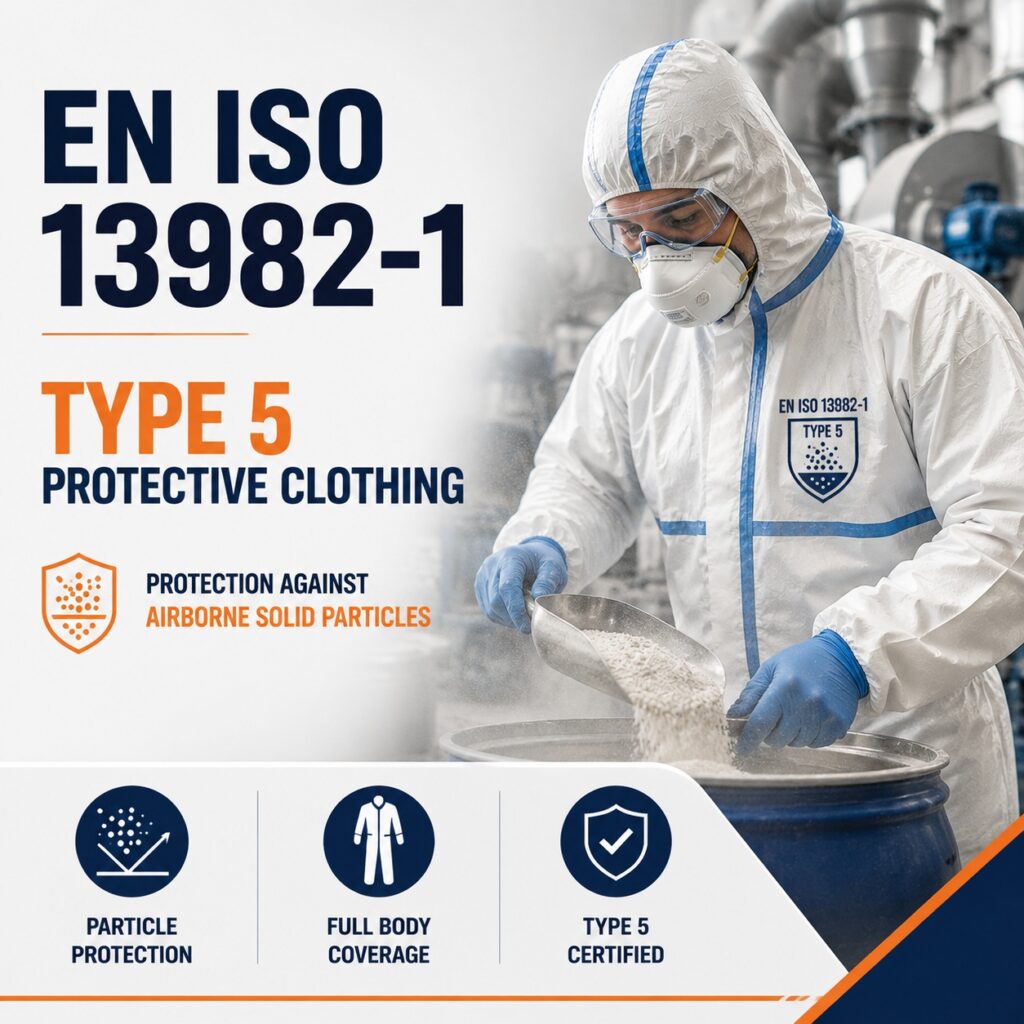
Many industrial environments involve exposure to hazardous solid particles, including dust, fibers, powders, and other airborne contaminants. Without suitable protective clothing, these particles can come into contact with workers’ skin and clothing, increasing health risks.
Industries such as chemical processing, pharmaceutical manufacturing, construction, and industrial cleaning often require protective garments designed specifically for particle hazards.
EN ISO 13982-1 is an important standard that defines requirements for protective clothing against airborne solid particles.
This guide explains what EN ISO 13982-1 means, how Type 5 protective clothing works, and how companies can choose suitable particle protection PPE.
What Is EN ISO 13982-1?
EN ISO 13982-1, also known as Type 5 protective clothing, specifies the requirements for protective clothing designed to protect workers against hazardous airborne solid particles.
It focuses on preventing particles from penetrating through:
- Fabric materials
- Seams
- Closures
- Garment openings
The standard is commonly applied to disposable or limited-use protective coveralls used in environments where workers may encounter harmful dust or particles.
What Does Type 5 Protection Mean?
Type 5 represents protection against dry solid particles suspended in the air.
Examples include:
- Industrial dust
- Fibers
- Powder particles
- Hazardous solid contaminants
Type 5 protective clothing is designed to reduce particle penetration and limit contamination of workers’ skin and personal clothing.
Where Is EN ISO 13982-1 Protective Clothing Used?
1. Pharmaceutical Manufacturing
Pharmaceutical production requires strict contamination control.
Workers may need protection from:
- Active pharmaceutical ingredients (APIs)
- Fine powders
- Chemical particles
Common PPE:
- Type 5 coveralls
- Gloves
- Respiratory protection
2. Chemical and Industrial Processing
Workers handling powders and solid chemicals may face particle exposure.
Applications include:
- Chemical powder production
- Raw material handling
- Industrial mixing processes
3. Construction and Renovation
Construction workers may encounter:
- Cement dust
- Mineral fibers
- Fine particles
Protective coveralls help reduce dust contamination during high-exposure tasks.
4. Spray Painting and Surface Treatment
Processes such as sanding and surface preparation generate airborne particles.
Type 5 protective clothing helps protect workers and prevents contamination of workwear.
How Does EN ISO 13982-1 Protect Workers?
1. Particle Barrier Performance
The garment material is tested to evaluate resistance against particle penetration.
Important factors include:
- Fabric structure
- Material density
- Protective design
2. Sealed Garment Design
Particle protection depends not only on fabric but also on garment construction.
Important features:
- Elastic cuffs
- Elastic hood
- Covered zippers
- Reinforced seams
These designs help reduce entry points for particles.
3. Full Body Coverage
Type 5 coveralls typically provide:
- Head coverage
- Arm protection
- Leg protection
- Body protection
This helps minimize contamination during dusty operations.
EN ISO 13982-1 vs EN 13034: What Is the Difference?
Many buyers compare these two standards because both are used for protective coveralls.
| Standard | Protection Type | Main Hazard |
|---|---|---|
| EN ISO 13982-1 Type 5 | Dry particle protection | Dust and airborne solid particles |
| EN 13034 Type 6 | Limited liquid protection | Chemical liquid splashes |
EN ISO 13982-1
Suitable for:
- Dust
- Fibers
- Powder particles
Examples:
- Pharmaceutical production
- Cement handling
- Industrial cleaning
EN 13034
Suitable for:
- Liquid chemical splashes
- Low-level chemical exposure
Examples:
- Chemical maintenance
- Cleaning operations
Type 5 vs Type 6: Which One Should You Choose?
The choice depends on the workplace hazard.
Choose Type 5 when:
✔ Workers face airborne dust
✔ Solid particles are the main risk
✔ Contamination control is required
Choose Type 6 when:
✔ Workers face liquid splashes
✔ Chemical solutions are involved
✔ Short-term exposure is expected
In some workplaces, both risks may exist.
A combined solution may require:
EN ISO 13982-1 + EN 13034
Key Features of EN ISO 13982-1 Protective Clothing
Lightweight Materials
Many Type 5 coveralls use lightweight fabrics to provide protection while maintaining comfort.
Breathable Design
Workers often wear particle protection garments for extended periods.
Comfort features include:
- Air permeability
- Flexible materials
- Ergonomic design
Reliable Seams and Closures
Seam quality is critical because particles can enter through weak areas.
Common designs:
- Stitched seams
- Bound seams
- Covered zippers
How to Choose EN ISO 13982-1 Protective Clothing?
1. Identify Particle Hazards
Consider:
- Particle type
- Exposure duration
- Concentration level
- Working environment
2. Check Certification
Before purchasing, verify:
✔ EN ISO 13982-1 compliance
✔ Type 5 classification
✔ Test reports
✔ Product labeling
3. Consider Additional PPE
Particle protection clothing is usually part of a complete PPE system.
Additional equipment may include:
- Respirators
- Safety goggles
- Protective gloves
- Safety footwear
Common Mistakes When Buying Type 5 Protective Clothing
Mistake 1: Assuming All Disposable Coveralls Are Type 5
Not every disposable coverall provides particle protection.
Always check certification.
Mistake 2: Ignoring Seam Design
A high-quality fabric alone does not guarantee protection.
Seams and closures are equally important.
Mistake 3: Choosing Protection Without Considering Comfort
Uncomfortable PPE may reduce correct usage.
The best solution balances:
Protection + Comfort + Practicality
How GONOW SAFETY Supports Particle Protection Solutions
At GONOW SAFETY, we provide protective clothing solutions for industries requiring reliable particle and contamination protection.
Our product range includes:
- Type 5 protective coveralls
- Disposable protective clothing
- Chemical protective garments
- Industrial PPE solutions
We support customers by selecting suitable PPE based on:
- Workplace hazards
- Industry requirements
- International safety standards
From particle protection to chemical splash protection, GONOW SAFETY helps businesses create safer working environments.
Conclusion
EN ISO 13982-1 is an important standard for protective clothing against airborne solid particles.
For industries involving dust, powders, fibers, and hazardous particles, Type 5 protective clothing provides an effective barrier between workers and workplace contaminants.
Choosing the right protective clothing requires understanding hazards, certification standards, garment design, and worker comfort.
The right PPE helps protect workers while improving workplace safety and efficiency.