When selecting arc flash protective clothing, many buyers focus on the standard certification but overlook one of the most important factors: the protection rating.
Arc-rated garments are commonly labeled with values such as:
- ATPV
- ELIM
These ratings indicate how much thermal energy a garment can withstand during an electric arc event.
Understanding the difference between ATPV and ELIM helps electrical workers and PPE buyers select the appropriate arc flash protection level for their working environment. These ratings are used within different arc flash testing and certification systems. For a comparison of two major arc-rated clothing standards, see our guide to ASTM F1506 vs IEC 61482.
What Is ATPV?
ATPV: Arc Thermal Performance Value
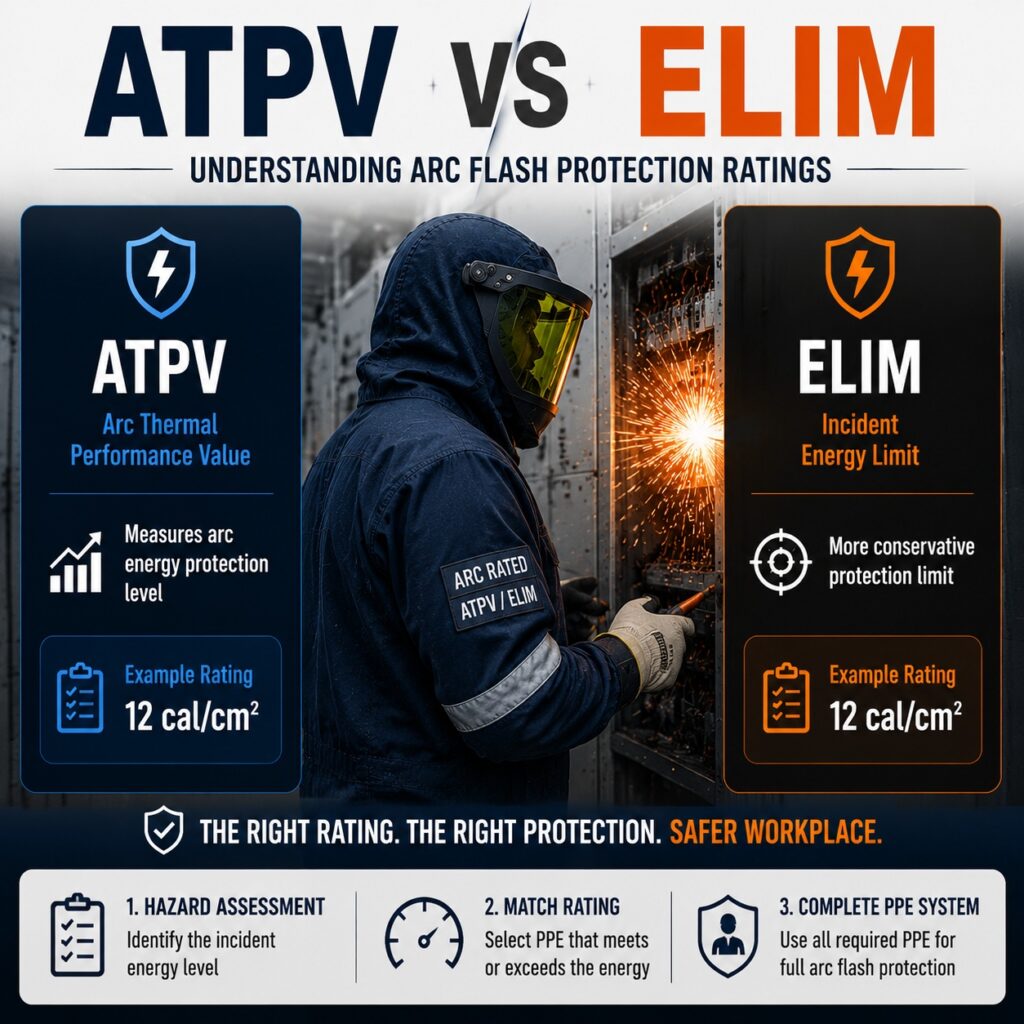
ATPV stands for Arc Thermal Performance Value.
It represents the maximum incident energy level that a fabric or garment can withstand before there is a 50% probability of a second-degree burn.
The unit is:
cal/cm²
The higher the ATPV value, the greater the arc flash protection level.
Example:
A garment rated:
ATPV 12 cal/cm²
means the clothing has been tested to provide protection against an arc thermal exposure up to 12 calories per square centimeter before reaching the defined burn threshold.
What Is ELIM?
ELIM: Incident Energy Limit
ELIM stands for Incident Energy Limit.
It represents the maximum incident energy level where the garment can protect the wearer without exceeding the energy level associated with excessive heat transfer.
Compared with ATPV, ELIM uses a more conservative approach.
It helps define a safer working limit for arc-rated clothing.
ATPV vs ELIM: Key Differences
| Feature | ATPV | ELIM |
|---|---|---|
| Full Name | Arc Thermal Performance Value | Incident Energy Limit |
| Meaning | Protection value based on burn probability | Maximum energy protection limit |
| Approach | Statistical calculation | More conservative measurement |
| Unit | cal/cm² | cal/cm² |
| Used For | Arc-rated clothing selection | Arc-rated clothing selection |
| Protection Goal | Reduce burn risk | Limit excessive thermal exposure |
Why Are ATPV and ELIM Important?
During an arc flash event, workers may experience:
- Extreme heat
- Thermal radiation
- Molten metal
- Flame exposure
The correct arc rating helps determine whether protective clothing can reduce injury severity.
Choosing clothing with an unsuitable rating may result in:
- Insufficient protection
- Increased burn risk
- Non-compliance with safety requirements
How Are ATPV and ELIM Tested?
Arc-rated clothing is tested by exposing materials to controlled electrical arc energy.
Testing evaluates:
1. Heat Transfer
How much thermal energy passes through the material.
2. Fabric Performance
Including:
- Ignition resistance
- Fabric breakdown
- After-flame behavior
3. Protective Capability
The test determines the energy level the garment can safely withstand.
ATPV vs ELIM: Which Rating Should You Use?
Both ATPV and ELIM are important indicators of arc flash protection.
The correct selection depends on:
- Workplace hazard assessment
- Incident energy level
- Electrical equipment
- Working conditions
Lower Risk Electrical Work
Examples:
- Electrical inspection
- Low-energy maintenance
May require:
- Lower arc rating PPE
Higher Risk Electrical Work
Examples:
- Power equipment maintenance
- High-energy electrical systems
May require:
- Higher ATPV / ELIM rated clothing
How Do ATPV and ELIM Relate to IEC 61482?
IEC 61482 is a key international standard for arc flash protective clothing and focuses on the thermal hazards associated with electric arcs. To understand how IEC 61482 differs from workplace electrical safety requirements under NFPA 70E, see our guide to IEC 61482 vs NFPA 70E.
Under IEC 61482 testing:
Arc-rated garments may be evaluated using:
- ATPV
- ELIM
These ratings help users understand the protection level provided by the garment.
ATPV, ELIM, and Arc Rated Clothing Selection
When selecting arc flash clothing, consider:
1. Incident Energy Level
Determine the expected arc flash energy.
2. Required Protection Level
Choose clothing with a suitable:
- ATPV rating
- ELIM rating
3. Complete PPE System
Arc flash protection usually includes:
- Arc-rated coveralls
- Arc-rated jackets
- Protective gloves
- Face shields
- Safety helmets
- Electrical footwear
Arc-rated clothing is only one part of an electrical PPE system. Employers should consider the complete set of protective equipment and workplace hazards when selecting arc flash PPE. For a broader guide, see Arc Flash PPE: What Employers Must Know in 2026.
Common Mistakes When Understanding Arc Ratings
Mistake 1: Choosing the Highest Rating Without Assessment
Higher protection does not always mean the best choice.
Heavy garments may reduce:
- Comfort
- Mobility
- Worker acceptance
Mistake 2: Treating ATPV and ELIM as Identical
Although both measure arc protection, they represent different evaluation methods.
Mistake 3: Ignoring Other PPE Components
Arc protection depends on the complete PPE system.
Clothing alone may not provide full protection.
How GONOW SAFETY Supports Arc Flash Protection Solutions
At GONOW SAFETY, we provide arc flash protective clothing solutions designed for electrical safety applications.
Our solutions include:
- Arc-rated coveralls
- Flame-resistant workwear
- Electrical protective clothing
- Customized PPE solutions
We support customers by selecting suitable protection based on:
- Electrical hazards
- Required protection levels
- Industry standards
From arc flash protection to electrical workplace safety, GONOW SAFETY helps companies create safer working environments.
Conclusion
ATPV and ELIM are important ratings used to understand arc flash protective clothing performance.
In simple terms:
- ATPV indicates the arc energy level a garment can withstand before reaching the defined burn threshold.
- ELIM provides a more conservative protection limit for arc-rated clothing performance.
Understanding these ratings helps electrical workers and PPE buyers choose the right protective clothing for their specific hazards.
The right arc rating means better protection when electrical hazards occur.