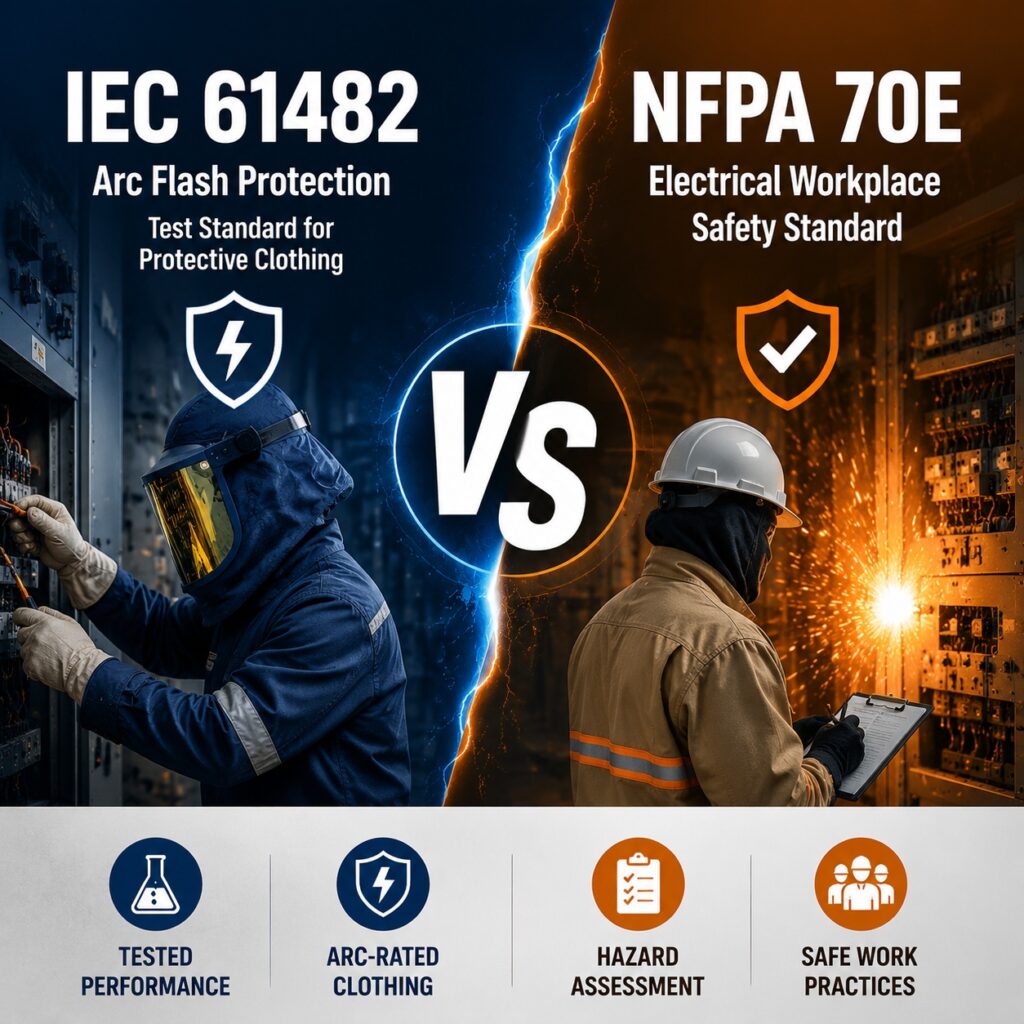
Electrical workers face serious risks when working near energized equipment. Among these hazards, arc flash is one of the most dangerous events, capable of releasing extreme heat, molten metal, intense light, and pressure within milliseconds.
To reduce the risk of severe burns and injuries, companies rely on electrical safety standards and arc-rated protective clothing.
Two commonly referenced standards are:
- IEC 61482 — Arc flash protective clothing standard
- NFPA 70E — Electrical safety standard for workplaces
Although both are related to arc flash protection, they serve different purposes.
Understanding the difference helps companies select the right electrical PPE and improve workplace safety. For a broader overview of arc flash PPE selection and employer responsibilities, see our guide on [Arc Flash PPE: What Employers Must Know in 2026].
What Is IEC 61482?
IEC 61482: Arc Flash Protective Clothing Standard
IEC 61482 specifies requirements and test methods for protective clothing designed to protect workers against the thermal hazards of electric arcs.
It focuses on:
- Arc flash thermal performance
- Fabric behavior during arc exposure
- Heat transfer protection
- Arc rating performance
IEC 61482 evaluates whether protective clothing can reduce the severity of burn injuries during an electrical arc event.
What Does IEC 61482 Test?
IEC 61482 clothing is evaluated through arc testing.
Important measurements include:
ATPV (Arc Thermal Performance Value)
ATPV indicates the maximum incident energy level that the garment can protect against before reaching a second-degree burn threshold.
ELIM (Incident Energy Limit)
ELIM represents the maximum incident energy level at which the garment provides protection without excessive heat transfer. ATPV and ELIM are important values when evaluating arc-rated clothing. For a detailed explanation of the differences between these ratings, see our guide to [ATPV vs ELIM].
Arc Rating
Arc-rated clothing is selected based on:
- Incident energy level
- Electrical hazard assessment
- Required protection level
What Is NFPA 70E?
NFPA 70E: Electrical Workplace Safety Standard
NFPA 70E is a workplace electrical safety standard widely used in North America.
Unlike IEC 61482, NFPA 70E is not a clothing test standard.
It provides guidance for:
- Electrical hazard assessment
- Safe work practices
- Electrical risk control
- PPE selection
What Does NFPA 70E Cover?
NFPA 70E focuses on:
Electrical Hazard Assessment
Companies evaluate:
- Arc flash risk
- Incident energy levels
- Equipment conditions
Safe Working Procedures
Including:
- Electrically safe work conditions
- Qualified worker requirements
- Safety boundaries
PPE Requirements
NFPA 70E helps determine:
- Required arc rating
- Protective equipment selection
- Worker protection levels
IEC 61482 vs NFPA 70E: Key Differences
| Feature | IEC 61482 | NFPA 70E |
|---|---|---|
| Main Purpose | Test standard for arc protective clothing | Electrical workplace safety standard |
| Focus | Clothing performance | Workplace safety practices |
| Region | International / Europe | North America |
| Measures | ATPV, ELIM, arc performance | Hazard assessment and PPE selection |
| Applies To | Protective garments | Electrical work procedures |
| Related Products | Arc-rated clothing | Complete electrical PPE system |
Are IEC 61482 and NFPA 70E the Same?
No.
This is one of the most common misunderstandings.
IEC 61482 answers:
“How well does this clothing protect against arc flash energy?”
It evaluates:
- Fabric
- Garment construction
- Arc performance
NFPA 70E answers:
“What protection does the worker need for this electrical task?”
It considers:
- Workplace conditions
- Electrical hazards
- Required PPE level
How Do They Work Together?
In many electrical safety programs:
NFPA 70E helps determine:
What level of protection is required
↓
IEC 61482 helps verify:
Whether the clothing provides tested arc flash protection
Example:
A U.S. electrical contractor may use:
- NFPA 70E for workplace risk assessment
- IEC 61482 certified clothing for arc flash protection
IEC 61482 vs NFPA 70E: Which One Should You Choose?
The answer depends on your market and application.
For European and International Markets
Common requirements:
- IEC 61482
- EN ISO 11612
- EN 1149
Applications:
- Power utilities
- Industrial electrical maintenance
- Manufacturing plants
For North American Markets
Common requirements:
- NFPA 70E
- ASTM F1506
- Arc-rated PPE requirements
For a detailed comparison between ASTM F1506 and IEC 61482, see our guide to [ASTM F1506 vs IEC 61482].
Applications:
- Electrical contractors
- Utility companies
- Industrial facilities
Choosing Arc Flash Protective Clothing
1. Identify Workplace Hazards
Before selecting PPE, evaluate:
- Electrical equipment
- Voltage level
- Incident energy
- Working environment
2. Select the Correct Arc Rating
Consider:
- ATPV value
- ELIM rating
- Required protection category
Higher protection levels should be selected based on actual risk.
3. Consider Complete Electrical PPE
Arc flash protection usually includes:
- Arc-rated coveralls
- Arc-rated jackets
- Electrical gloves
- Face shields
- Safety helmets
- Protective footwear
Common Mistakes When Buying Arc Flash PPE
Mistake 1: Confusing Flame Resistant and Arc Rated Clothing
Flame-resistant clothing does not always mean arc-rated clothing.
Arc flash protection requires specific testing.
Mistake 2: Looking Only at Certification Names
The correct PPE depends on:
- Workplace hazard
- Local regulations
- Electrical risk assessment
Mistake 3: Ignoring Comfort
Workers must wear PPE correctly to stay protected.
Important factors:
- Breathability
- Weight
- Mobility
- Durability
How GONOW SAFETY Supports Arc Flash Protection Solutions
At GONOW SAFETY, we provide electrical safety PPE solutions designed for industrial applications.
Our product range includes:
- Arc flash protective clothing
- Flame-resistant workwear
- Electrical safety PPE
- Customized protective garments
We help customers select suitable protection based on:
- Workplace hazards
- Regional standards
- Industry requirements
From electrical maintenance to industrial power operations, GONOW SAFETY supports safer workplaces with reliable PPE solutions.
Conclusion
IEC 61482 and NFPA 70E are both important in arc flash protection, but they serve different roles.
- IEC 61482 focuses on testing and performance of arc flash protective clothing.
- NFPA 70E focuses on electrical workplace safety practices and PPE selection.
Understanding the difference helps companies choose the right arc-rated clothing and build a safer electrical workplace.
The right standard, combined with the right PPE, helps protect workers when electrical hazards occur.