Workplace hazards exist in almost every industry. From construction sites and manufacturing facilities to healthcare environments and laboratories, workers may face risks such as impact injuries, chemical exposure, airborne particles, excessive noise, heat, and electrical hazards.
Personal Protective Equipment (PPE) is designed to reduce workers’ exposure to these hazards and provide an essential layer of protection when engineering controls and administrative measures cannot completely eliminate risks.
This PPE guide explains what personal protective equipment is, the main PPE types, different protection categories, and the PPE required for various industries.
What Is PPE (Personal Protective Equipment)?
Personal Protective Equipment (PPE) refers to protective equipment, clothing, and devices worn by workers to minimize exposure to workplace hazards that may cause injuries or illnesses.
PPE does not remove hazards from the workplace, but it helps create a barrier between workers and potential dangers.
Common workplace hazards include:
- Flying particles and impact hazards
- Dust, fumes, and airborne contaminants
- Chemical splashes and hazardous substances
- Heat, flames, and molten materials
- Electrical risks
- Slips, trips, and falls
- Excessive workplace noise
- Biological hazards
A complete PPE program usually includes:
- Hazard identification
- Risk assessment
- Proper PPE selection
- Employee training
- Regular inspection and replacement
Choosing the correct PPE is essential because unsuitable equipment may provide insufficient protection or reduce worker comfort and compliance.
Why Is PPE Important?
PPE plays a critical role in workplace safety by helping protect employees from preventable injuries.
The benefits of using proper PPE include:
1. Reducing Workplace Injuries
Safety helmets, gloves, protective eyewear, and safety footwear help prevent common workplace injuries caused by impacts, cuts, burns, and chemical exposure.
2. Protecting Worker Health
Respiratory protection, protective clothing, and chemical-resistant equipment help reduce exposure to harmful substances.
3. Improving Workplace Safety Culture
Providing suitable PPE demonstrates an organization’s commitment to employee safety and encourages workers to follow safety procedures.
4. Meeting Safety Standards
Many industries require PPE that complies with international standards, such as:
- EN Standards (European Standards)
- ANSI/ISEA Standards (United States)
- ISO Standards
- ASTM Standards
Main Types of PPE (PPE Types)
Personal protective equipment can generally be divided into several categories based on the part of the body being protected.
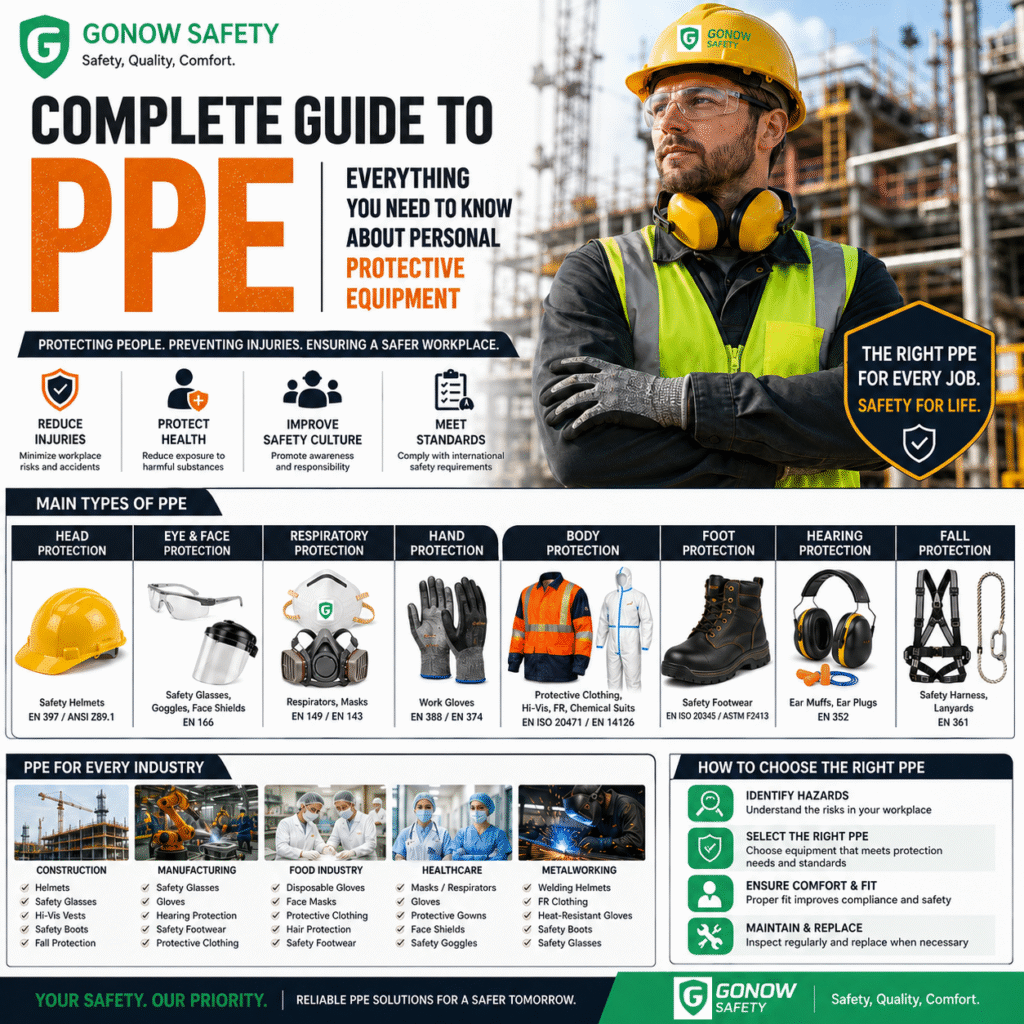
The main PPE types include:
- Head Protection
- Eye and Face Protection
- Respiratory Protection
- Hand Protection
- Body Protection
- Foot Protection
- Hearing Protection
- Fall Protection
1. Head Protection
Head protection helps protect workers from falling objects, impact hazards, electrical risks, and other workplace dangers.
Common head protection products include:
Safety Helmets
Safety helmets are widely used in construction, manufacturing, mining, and industrial environments.
They provide protection against:
- Falling objects
- Impact forces
- Penetration hazards
- Electrical hazards (depending on helmet type)
Common standards:
- EN 397 – Industrial safety helmets
- ANSI Z89.1 – Industrial head protection
Applications:
- Construction sites
- Factories
- Oil & gas facilities
- Warehouses
2. Eye and Face Protection
The eyes are highly vulnerable to workplace hazards. Proper eye protection helps prevent injuries caused by particles, chemicals, radiation, and sparks.
Common eye and face PPE includes:
Safety Glasses
Used for protection against:
- Dust
- Flying particles
- Minor impacts
Safety Goggles
Provide better protection against:
- Chemical splashes
- Liquid hazards
- Fine particles
Face Shields
Used when workers require full-face protection from:
- Chemical splashes
- Hot materials
- Grinding sparks
- Welding hazards
Common applications:
- Manufacturing
- Laboratory work
- Welding
- Chemical processing
3. Respiratory Protection
Respiratory PPE protects workers from inhaling harmful airborne substances, including dust, fumes, gases, and biological contaminants.
Common respiratory protection products include:
Disposable Respirators
Examples:
- FFP1 masks
- FFP2 masks
- FFP3 masks
- N95 respirators
Used for:
- Dust protection
- Aerosols
- Workplace particles
Half Face Respirators
Designed for reusable protection with replaceable filters or cartridges.
Protection against:
- Chemical vapors
- Gases
- Particles
Full Face Respirators
Provide both:
- Respiratory protection
- Eye and face protection
Common industries:
- Healthcare
- Chemical manufacturing
- Painting
- Pharmaceutical production
4. Hand Protection
Hands are one of the most frequently injured body parts in workplaces. Selecting the correct gloves is essential because different hazards require different protection.
Common PPE gloves include:
Cut-Resistant Gloves
Protect against:
- Sharp tools
- Metal edges
- Glass handling
Chemical-Resistant Gloves
Used when handling:
- Chemicals
- Solvents
- Hazardous liquids
Heat-Resistant Gloves
Designed for:
- Welding
- Hot materials
- High-temperature environments
Impact-Resistant Gloves
Provide protection against:
- Crushing hazards
- Mechanical impacts
Industries requiring hand protection:
- Manufacturing
- Metalworking
- Construction
- Automotive
5. Body Protection
Body protection helps protect workers from chemical exposure, heat, flames, contamination, and physical hazards.
Common body PPE includes:
Workwear
General protective clothing for industrial environments.
High Visibility Clothing
Designed to improve worker visibility in:
- Road construction
- Warehouses
- Transportation
Common standard:
- EN ISO 20471 – High visibility clothing
Flame-Resistant Clothing
Protects against:
- Heat exposure
- Flash fire
- Molten metal hazards
Chemical Protective Suits
Used in environments involving:
- Chemical handling
- Hazardous substances
- Emergency response
6. Foot Protection
Safety footwear protects workers from injuries caused by falling objects, sharp materials, electrical hazards, and slippery surfaces.
Common safety footwear features include:
- Steel toe caps
- Composite toe protection
- Anti-slip soles
- Puncture-resistant midsoles
- Electrical resistance
Common standards:
- EN ISO 20345
- ASTM F2413
Industries requiring safety footwear:
- Construction
- Manufacturing
- Logistics
- Warehousing
PPE Requirements by Industry
Different industries face different workplace hazards, so PPE selection should always be based on risk assessment.
Construction Industry PPE
Common hazards:
- Falling objects
- Dust
- Noise
- Falls
- Sharp materials
Recommended PPE:
✓ Safety helmets
✓ Safety glasses
✓ Dust masks / respirators
✓ High visibility vests
✓ Cut-resistant gloves
✓ Safety boots
✓ Fall protection equipment
Manufacturing Industry PPE
Common hazards:
- Machinery
- Metal particles
- Chemicals
- Noise
Recommended PPE:
✓ Safety glasses
✓ Protective gloves
✓ Hearing protection
✓ Safety footwear
✓ Protective clothing
✓ Respiratory protection
Food Industry PPE
Common hazards:
- Contamination
- Hygiene risks
- Sharp tools
Recommended PPE:
✓ Disposable gloves
✓ Face masks
✓ Protective clothing
✓ Safety footwear
✓ Hair protection
Healthcare Industry PPE
Common hazards:
- Biological exposure
- Infection risks
- Contaminated materials
Recommended PPE:
✓ Medical masks
✓ Respirators
✓ Protective gowns
✓ Gloves
✓ Face shields
✓ Safety goggles
Metalworking Industry PPE
Common hazards:
- Sparks
- Heat
- Sharp edges
- Metal particles
Recommended PPE:
✓ Welding helmets
✓ Flame-resistant clothing
✓ Heat-resistant gloves
✓ Safety glasses
✓ Safety boots
How to Choose the Right PPE?
Selecting the right PPE requires understanding:
1. Identify Workplace Hazards
Evaluate:
- Type of hazard
- Exposure level
- Working environment
2. Choose PPE According to Protection Requirements
Consider:
- Required protection level
- Applicable safety standards
- Compatibility with other PPE
3. Consider Comfort and Fit
Workers are more likely to wear PPE consistently when equipment is:
- Comfortable
- Lightweight
- Properly fitted
- Easy to use
4. Maintain and Replace PPE Regularly
PPE should be inspected regularly and replaced when:
- Damaged
- Contaminated
- Expired
- No longer provides adequate protection
Conclusion: PPE Is Essential for Workplace Safety
Personal protective equipment is a key component of workplace safety. Understanding different PPE types helps companies select suitable protection for their employees and working environments.
From head protection and respiratory equipment to gloves, protective clothing, and safety footwear, every category of PPE plays an important role in reducing workplace risks.
A proper PPE selection process ensures workers stay protected, comfortable, and prepared for daily challenges.
At GONOW SAFETY, we provide reliable PPE solutions for industries including construction, manufacturing, food processing, metalworking, and healthcare.
Protect your workforce with the right PPE. Safety, Quality, Comfort.