Choosing the right protective clothing can be challenging for companies purchasing PPE for industrial workers. Different workplaces involve different hazards, and protective garments are designed according to specific safety requirements.
Among the most commonly referenced protective clothing standards are:
- EN ISO 13688 — General requirements for protective clothing
- EN ISO 11612 — Protective clothing against heat and flame
- EN ISO 11611 — Protective clothing for welding and related processes
Although these standards are often used together, they serve different purposes.
Understanding the differences helps PPE buyers select suitable workwear and avoid choosing the wrong level of protection.
What Are These Three Standards?
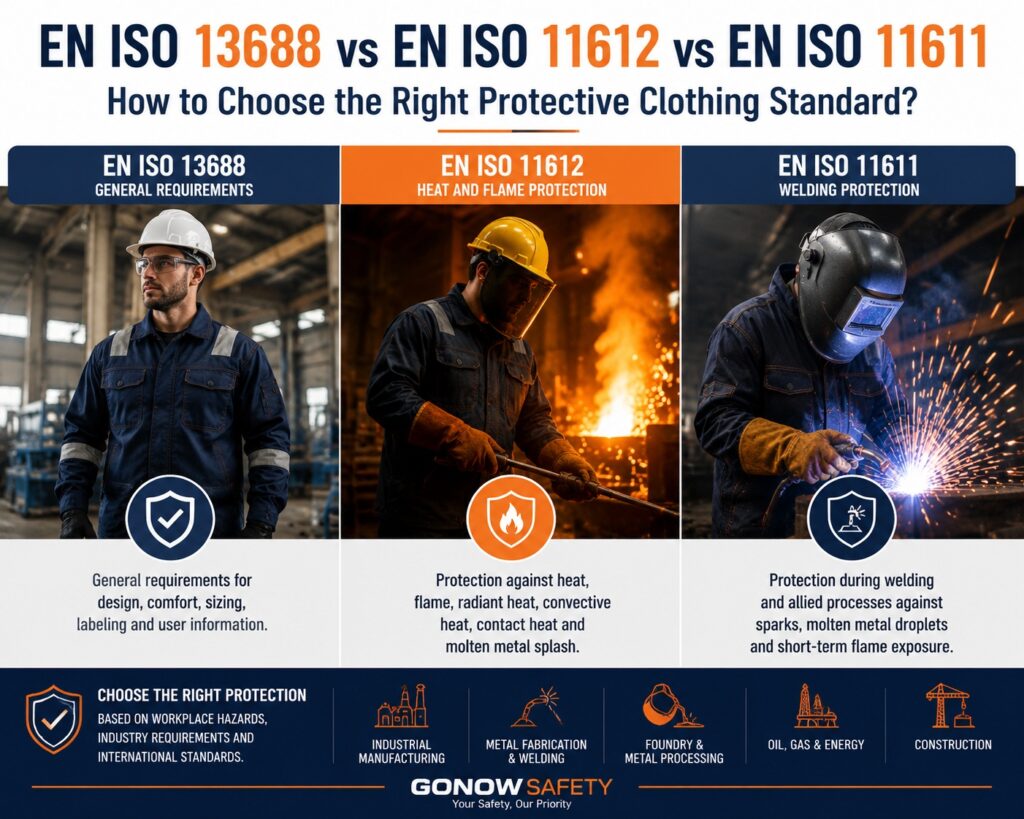
EN ISO 13688: General Requirements for Protective Clothing
EN ISO 13688 defines the basic requirements that protective clothing should meet.
It focuses on:
- Ergonomic design
- Comfort and wearability
- Size designation
- Labeling requirements
- User information
- Material safety
However, EN ISO 13688 does not provide specific protection against hazards such as flames, heat, chemicals, or welding sparks.
It is usually combined with other protective clothing standards.
Example:
A flame-resistant coverall may be certified:
EN ISO 13688 + EN ISO 11612
EN ISO 11612: Protection Against Heat and Flame
EN ISO 11612 is designed for workers exposed to heat and flame hazards.
It provides protection against:
- Limited flame spread
- Convective heat
- Radiant heat
- Contact heat
- Molten metal splash
Common industries:
- Metal processing
- Foundries
- Manufacturing
- Energy industries
- High-temperature workplaces
Typical products:
- Flame-resistant coveralls
- Heat-resistant jackets
- Protective trousers
EN ISO 11611: Welding Protective Clothing
EN ISO 11611 is specifically designed for welding and related processes.
It protects workers against:
- Welding sparks
- Molten metal droplets
- Short-term flame exposure
- Radiant heat from welding arcs
Common applications:
- Welding workshops
- Shipbuilding
- Metal fabrication
- Construction
Typical products:
- Welding jackets
- Welding coveralls
- Welding protective suits
EN ISO 13688 vs EN ISO 11612 vs EN ISO 11611 Comparison
| Standard | Main Purpose | Protection Focus | Typical Users |
|---|---|---|---|
| EN ISO 13688 | General protective clothing requirements | Design, comfort, labeling | All protective clothing users |
| EN ISO 11612 | Heat and flame protection | Heat, flame, molten metal | High-temperature workers |
| EN ISO 11611 | Welding protection | Welding sparks, metal splash, welding heat | Welders |
Key Differences Between EN ISO 11612 and EN ISO 11611
Many buyers confuse EN ISO 11612 and EN ISO 11611 because both involve heat protection.
However, their applications are different.
EN ISO 11612
Focus:
Protection against general heat and flame hazards
Examples:
- Furnace operation
- Hot metal handling
- Industrial heating processes
Main concern:
How well does clothing protect against thermal hazards?
EN ISO 11611
Focus:
Protection during welding operations
Examples:
- MIG welding
- TIG welding
- Arc welding
- Metal cutting
Main concern:
How well does clothing protect against welding-related risks?
Can One Garment Meet Multiple Standards?
Yes.
Many industrial protective garments are certified to multiple standards.
For example:
Welding Coverall
Possible certification:
✔ EN ISO 13688
✔ EN ISO 11611
✔ EN ISO 11612
This means the garment provides:
- General protective clothing requirements
- Welding protection
- Heat and flame protection
Multi-standard clothing is often preferred by industrial customers because it provides broader workplace protection.
How to Choose the Right Protective Clothing Standard?
Step 1: Identify Workplace Hazards
Before purchasing PPE, evaluate:
Welding Work
Risks:
- Sparks
- Molten metal
- Welding radiation
Recommended:
EN ISO 11611
High Temperature Work
Risks:
- Flame
- Heat radiation
- Hot materials
Recommended:
EN ISO 11612
General Industrial Work
Risks:
- Mechanical hazards
- Workplace exposure
Recommended:
EN ISO 13688 + relevant protection standard
Step 2: Consider Additional Requirements
Depending on the workplace, other standards may also be required.
Examples:
| Hazard | Additional Standard |
|---|---|
| Electrical arc flash | IEC 61482 |
| High visibility requirements | EN ISO 20471 |
| Chemical protection | EN 13034 / EN 14605 |
| Anti-static environments | EN 1149 |
A complete PPE solution should match the actual workplace risks.
Step 3: Consider Comfort and Usability
Even certified protective clothing must be comfortable enough for workers to wear regularly.
Important factors include:
- Breathability
- Fabric weight
- Freedom of movement
- Durability
- Correct sizing
Comfort improves PPE acceptance and helps maintain workplace safety.
Common Mistakes When Buying Protective Clothing
Mistake 1: Choosing Based Only on Certification
A certificate alone does not mean the product is suitable for every workplace.
The correct standard depends on:
- Work environment
- Hazard type
- Exposure level
Mistake 2: Assuming EN ISO 13688 Provides Hazard Protection
EN ISO 13688 is a foundation standard.
It does not replace:
- Heat protection standards
- Welding protection standards
- Chemical protection standards
Mistake 3: Ignoring Worker Comfort
Heavy or uncomfortable PPE may reduce actual usage.
The best protective clothing balances:
Safety + Comfort + Functionality
How GONOW SAFETY Helps Customers Choose Protective Clothing
At GONOW SAFETY, we provide protective clothing solutions for different industrial applications.
Our product range includes:
- Flame-resistant clothing
- Welding protective clothing
- Industrial coveralls
- Customized protective workwear
We help customers select suitable PPE based on:
- Workplace hazards
- Industry requirements
- International safety standards
From general workwear to specialized protective clothing, GONOW SAFETY supports businesses with reliable PPE solutions.
Conclusion
EN ISO 13688, EN ISO 11612, and EN ISO 11611 serve different purposes in protective clothing.
- EN ISO 13688 provides general requirements for protective clothing.
- EN ISO 11612 protects workers from heat and flame hazards.
- EN ISO 11611 protects workers during welding operations.
Understanding these differences helps companies purchase the right PPE, improve worker safety, and ensure compliance with workplace requirements.
Choosing the correct standard is the first step toward creating a safer workplace.