Protective clothing plays an essential role in industries where workers face heat, flames, and electrical hazards.
However, many buyers confuse Flame Resistant (FR) clothing with Arc Rated clothing.
Although both types of garments provide protection against thermal hazards, they are designed for different risks and tested according to different requirements.
Understanding the difference between FR clothing and Arc Rated clothing helps companies select the right PPE for electrical work, welding, manufacturing, and industrial applications. For a broader guide to arc flash hazards and PPE selection, see Arc Flash PPE: What Employers Must Know in 2026.
What Is FR Clothing?
Flame Resistant (FR) Clothing
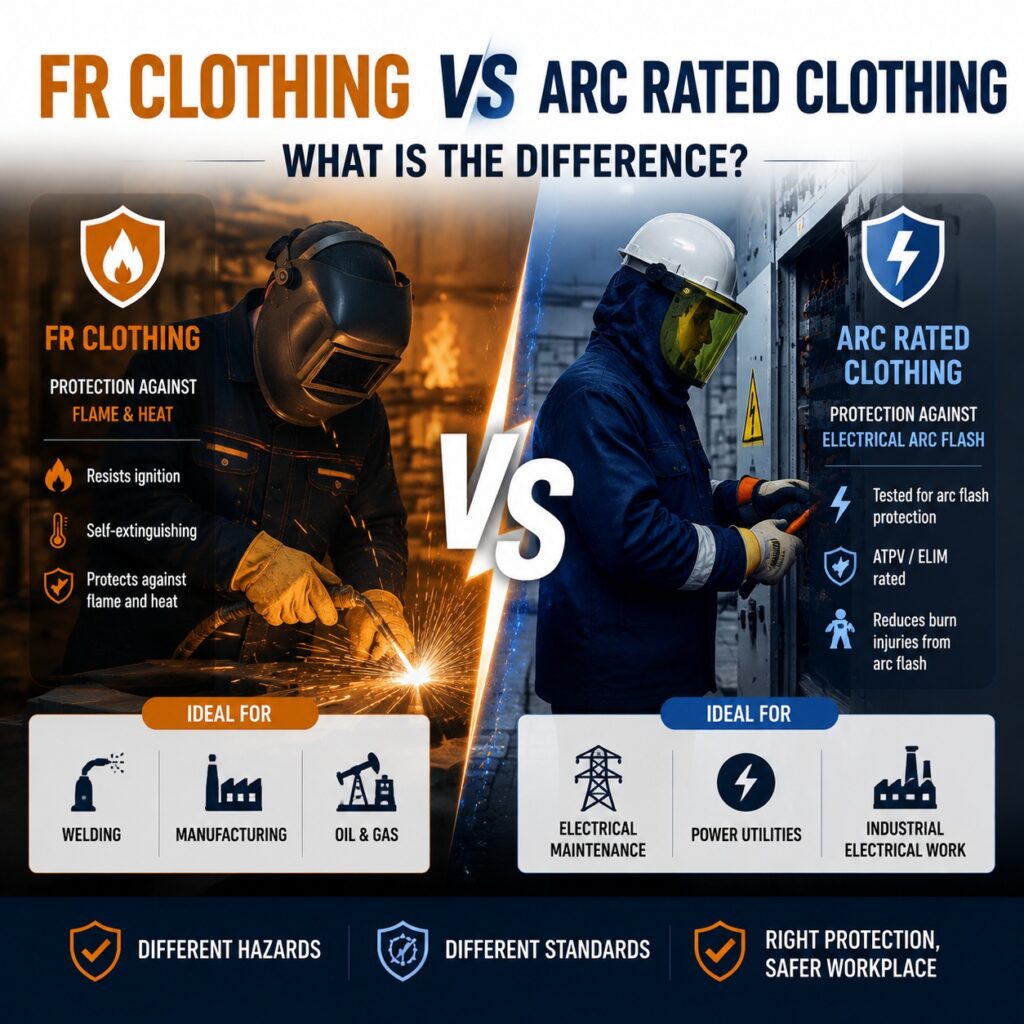
FR clothing is designed to resist ignition and reduce the spread of flames when exposed to fire or heat.
The main purpose of FR clothing is to:
- Resist burning
- Self-extinguish after flame exposure
- Reduce flame-related injuries
FR clothing does not continue burning like ordinary fabrics and helps provide additional protection in environments with flame hazards.
Common Applications of FR Clothing
FR clothing is commonly used in:
Welding Operations
Protection against:
- Sparks
- Molten metal
- Flame exposure
Related standard:
- EN ISO 11611
Industrial Manufacturing
Used in environments involving:
- Heat sources
- Hot surfaces
- Open flames
Related standard:
- EN ISO 11612
Oil, Gas, and Energy Industries
Workers may face:
- Flash fire risks
- Thermal hazards
FR workwear helps reduce injury severity.
What Is Arc Rated Clothing?
Arc Rated Clothing
Arc Rated clothing is specifically designed to protect workers from the thermal energy released during an electrical arc flash.
An arc flash can produce:
- Extremely high temperatures
- Intense thermal radiation
- Molten metal
- Pressure waves
Arc Rated clothing is tested to measure how well it protects against arc flash energy.
Common Arc Rated Clothing Standards
IEC 61482
International standard for arc flash protective clothing.
ASTM F1506
North American standard for flame-resistant and arc-rated textile materials used by electrical workers.
NFPA 70E
Electrical workplace safety standard used for hazard assessment and PPE selection. To better understand how clothing performance standards differ from workplace electrical safety requirements, see IEC 61482 vs NFPA 70E.
FR Clothing vs Arc Rated Clothing: Key Differences
| Feature | FR Clothing | Arc Rated Clothing |
|---|---|---|
| Main Protection | Flame and heat | Arc flash thermal energy |
| Main Hazard | Fire, sparks, heat | Electrical arc flash |
| Testing Focus | Flame resistance | Arc thermal performance |
| Common Ratings | Flame spread, heat resistance | ATPV, ELIM |
| Typical Users | Welders, industrial workers | Electricians, electrical maintenance teams |
| Standards | EN ISO 11612, EN ISO 11611 | IEC 61482, ASTM F1506 |
Is All FR Clothing Arc Rated?
No.
This is one of the most common misunderstandings.
FR clothing means:
The fabric resists ignition and limits flame spread.
Arc Rated clothing means:
The garment has been tested for protection against arc flash thermal energy.
A garment can be:
- FR but not Arc Rated
- Both FR and Arc Rated
For electrical work, Arc Rated protection is required when workers face arc flash hazards.
Is Arc Rated Clothing Also Flame Resistant?
In most cases, yes.
Arc Rated garments are usually made from flame-resistant materials because the clothing must prevent continued burning after an arc flash.
However, the key difference is:
FR = flame protection
Arc Rated = tested arc flash protection
Understanding ATPV and ELIM Ratings
Arc Rated clothing uses specific performance ratings.
ATPV (Arc Thermal Performance Value)
ATPV indicates the amount of incident energy a garment can withstand before reaching a second-degree burn threshold.
Higher ATPV values indicate higher protection.
ELIM (Incident Energy Limit)
ELIM represents the maximum incident energy level that the garment can protect against without excessive heat transfer.
These values help workers select appropriate arc flash PPE. For a more detailed explanation of these protection ratings, see ATPV vs ELIM.
When Should You Choose FR Clothing?
Choose FR clothing when the main hazards include:
✔ Open flames
✔ Heat exposure
✔ Welding sparks
✔ Molten metal
Examples:
- Welding
- Metal processing
- Manufacturing
Recommended standards:
- EN ISO 11611
- EN ISO 11612
When Should You Choose Arc Rated Clothing?
Choose Arc Rated clothing when workers face:
✔ Electrical arc flash risks
✔ Energized equipment
✔ Electrical maintenance tasks
Examples:
- Power utilities
- Electrical contractors
- Industrial electrical maintenance
Recommended standards:
- IEC 61482
- ASTM F1506
- NFPA 70E
Can One Garment Provide Both FR and Arc Protection?
Yes.
Many modern protective garments combine:
- Flame resistance
- Arc flash protection
- Anti-static performance
For example:
Arc Rated coveralls may also meet:
- IEC 61482
- EN ISO 11612
- EN 1149
This provides broader protection for complex industrial environments.
How to Choose Between FR and Arc Rated Clothing?
Step 1: Identify the Hazard
Ask:
- Is the risk from fire or electricity?
- Is there potential for arc flash?
- Is the worker near energized equipment?
Step 2: Check Required Standards
For flame hazards:
Choose:
- EN ISO 11612
- EN ISO 11611
For electrical hazards:
Choose:
- IEC 61482
- ASTM F1506
- NFPA 70E requirements
Step 3: Consider Worker Comfort
Protective clothing should provide:
- Protection
- Comfort
- Mobility
- Durability
Workers are more likely to wear PPE correctly when it is comfortable.
Common Mistakes When Selecting Protective Clothing
Mistake 1: Assuming FR Means Arc Protection
FR clothing alone may not provide sufficient protection against electrical arc flash.
Mistake 2: Choosing PPE Based Only on Fabric
Protection depends on:
- Garment design
- Testing standard
- Certification
- Performance rating
Mistake 3: Ignoring Workplace Assessment
The correct PPE depends on actual workplace hazards.
How GONOW SAFETY Supports Thermal and Electrical Protection Solutions
At GONOW SAFETY, we provide protective clothing solutions for industries exposed to thermal and electrical hazards.
Our product range includes:
- Flame resistant clothing
- Arc flash protective clothing
- Electrical safety PPE
- Customized protective garments
We help customers select suitable PPE based on:
- Workplace risks
- Industry requirements
- International safety standards
From heat protection to electrical safety, GONOW SAFETY supports safer workplaces with reliable protective solutions.
Conclusion
FR clothing and Arc Rated clothing serve different purposes.
- FR clothing protects against flames and heat
- Arc Rated clothing protects against electrical arc flash energy
Choosing the correct protective clothing requires understanding workplace hazards, safety standards, and required protection levels.
The right PPE is not only about compliance — it is about providing workers with the protection they need in real working conditions.